
What Is a "Positive No" — and Why Does It Matter for Parents?
William Ury's "Positive No" framework gives parents a three-step script — Yes! → No. → Yes? — that lets you hold a firm boundary while keeping the relationship intact and the door open to a better outcome.

In this article
Think about the last time your child asked for something you couldn't — or shouldn't — say yes to. Did you cave a little, over-explain, or feel a wave of guilt even when you knew "no" was the right answer? You're not alone. Research published by the American Psychological Association shows that parental boundary-setting is one of the strongest predictors of children's self-regulation, yet many parents report feeling anxious, guilty, or conflict-avoidant when they have to refuse a child's request. The problem isn't the "no" itself — it's that most of us were never taught how to say it well.
Harvard negotiation expert William Ury, co-author of the landmark Getting to Yes and founder of the Harvard Negotiation Project, tackled exactly this problem in his book The Power of a Positive No (2007). His framework was designed for boardrooms and international diplomacy, but its principles map almost perfectly onto the daily negotiations of family life — from a two-year-old's bedtime protest to a twelve-year-old lobbying for more screen time.
In this guide you'll understand:
1. What Is a "Positive No" — and Why Does It Matter for Parents?
A Positive No is a refusal that is grounded in something you value, not just something you want to avoid. Ury's central argument is that most people say "no" in one of two unhelpful ways: they either accommodate (saying a reluctant "yes" they don't mean) or they attack (a blunt "no" that shuts down conversation). The Positive No is the third path — firm on the boundary, warm on the relationship.
For parents, this distinction is enormous. When you say "No, because screens off at 7 pm is our family rule and it helps your brain sleep," you are doing something very different from "No, because I said so" or a tired "Fine, just ten more minutes." The first version is a Positive No: it names the value (sleep, health), states the limit clearly, and implicitly respects your child enough to give them a reason.
Why parents struggle to say no
- Fear of damaging the relationship or being seen as the "mean" parent - Guilt, especially after a long workday away from the child - Uncertainty about whether the limit is actually justified - A childhood in which "no" was always delivered harshly, so any refusal feels cruelRecognising which of these is your personal sticking point is the first step Ury recommends before any difficult conversation.

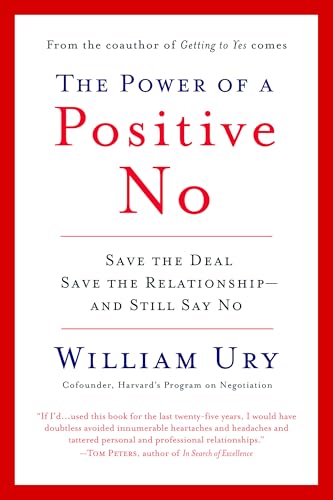
The Power of a Positive No: Save The Deal Save The Relationship and Still Say No
- Relationships
- Interpersonal Relations
- Image Unavailable Image not available forColor:
2. The Yes! → No. → Yes? Framework Explained Step by Step
Ury's three-part structure is the practical core of the book, and it translates cleanly into parenting language.
Step 1 — Yes! (Your why)
Before you deliver the "no," anchor it in a positive value or need. This is the "Yes!" to what matters most to you. For a parent, that might be your child's health, safety, fairness to a sibling, or a family commitment.Example: "I love that you want to keep playing — you've been so creative today."
Step 2 — No. (The clear limit)
State the refusal plainly and without apology. Ury is emphatic: vague language invites negotiation on the wrong terms. "Maybe later" or "we'll see" trains children to keep pushing.Example: "And it's 7 pm, so screens are off now."
Step 3 — Yes? (An open door)
Offer a constructive alternative or invite the child to problem-solve with you. This is not a bribe or a cave — it's a signal that the relationship is still collaborative.Example: "Would you like to read together or build with Lego before bed?"
3. Applying the Framework by Age: From Babies to Pre-Teens
The words change, but the structure doesn't. Here's how the Positive No adapts across childhood.
Babies and toddlers (0–3 years)
At this stage your "no" is mostly physical and tonal. Infants and young toddlers respond to calm, consistent redirection far more than to verbal explanation. The "Yes!" is your warm tone; the "No." is a gentle physical intervention or a firm, low-pitched single word; the "Yes?" is an immediate redirect to something safe.Preschool and early school age (3–7 years)
Now language matters. Children this age are testing limits as a developmental task — it's how they map the world. The Positive No gives them the reason behind the rule, which research from developmental psychologist Diana Baumrind's work on authoritative parenting shows produces better self-regulation than rules without rationale.Middle childhood (8–12 years)
Children this age are capable of genuine negotiation. Ury's "Yes?" step becomes a real invitation. Involving them in problem-solving ("What do you think would be fair?") builds the executive-function skills — planning, impulse control, perspective-taking — that the CDC identifies as central to healthy child development.

Getting Past No: Negotiating in Difficult Situations
- Kindle Store
- Kindle eBooks
- Business & Money
4. Assertive vs. Aggressive: The Line Every Parent Needs to Know
One of the most practically useful distinctions in Ury's book is the difference between assertiveness and aggression — and it applies directly to how children learn to handle conflict themselves.
Assertive means expressing your need or boundary clearly and respectfully, while acknowledging the other person's feelings. It is confident without being contemptuous.
Aggressive means imposing your will without regard for the other person's experience. Even when the content of the message is correct ("You can't have that"), the delivery damages trust and teaches children that power, not reason, wins arguments.
| Approach | Tone | Respects Child's Feelings? | Models for Child | Best Used | Recommended Resource |
|---|---|---|---|---|---|
| Aggressive No | Harsh, dismissive | ✗ | That power overrides reason | Almost never | The Positive No – Paperback |
| Passive/Caving Yes | Anxious, apologetic | Over-accommodates | That persistence beats limits | Almost never | The Power of a Positive No (2008) |
| Positive No (Ury) | Warm, firm, clear | ✓ | Assertiveness + empathy | Daily boundary-setting | The Power of a Positive No |
| Collaborative Problem-Solving | Curious, open | ✓ | Negotiation + mutual respect | School-age conflicts | Getting Past No |
| Delayed Response | Calm, thoughtful | ✓ | That reflection beats reaction | High-emotion moments | Getting Past No – eBook |
| Empathic Refusal | Soft but clear | ✓ | Feelings matter AND limits hold | Toddler–preschool | The Power of a Positive No – Paperback |
5. How Saying No Well Builds Your Child's Mental Health
This is the pillar insight that connects Ury's negotiation framework to child development science: the way you say "no" is a mental health intervention.
Children who grow up with consistent, explained limits — the hallmark of authoritative parenting — show lower rates of anxiety, better peer relationships, and stronger academic outcomes, according to decades of research synthesised by the American Academy of Pediatrics (AAP). The mechanism is straightforward: predictable limits create felt safety, and felt safety is the foundation on which emotional regulation is built.
Children thrive when they know where the edges are. The problem is not the 'no' — it's the inconsistency.
— American Academy of Pediatrics, *Guidance for Effective Discipline* (2018)
When you model a Positive No, you are also teaching your child:
These are precisely the skills that child psychologists identify as protective factors against anxiety, people-pleasing, and poor boundary-setting in adolescence and adulthood.

Getting Past No: Negotiating in Difficult Situations
- Business & Money
- Business Culture
- Motivation & Self-Improvement
6. Preparing Your Positive No: What to Do Before the Conversation
Ury devotes a significant section of the book to preparation, and for parents this is often the missing step. We tend to respond to children's requests in real time, under pressure, without having thought through our own position.
Three questions to ask yourself beforehand
1. What is my "Yes!"? What value or need is this limit protecting? (Sleep? Safety? Fairness? Your own wellbeing?) 2. What is my BATNA? Ury borrows this term from Getting to Yes — Best Alternative to a Negotiated Agreement. In parenting terms: if the child keeps pushing, what will you actually do? Having a clear answer prevents you from caving under pressure. 3. What is a realistic "Yes?" What alternative or compromise could you genuinely live with?7. When Your Child Says No to You: Raising a Child Who Can Hold a Boundary
Here is the reciprocal insight that Ury's framework opens up for parents: a child who has experienced a well-delivered Positive No is learning how to give one. And that is a gift.
A pre-teen who can say "No, I don't want to do that, because it doesn't feel right to me — but can we find another way?" to a peer is demonstrating exactly the skill that protects against bullying, coercive relationships, and risky behaviour. The World Health Organization (WHO) identifies social-emotional skills — including the ability to set and respect boundaries — as a core component of child mental health promotion.
Expert Insights
Learning to say no well is one of the quietest, most powerful things you can do for your family. It tells your child: I love you enough to hold this line, and I respect you enough to explain why. William Ury's framework won't eliminate conflict — nothing will — but it gives you a structure that keeps you calm, keeps the relationship warm, and keeps your child learning rather than just reacting. The next time you feel that familiar wave of guilt before a refusal, remember: a well-placed "no" is not the opposite of love. It is one of its clearest expressions. Save this guide, share it with your co-parent, and try the Yes! → No. → Yes? script just once today — you may be surprised how quickly the dynamic shifts.
Sources & References
- American Academy of Pediatrics. "Effective Discipline to Raise Healthy Children." Pediatrics, Vol. 142, No. 6, 2018. https://doi.org/10.1542/peds.2018-3112
- Ury, William L. The Power of a Positive No: Save the Deal, Save the Relationship and Still Say No. Bantam Books, 2007.
- Ury, William L., and Roger Fisher. Getting to Yes: Negotiating Agreement Without Giving In. Penguin Books, 1981 (rev. 2011).
- Baumrind, Diana. "Effects of Authoritative Parental Control on Child Behavior." Child Development, Vol. 37, No. 4, 1966, pp. 887–907. University of California, Berkeley.
- World Health Organization. "Mental Health: Strengthening Our Response — Social and Emotional Skills in Children." WHO Fact Sheet, 2022. https://www.who.int/news-room/fact-sheets/detail/mental-health-strengthening-our-response
- American Psychological Association. "Parenting Styles and Their Effects on Children." APA, 2023. https://www.apa.org/topics/parenting
- Centers for Disease Control and Prevention. "Child Development: Positive Parenting Tips." CDC, 2023. https://www.cdc.gov/ncbddd/childdevelopment/positiveparenting
Frequently Asked Questions
What is the core message of "The Power of a Positive No"?
How do I say no to my toddler without a meltdown?
Is it OK to give a reason when I say no to my child?
What if my child keeps pushing after I've said no?
Can the Positive No framework work with teenagers?
How does saying no well affect my child's mental health long-term?
Where can I read William Ury's framework in full?
Was this helpful?
Thanks — your feedback helps us pick what to write next.