Why Play Is the Engine of Child Development
The right learning toys — matched to your child's developmental stage — build cognitive, language, motor, and social skills far more effectively than passive screen time.
In this article
By age five, 90% of a child's brain development is already complete, according to the Harvard Center on the Developing Child. That's a remarkable window — and the toys your child reaches for during those early years are quietly doing some of the most important work of their life. But the same principle holds well beyond toddlerhood: purposeful play shapes memory, creativity, resilience, and even maths ability right through the primary and middle-school years.
This guide will help you:
1. Why Play Is the Engine of Child Development
Learning toys work because play is not the opposite of learning — it is learning. The American Academy of Pediatrics (AAP) published a landmark clinical report in 2018 confirming that play builds executive function, language, self-regulation, and social-emotional skills, and that these gains are measurable on standardised assessments.
Play is not a break from learning. It is the primary vehicle through which young children learn.
— American Academy of Pediatrics, Clinical Report on the Power of Play (2018)
What separates a learning toy from a random plaything is the presence of what developmental psychologists call "contingent feedback" — the toy responds to what the child does, pushing them to adjust, problem-solve, and try again. Think of a wooden puzzle: the piece either fits or it doesn't. That binary feedback loop, repeated dozens of times per session, is exactly how the brain builds new neural pathways.
The "Serve and Return" Principle
The Harvard Center on the Developing Child describes healthy development as a "serve and return" interaction — a child initiates (serves), a caregiver or toy responds (returns). The best learning toys are built around this loop. A sorting box that rewards correct placement, a flash card that speaks the word aloud, a puzzle piece that clicks satisfyingly into place — all of these keep the serve-and-return cycle spinning independently, even when you're not sitting beside your child.2. Birth to 18 Months — Sensory Foundations First
In the first year and a half, your baby's brain is wiring its sensory and motor systems at extraordinary speed. The toys that matter most here are those that stimulate touch, sight, sound, and early cause-and-effect understanding.
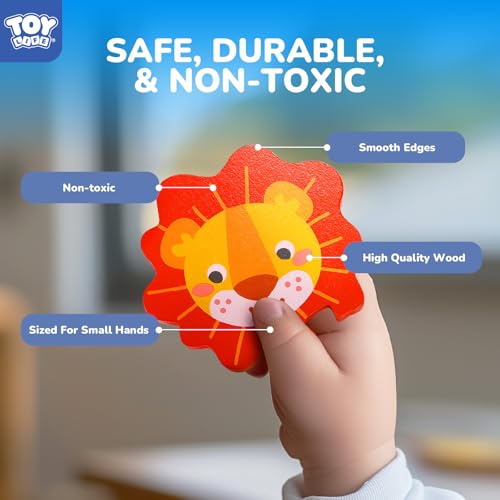
Bright colours, varied textures, and simple shapes are the curriculum. Wooden toys with smooth, rounded edges and non-toxic finishes are ideal because babies explore everything with their mouths — safety is the non-negotiable starting point.

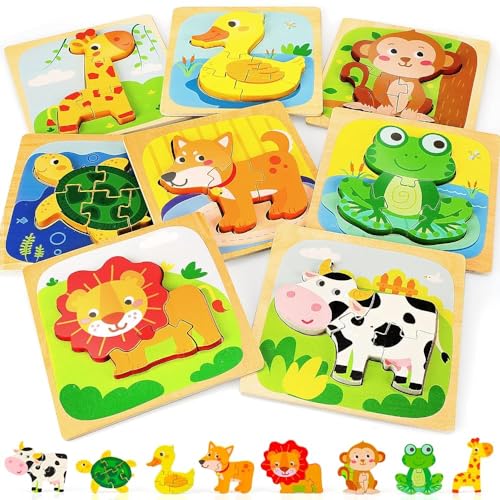
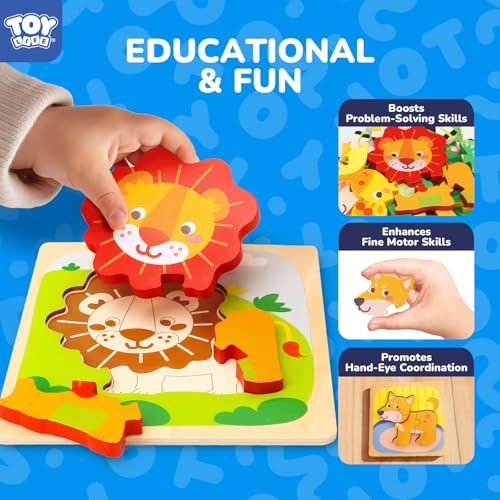
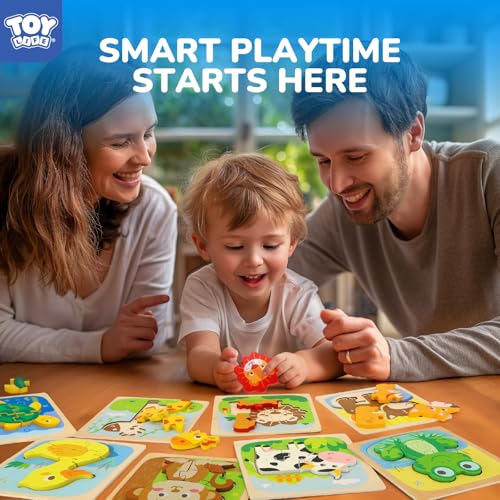
TOY Life Wooden Puzzles for Toddlers 2-4, Montessori Toys for 1 2 3 Year Old Boys Girls, Animals Puzzles Educational Learning Toys 2 Year Old, Toddler Birthday Gifts Toy for Baby Girl Boy 6M+
- SAFE LEARNING TOYS WOODEN PUZZLE FOR TODDLER: Designed with the toddler in mind, this wooden puzzle toy is mad
- 8 DIFFERENT SHAPE WITH BRIGHT COLORS: This wooden puzzle comes with 8 different Shape with bright colors, incl
- DURABLE AND LARGE PART: Made of environmentally friendly solid wood, this wooden puzzle is so durable that you
The TOY Life Wooden Puzzles are a strong pick for this age band. Each of the eight animal shapes is sized specifically so tiny fingers can grasp without the piece being small enough to swallow — a design detail that matters enormously for under-twos. The high-contrast, bright colours (yellow duck, green frog, orange lion) are precisely the kind of visual stimulation that supports early colour discrimination.
What to Look For at This Stage
3. Ages 1–3 — Language, Sorting, and Fine Motor Skills
Between one and three, children are acquiring language at a pace that will never be matched again in their lives — roughly three to five new words every single day during peak periods, according to the National Institute on Deafness and Other Communication Disorders (NIDCD). Toys that name, sort, and categorise are doing double duty: building vocabulary and early logical thinking simultaneously.

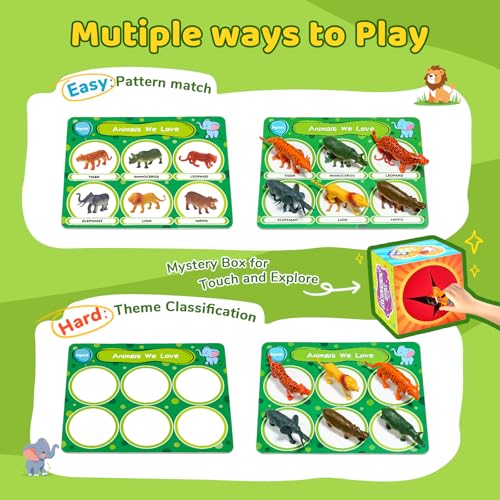
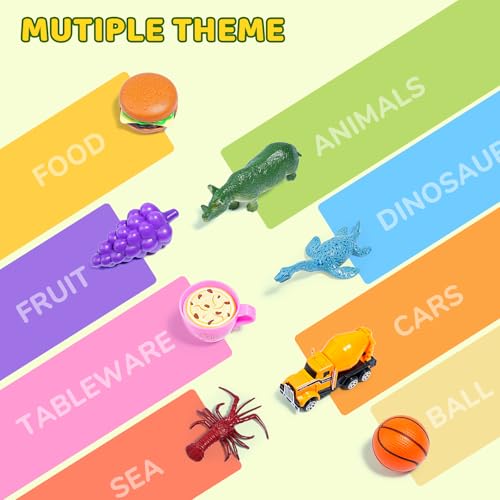
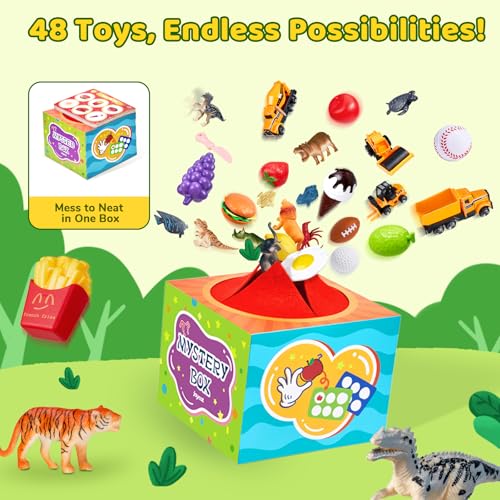
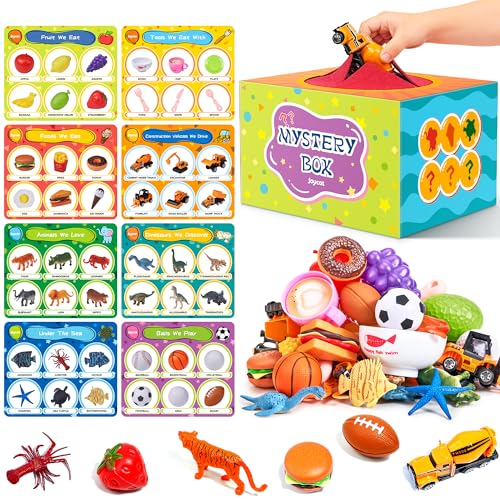
JoyCat Sorting Toys for Toddlers – Sensory Play Box with 48 Sorting Objects, Montessori Preschool Learning Toy to Support Early Cognitive & Speech Development for Ages 2–5
- Sensory Sorting Toy for Early Learning: Designed as a hands-on sensory sorting toy, this play set helps toddle
- Supports Speech & Language Development Through Play: Sorting, naming, and matching the objects encourage toddl
- Ideal for Preschool & At-Home Learning: With 8 double-sided activity mats, children can follow visual prompts
The JoyCat Sorting Toys for Toddlers is purpose-built for this developmental sweet spot. Its 48 sorting objects paired with eight double-sided activity mats give children a visual prompt to classify by colour, shape, and category — exactly the kind of schema-building that underpins later reading and maths readiness. Crucially, the naming and matching process actively encourages toddlers to practise vocabulary and expressive language, making it a practical speech-support tool for everyday home use.
For families working on language specifically, the Airbition Talking Flash Cards bring 224 illustrated words to life with real sounds and a standard American accent — a genuinely useful bridge between picture recognition and spoken vocabulary.



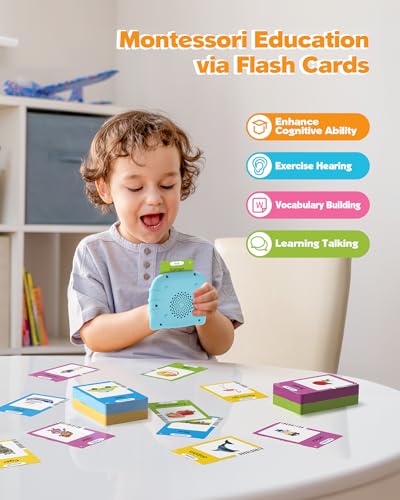

Airbition Talking Flash Cards for Toddlers 1 2 3 4 Year Olds, Montessori Language Learning Toys with 224 Words, Pocket Speech Therapy Toys, and Speech Development Educational Playthings for Children
- Toddler Montessori Learning Toys: This educational talking flash card features 224 colorful illustrations and
- Speech Therapy and Sensory Toys: Talking flashcards are a valuable tool for children. The sound-image combo he
- Easy to Use: Simply turn on the switch, insert a card into the reader, and hear content in a standard American
Red Flags to Avoid at This Age
4. Ages 2–5 — Puzzles, Problem-Solving, and Persistence
Puzzles are one of the most well-researched categories in developmental toy literature. A 2012 study published in the Journal of Experimental Child Psychology found that children aged 2–4 who played with puzzles regularly demonstrated significantly stronger spatial skills — skills that predict maths performance years later.
The key at this stage is a graduated challenge: start simple, add complexity as confidence grows. A four-piece puzzle at age two; a 60-piece floor puzzle by age five. That arc of increasing difficulty is precisely what builds what psychologist Carol Dweck calls a "growth mindset" — the belief that effort leads to improvement.

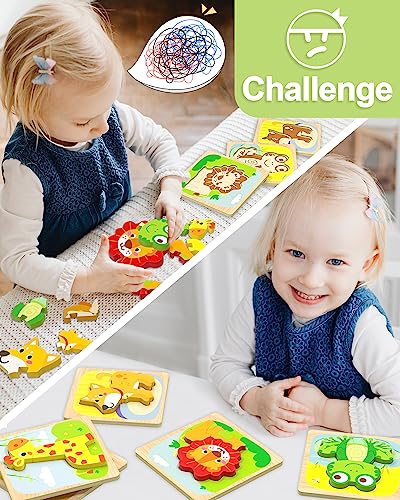
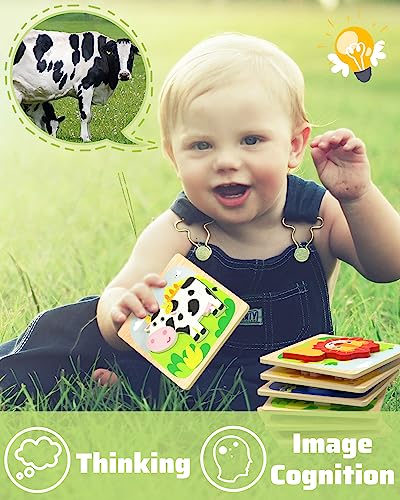
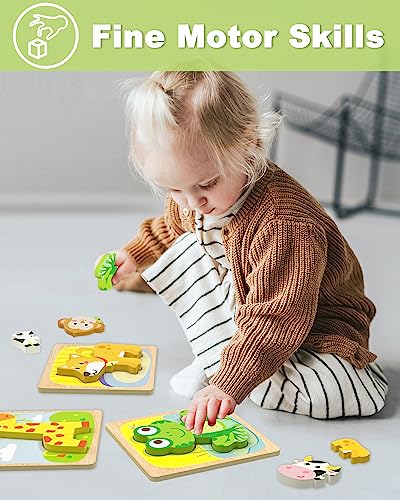
Benresive Wooden Toddler Puzzles, 6pcs Animal Montessori Toys for 1-3 Year Old Boys & Girls, Learning Educational Preschool Toys, Great Gifts for 1 2 3 Year Olds
- High Quality Toddler Toys: Each component of this Montessori toys is made of superior solid wood and water-pro
- Learning While Playing: Montessori toys for 1 2 3 year old contains 6 pieces of selected shapes: giraffe, frog
- 1 2 Year Old Girl Boy Birthday Gift: Each piece Toys for 1 2 3 year old boys girls are in 5.8 x 5.8 x 0.2 inch
The Benresive Wooden Toddler Puzzles offer a gentle entry point: six chunky animal shapes, each 5.8 × 5.8 inches, with waterproof painting and smooth edges. For families ready to move up the challenge ladder, the Dinomini 4-in-1 Floor Puzzle Pack is an outstanding value — four puzzles ranging from 24 to 60 pieces in one set, so your child progresses from beginner to intermediate without needing a new purchase.
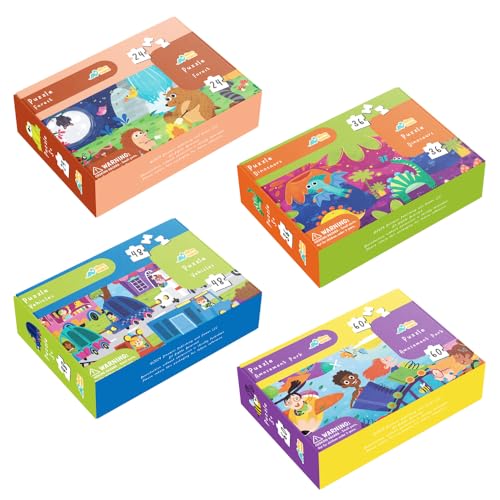
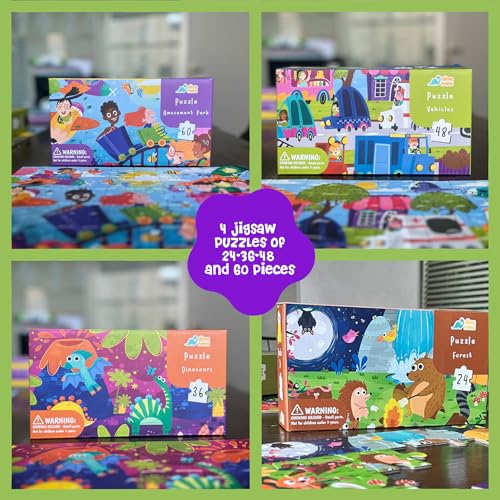

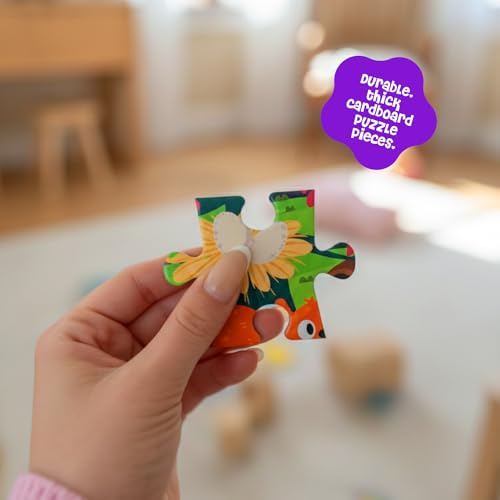
Dinomini Floor Puzzles for Toddlers 4-in-1 Value Pack - 4 x Puzzles for Toddlers 2-4 - 24, 36, 48 & 60 Pieces - Preschool Learning Activities - Learning & Educational Toys
- Four large floor puzzles in one set let children start with an easy build and gradually take on more challenge
- Large, cardboard backed pieces that are designed for lasting play by toddlers and preschoolers, making this ji
- Starting with simpler puzzles and moving to more complex ones gives kids a sense of achievement and motivates
The Spatial Skills Connection
Research from the University of Chicago (Levine et al., 2012) specifically identified puzzle play — not blocks, not drawing — as the activity most strongly associated with mental rotation ability in preschoolers. Mental rotation is a core component of the spatial reasoning that underpins STEM subjects.5. Ages 3–6 — Letters, Numbers, and Early Literacy Through Play
Formal reading instruction typically begins around age five or six, but the foundations — phonemic awareness, letter recognition, number sense — are built years earlier through play. The most effective early literacy toys are those that make abstract symbols (letters, numbers) concrete and interactive.
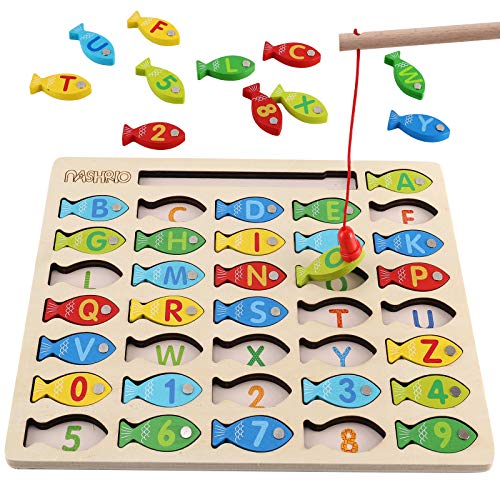


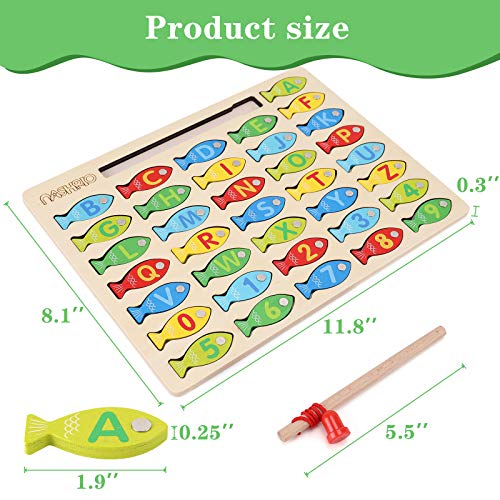
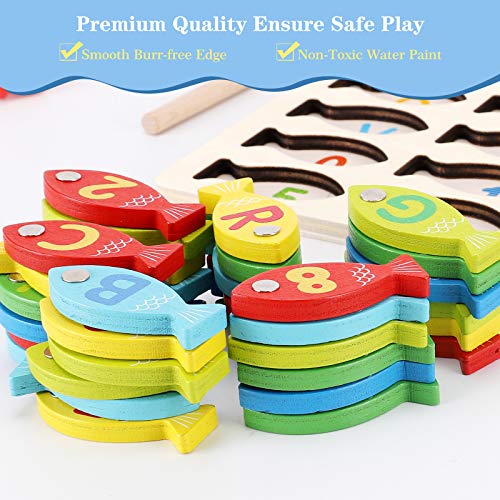
Magnetic Wooden Fishing Game Toy for Toddlers, Alphabet Fish Catching Counting Games Puzzle with Numbers and Letters, Preschool Learning ABC Math Educational Toys 3 4 5 Years Old Girl Boy Kids
- DESIGNED FOR KIDS: Fun never stops with our wooden fishing game! This interactive fishing toy is a great learn
- HOW IT WORKS: Our fishing game puzzle consists of a wooden board with a multitude of colorful fish pieces with
- HIGH STANDARDS: The motor skills toys for toddlers 3-5 are made entirely out of well-polished wood. It feature
The NASHRIO Magnetic Wooden Fishing Game is a deceptively simple toy that delivers on multiple fronts. Children fish for wooden pieces printed with letters and numbers, which means every "catch" is a teachable moment: letter identification, colour discrimination, counting, and fine motor control (holding the magnetic rod requires genuine hand steadiness). At under $9, it's one of the best value-per-skill toys in this guide.
Building Number Sense Before School
Number sense — the intuitive understanding that numbers represent quantities — is not the same as counting aloud. Children who can recite "1, 2, 3, 4, 5" don't necessarily understand that five means five things. Hands-on sorting and counting toys, where a child physically handles five objects and counts them into groups, build genuine number sense in a way that rote repetition cannot.6. Ages 6–12 — Science, Coding, and Creative Problem-Solving
As children enter primary school, their capacity for abstract thinking expands rapidly. This is the window for science kits, coding toys, geography tools, and building systems that require multi-step planning. The research here is clear: hands-on STEM play at this age builds the kind of flexible problem-solving that schools and employers consistently identify as the most valuable 21st-century skill.
The AAP's 2018 report specifically highlighted that unstructured creative play — building, experimenting, making — strengthens executive function more reliably than structured drills or passive learning. Coding robots like Botley (Learning Resources) and science experiment kits that include 80+ activities give children genuine agency: they design the experiment, they write the code, they see the result.
What "Good" STEM Toys Actually Do
7. Comparison: Which Learning Toy Type Fits Your Child Right Now?
| Toy Type | Best Age Range | Primary Skill Built | Key Drawback | Recommended Product | Price Range |
|---|---|---|---|---|---|
| Wooden shape puzzles | 6 months–3 years | Fine motor, colour/shape recognition | Limited replay value as skills grow | TOY Life Wooden Puzzles | $13–23 |
| Animal sorting set | 2–5 years | Categorisation, early language, cognitive sorting | Pieces can scatter | JoyCat Sorting Toy | $32 |
| Graduated floor puzzles | 2–5 years | Spatial reasoning, persistence, problem-solving | Requires floor space | Dinomini 4-in-1 Puzzle Pack | $25 |
| Talking flash cards | 1–4 years | Vocabulary, phonics, sound-image association | Battery dependent | Airbition Talking Flash Cards | $10 |
| Magnetic fishing/letter game | 3–6 years | Letter/number recognition, fine motor, colour ID | Small pieces for under-3s | NASHRIO Fishing Game | $9 |
| Chunky Montessori puzzles | 1–3 years | Hand-eye coordination, shape recognition | Simple enough to outgrow quickly | Benresive Wooden Puzzles | $14 |
8. Expert Insights on Learning Through Play
Conclusion
Choosing learning toys doesn't have to be overwhelming or expensive. The research points consistently in the same direction: hands-on, open-ended, age-matched play builds the cognitive, language, and motor skills that set children up for a lifetime of learning. A simple wooden puzzle at six months, a sorting set at two, a floor puzzle challenge at four, a magnetic fishing game at five — these aren't just toys. They're the quiet infrastructure of a developing mind.
The best toy you'll ever give your child is one that makes them lean in, try again, and feel the satisfaction of figuring something out themselves. That feeling — of competence earned through effort — is what learning actually feels like.
If this guide helped you, save it for the next developmental stage, share it with a caregiver, or bookmark it for gift-giving season. The right toy at the right moment is one of the simplest, most powerful investments you can make.
Sources & References
- American Academy of Pediatrics. "The Power of Play: A Pediatric Role in Enhancing Development in Young Children." Pediatrics, 2018. https://doi.org/10.1542/peds.2018-2058
- Harvard Center on the Developing Child. "Brain Architecture." 2023. https://developingchild.harvard.edu/science/key-concepts/brain-architecture/
- Harvard Center on the Developing Child. "Serve and Return Interaction." 2023. https://developingchild.harvard.edu/science/key-concepts/serve-and-return/
- Levine, S.C., et al. "Puzzle Play: A Potent Vehicle for Promoting Spatial Development in Children." Journal of Experimental Child Psychology, 2012. https://doi.org/10.1016/j.jecp.2011.11.011
- Hassinger-Das, B., et al. "Electronic Toys Diminish Parent-Child Conversational Exchanges." JAMA Pediatrics, 2020. https://doi.org/10.1001/jamapediatrics.2019.5716
- Dauch, C., et al. "The Influence of the Number of Toys in the Environment on Toddlers' Play." Infant Behavior and Development, University of Toledo, 2018. https://doi.org/10.1016/j.infbeh.2017.11.005
- National Institute on Deafness and Other Communication Disorders (NIDCD). "Speech and Language Developmental Milestones." 2017. https://www.nidcd.nih.gov/health/speech-and-language
- Hirsh-Pasek, K., et al. "Putting Education in 'Educational' Apps: Lessons From the Science of Learning." Psychological Science in the Public Interest, 2015. https://doi.org/10.1177/1529100615569721
Frequently Asked Questions
At what age should I introduce puzzles?
Are wooden toys actually better than plastic?
How many toys does my toddler actually need?
Do talking/electronic toys help with language development?
What makes a toy "Montessori"?
When should I introduce coding or STEM toys?
How do I know if a toy is actually educational or just marketed that way?
Was this helpful?
Thanks — your feedback helps us pick what to write next.