Why Preschool Brains Are Wired for Big Feelings
Preschool big emotions are developmentally normal — the 3–5 age window is when children's brains are literally wiring up emotional control, and the right strategies now build lifelong self-regulation skills.
In this article
Your four-year-old just dissolved into a full-body meltdown because you cut their sandwich the "wrong" way. Sound familiar? You are not alone — and you are not failing. According to the American Academy of Pediatrics (AAP), emotional dysregulation in the preschool years is one of the top concerns parents raise at well-child visits. Research published by the CDC's National Center for Health Statistics found that roughly 1 in 6 children aged 2–8 has a diagnosed mental, behavioural, or developmental disorder — but the vast majority of preschool behaviour challenges are simply the normal growing pains of a brain that hasn't finished building its brakes yet.
This guide will help you understand:
1. Why Preschool Brains Are Wired for Big Feelings
The most important thing to understand is that your preschooler is not choosing to lose control — their brain simply cannot reliably stop itself yet. The prefrontal cortex (PFC), the region responsible for impulse control, planning, and emotional regulation, doesn't fully mature until the mid-twenties. At age three, four, or five, the emotional alarm system (the amygdala) fires fast and loud, while the PFC — the "thinking brake" — is still under construction.
What this looks like day-to-day
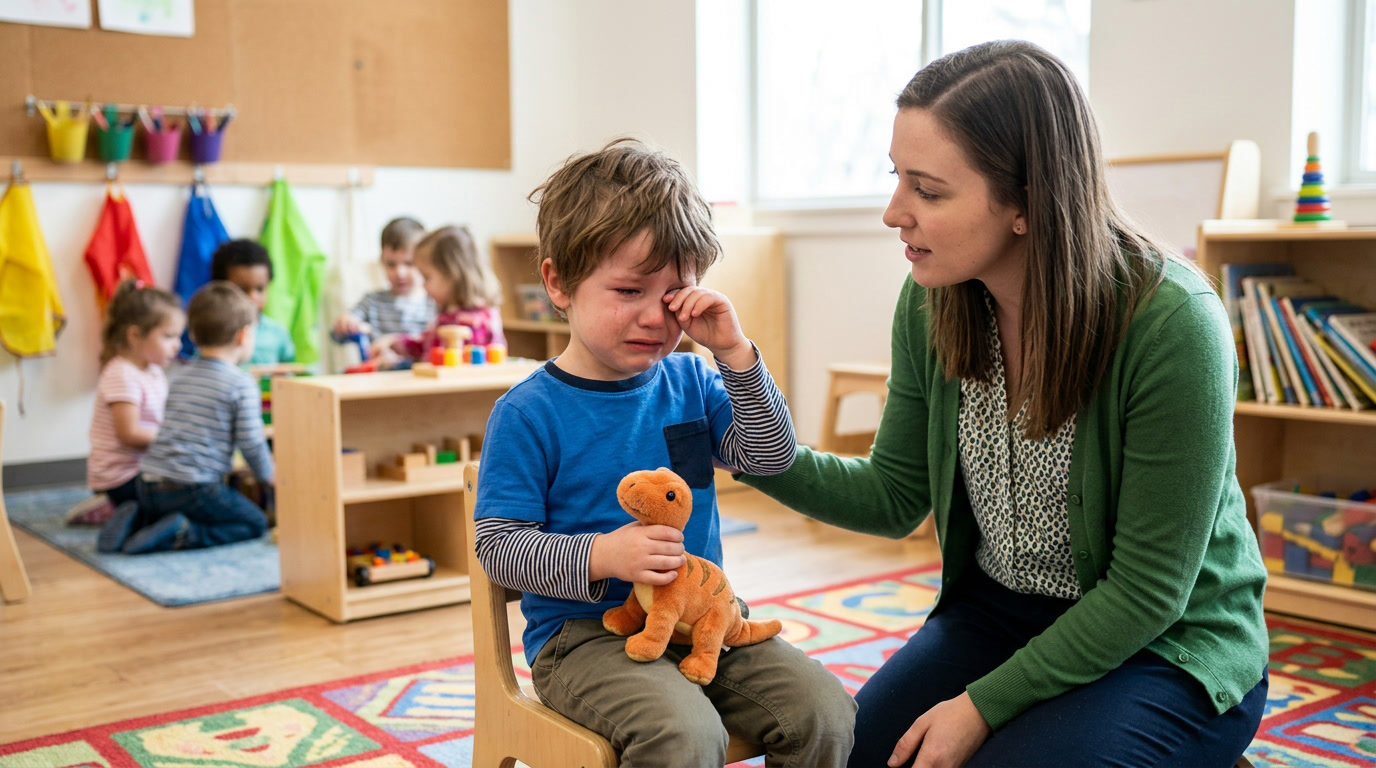
A preschooler who screams when a playdate ends isn't being manipulative. They genuinely feel overwhelmed and lack the neural hardware to down-regulate quickly. This is why: - Transitions trigger meltdowns (leaving the park, turning off screens) - Hunger and tiredness make everything worse - Frustration can flip to rage in seconds - The same rule needs repeating hundreds of times before it sticks
What you can do today: Before your next transition, give a two-minute warning, then a one-minute warning. This simple cue trains the brain to anticipate change rather than be ambushed by it.
2. Emotion Coaching: The Research-Backed Approach That Actually Works
Emotion coaching — acknowledging, naming, and validating a child's feeling before redirecting behaviour — is the most evidence-supported strategy for preschool emotional development.
Psychologist Dr. John Gottman, Professor Emeritus at the University of Washington, spent decades studying how parents respond to children's negative emotions. His research found that children of "emotion-coaching" parents had better physical health, higher academic achievement, fewer behavioural problems, and stronger friendships compared to children whose emotions were dismissed or punished.
The five steps of emotion coaching (simplified for preschoolers)
1. Notice the feeling before it escalates 2. Name it out loud: "You look really frustrated right now" 3. Validate it: "It makes sense you're upset — you were having so much fun" 4. Set limits if needed: "It's okay to feel angry; it's not okay to hit" 5. Problem-solve together once calm: "What could we do next time?"



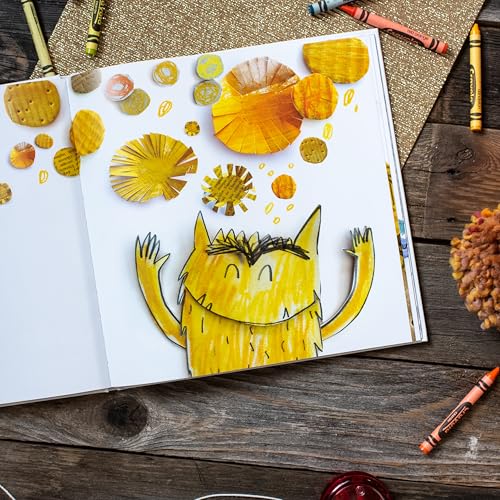

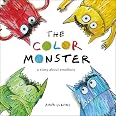
The Color Monster: A Story About Emotions
- Children's Books
- Growing Up & Facts of Life
- Friendship, Social Skills & School Life
3. Understanding Normal vs. Concerning Behaviour
Most preschool behaviour — even the stuff that makes you want to hide in the bathroom — is developmentally typical. But it helps to know where the line is.
What's developmentally normal at 3–5
Red flags worth discussing with your paediatrician
- Tantrums that are increasing in frequency or severity after age 4 - Aggression that regularly injures others or themselves - Complete inability to separate from caregivers (beyond typical separation anxiety) - Regression in previously mastered skills (toileting, speech) without a clear trigger - Persistent sadness, withdrawal, or loss of interest in play - Extreme, inflexible fears that interfere with daily life
What you can do today: Keep a brief behaviour diary for one week. Note what happened before, during, and after a difficult episode. Patterns (time of day, hunger, specific triggers) are incredibly useful for your paediatrician and for you.
4. Practical Strategies for Managing Meltdowns in the Moment
When the meltdown is already happening, your goal shifts from teaching to co-regulating — using your own calm nervous system to help your child's dysregulated one settle down.
A simple in-the-moment framework
S – Stay calm yourself. Children's nervous systems are literally contagious. If you escalate, they escalate further. Take one slow breath before responding.
T – Tune in, don't talk. Get down to their level. A hand on the shoulder (if they accept touch) signals safety without demanding words they can't produce right now.
O – Offer space or closeness. Some children need a hug; others need physical space. Learn your child's preference.
P – Pause on problem-solving. Wait until the storm passes — usually 10–20 minutes — before discussing what happened.

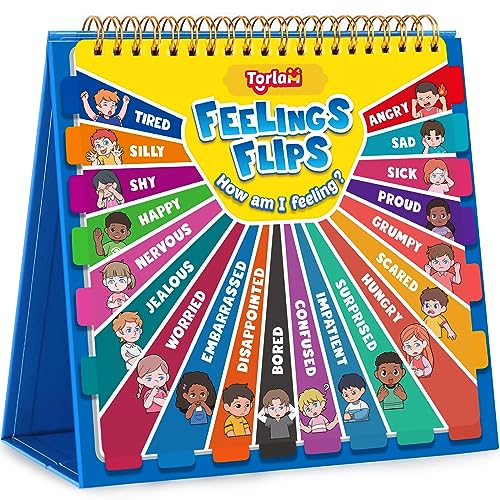
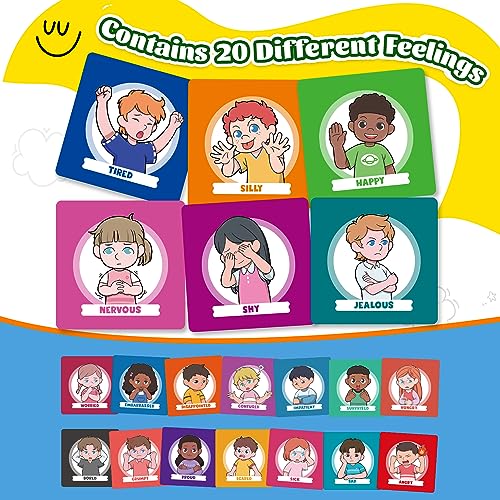
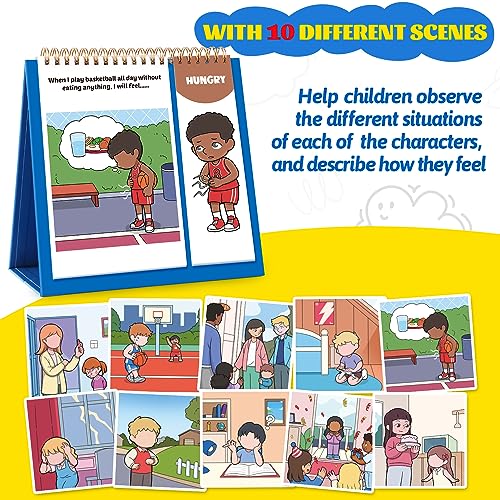
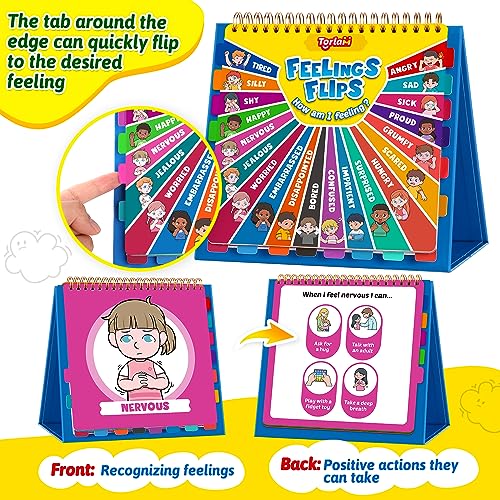
Torlam Feelings Wheel Emotions Book,Calming Down Corner Items Feelings Chart for Kids,Social Emotional Regulation Tools,Emotion Wheel Flip Book,Autism Must-Have ADHD Tools for Kids Classroom Preschool
- 【Feelings Wheel Emotions Book】The feelings book aims to guide children's emotions visually,help kids understan
- 【20 Different Feelings Emotion Wheel】 The feelings and emotions flip book includes 20 different emotions of ti
- 【10 Different Scenes Feelings Chart】With 10 different scenes,the social emotional books for kids allow childre
5. Building Emotional Literacy Through Everyday Moments
Emotional literacy — the ability to identify, understand, and express emotions — is a skill, and like all skills it needs practice. The preschool years are a sensitive window for this learning.
The good news: you don't need a curriculum. Everyday moments are the curriculum.
Strategies that fit into real life
During storytime: Pause and ask, "How do you think she's feeling right now?" Books like The Feelings Monsters and A Little SPOT: My First Emotions are purpose-built for this kind of guided conversation.
During conflict: Instead of immediately solving the dispute, narrate what you observe: "It looks like you both want the same toy and you're both feeling frustrated."
During your own emotions: Model emotional literacy out loud. "I'm feeling a bit stressed because I'm running late — I'm going to take three deep breaths." Children learn enormously from watching you name and manage your own feelings.
At the dinner table: Try a daily "high/low/feeling" check-in. Each person shares a high point, a low point, and how they felt. Even a three-year-old can participate.
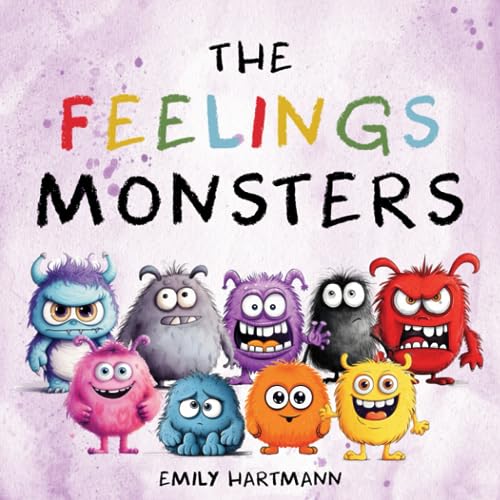


The Feelings Monsters: Children's Book About Emotions and Feelings, Kids Preschool Ages 3 -5 (Emotional Regulation)
- Children's Books
- Growing Up & Facts of Life
- Friendship, Social Skills & School Life
What you can do today: Read The Rabbit Listened tonight. It's a masterclass in what children actually need when they're upset — and it's a beautiful conversation starter about empathy.
6. Positive Behaviour Guidance: Setting Limits That Work
Discipline in the preschool years should teach, not just stop. The goal is to help your child internalise values and self-control — not simply to comply when you're watching.
What the evidence says about effective discipline
The AAP's 2018 policy statement on effective discipline explicitly states that spanking, yelling, and shaming are counterproductive and associated with increased aggression and poorer mental health outcomes. What works instead:

7. Comparison of Emotional Learning Tools for Preschoolers
| Tool Type | Best For | Emotional Skills Targeted | Ease of Use | Main Limitation | Recommended Product |
|---|---|---|---|---|---|
| Picture books (emotion-focused) | Ages 3–5, bedtime or storytime | Naming feelings, empathy, perspective-taking | Very easy — just read together | Passive unless you pause and discuss | The Color Monster |
| Feelings flip book / wheel | Ages 3–6, calm-down corner | Identifying & labelling current emotion, self-regulation | Easy — child-led | Works best after initial adult introduction | Torlam Feelings Wheel |
| Monster/character emotion books | Ages 3–5, any time | Normalising a range of emotions, vocabulary building | Very easy | May need pairing with real-life discussion | The Feelings Monsters |
| Empathy-focused picture books | Ages 3–6, after upsets | Empathy, coping strategies, being heard | Very easy | Concept of "listening" may need adult modelling | The Rabbit Listened |
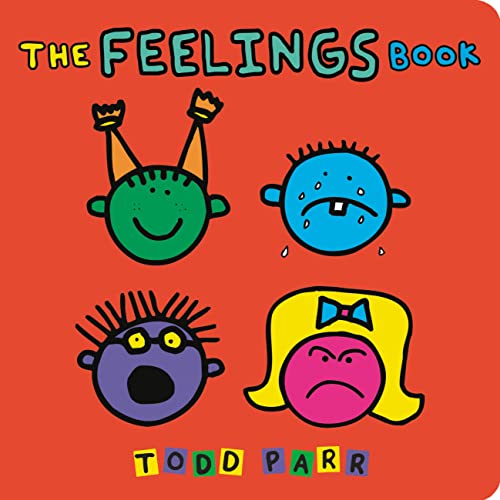
| Broad emotion storybooks | Ages 2–5, daily reading | Wide emotion vocabulary, mood identification | Very easy | Less interactive than flip tools | The Feelings Book |
| Spot character emotion series | Ages 2–5, introduction to emotions | First emotion concepts, self-expression | Very easy — great starting point | Limited depth for older preschoolers | A Little SPOT: My First Emotions |
Expert Insights
Frequently Asked Questions
Parenting a preschooler through big emotions is genuinely one of the hardest and most important jobs there is. On the days when you've repeated yourself forty times and still ended up on the kitchen floor with a crying four-year-old, remember this: every time you stay calm, name a feeling, or hold a limit with warmth, you are physically shaping your child's developing brain. The seeds you plant now — in the messy, exhausting, beautiful preschool years — grow into the emotional resilience that carries them through life.
The goal was never a child who never feels big things. It's a child who learns, slowly and safely, that big feelings are survivable.
If this guide helped, save it for the hard days, share it with another parent in the trenches, or subscribe to tinymindsworld.com for more evidence-based guidance at every stage.
Sources & References
- American Academy of Pediatrics. "Effective Discipline to Raise Healthy Children." Pediatrics, 2018. https://publications.aap.org/pediatrics/article/142/6/e20183112/38611
- American Academy of Pediatrics. "Developmental Surveillance and Screening." HealthyChildren.org. https://www.healthychildren.org/English/ages-stages/Pages/default.aspx
- Bitsko RH, et al. "Epidemiology and Impact of Health Care Provider–Diagnosed Anxiety and Depression Among US Children." CDC / Journal of Developmental & Behavioral Pediatrics, 2018. https://www.cdc.gov/childrensmentalhealth/data.html
- Gottman JM, Katz LF, Hooven C. "Parental Meta-Emotion Philosophy and the Emotional Life of Families." Journal of Family Psychology, 1996.
- Shonkoff JP, Phillips DA (Eds.). "From Neurons to Neighborhoods: The Science of Early Childhood Development." National Academies Press, 2000.
- Siegel DJ, Bryson TP. "The Whole-Brain Child." Delacorte Press, 2011.
- Yale Center for Emotional Intelligence. "The RULER Approach." https://www.rulerapproach.org/
- National Institute of Child Health and Human Development (NICHD). "Preschool-Age Children's Emotional Development." https://www.nichd.nih.gov/
Frequently Asked Questions
Is it normal for my 4-year-old to still have tantrums?
My preschooler hits when angry. What should I do?
How do I handle my child's big emotions in public?
Should I ignore tantrums or respond to them?
When should I be worried about my preschooler's behaviour?
How can books actually help with emotional regulation?
My child seems fine at school but falls apart at home. Is that normal?
Was this helpful?
Thanks — your feedback helps us pick what to write next.