Language and Literacy: Building the Foundation for Reading
The 30 activities below are grounded in child-development research and cover every major domain your 3-year-old is building right now — language, maths, motor skills, emotional intelligence, and social readiness.
In this article
Your 3-year-old woke up this morning and, before breakfast, asked why the sky is blue, where worms live, and whether dogs dream. Welcome to one of the most electrifying stages of childhood. According to the Centers for Disease Control and Prevention (CDC), children between ages 3 and 5 add roughly 1,000 words to their vocabulary — and the neural architecture supporting that growth is being laid down right now.
This guide gives you 30 concrete, research-backed activities organised by developmental domain. By the end, you'll understand:
1. Language and Literacy: Building the Foundation for Reading
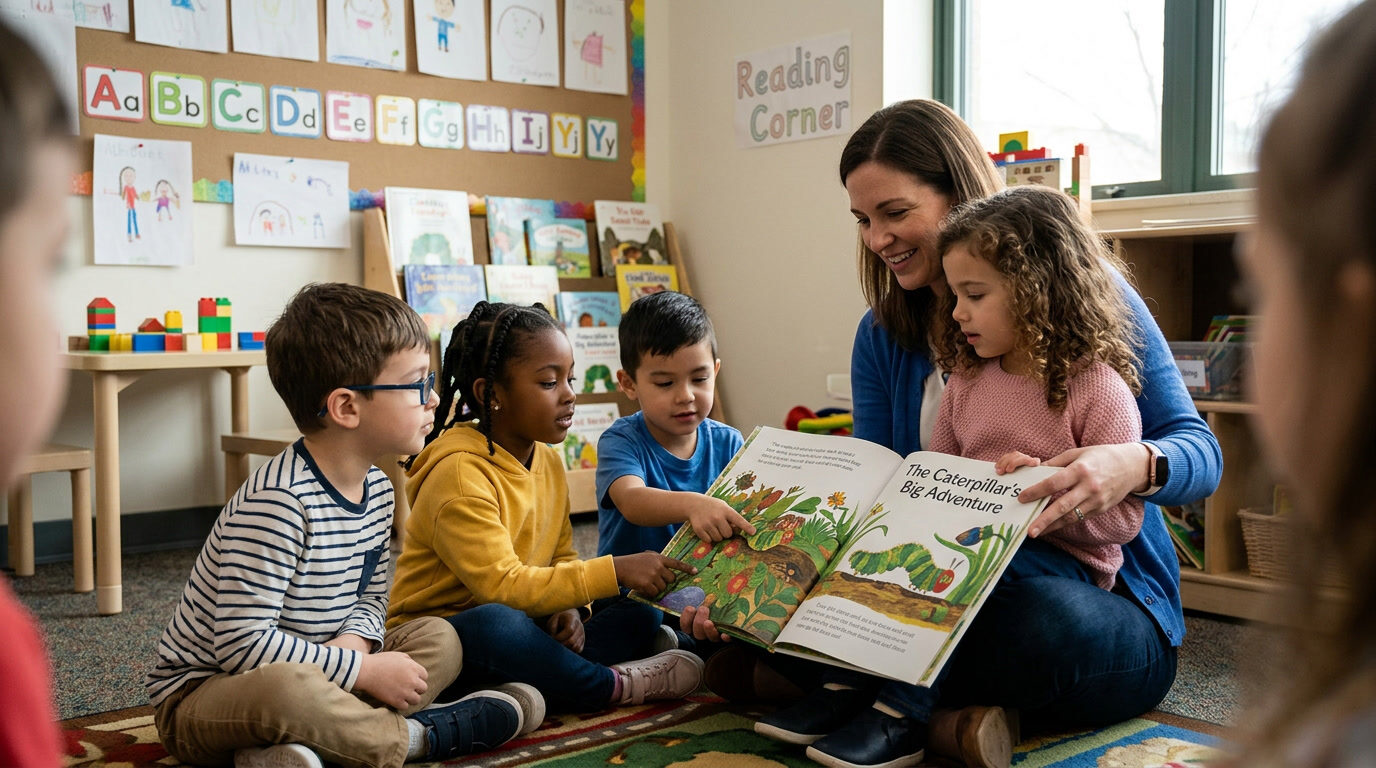
Language learning at age 3 is less about flash cards and more about rich, back-and-forth conversation — what researchers call "serve-and-return" interaction. The American Academy of Pediatrics (AAP) recommends reading aloud daily starting in infancy and continuing well into the school years, noting it is one of the single most effective things a parent can do to prepare a child for literacy.
Activities 1–6
1. Read aloud together every day. Choose books slightly above their current level — the "stretch" vocabulary is where the magic happens. Pause to ask, "What do you think happens next?"
2. Storytelling swap. After reading, close the book and ask your child to retell the story in their own words. This builds narrative sequencing, a key pre-literacy skill.
3. Rhyme games. "Cat, hat, bat — what rhymes with mat?" Phonological awareness (hearing the sounds inside words) is the single strongest predictor of later reading success, according to the National Reading Panel.
4. Label the world. Stick sticky-note labels on objects around the house — door, fridge, window. Seeing print in context is powerful.
5. Alphabet fishing. A hands-on game that blends fine motor skill with letter recognition in a low-pressure format. NASHRIO Magnetic Wooden Fishing Game turns letter-catching into a giggling competition — and at under $9, it's one of the best-value literacy tools available.
6. Memory matching with letters. Uppercase-to-lowercase matching builds the visual discrimination children need before phonics instruction begins. The Chuckle & Roar Alphabet Matching Memory Game is specifically designed for ages 3+ and doubles as a focus-building brain game.
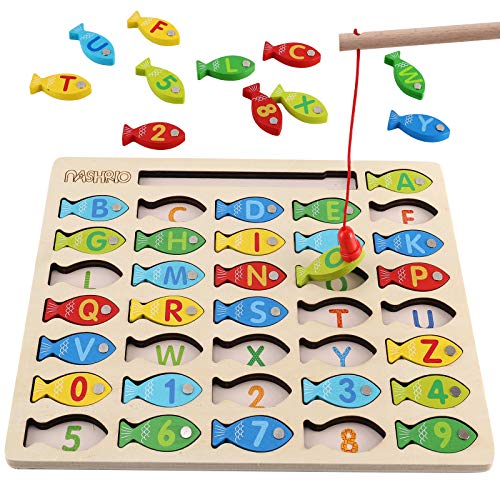


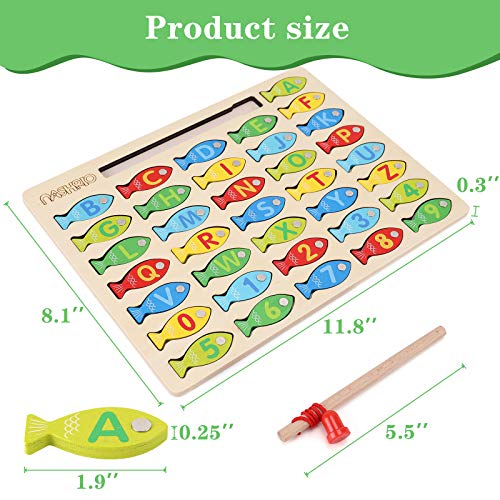
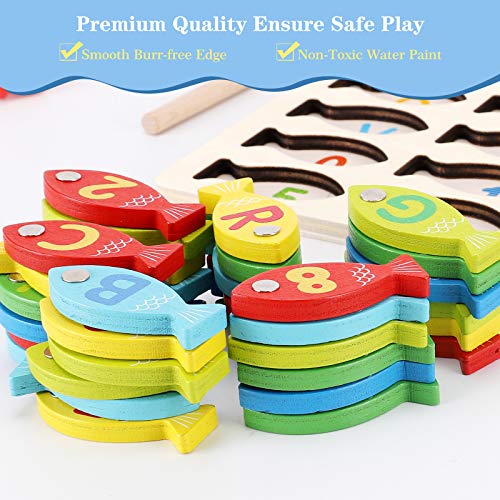
Magnetic Wooden Fishing Game Toy for Toddlers, Alphabet Fish Catching Counting Games Puzzle with Numbers and Letters, Preschool Learning ABC Math Educational Toys 3 4 5 Years Old Girl Boy Kids
- DESIGNED FOR KIDS: Fun never stops with our wooden fishing game! This interactive fishing toy is a great learn
- HOW IT WORKS: Our fishing game puzzle consists of a wooden board with a multitude of colorful fish pieces with
- HIGH STANDARDS: The motor skills toys for toddlers 3-5 are made entirely out of well-polished wood. It feature
2. Early Maths and Logic: Counting, Sorting, and Pattern Thinking
Maths at 3 is concrete, physical, and joyful — it has nothing to do with worksheets. The National Association for the Education of Young Children (NAEYC) emphasises that early maths concepts like counting, sorting, and pattern recognition form the scaffolding for later abstract thinking.
Activities 7–12
7. Count everything. Stairs, grapes, socks coming out of the dryer. One-to-one correspondence (touching each object as you count it) is the developmental goal, not rote recitation.
8. Sorting games. Sort laundry by colour, blocks by shape, or toy animals by size. The Play-Act Montessori Learning Farm Train is built for exactly this — 10 numbered barns, 4 coloured wagons, and 9 farm animals give children multiple sorting variables to explore.
9. Simple patterns. Line up coloured blocks: red, blue, red, blue. Ask your child to continue the sequence. Then let them make a pattern for you to extend.
10. Baking as maths. Measuring cups, counting eggs, and dividing dough into equal pieces are all applied maths. The context makes it meaningful.
11. Shape hunts. Walk around the house or garden and find circles, squares, and triangles. Then graduate to ovals, rectangles, and diamonds.
12. Number matching on a touch screen. For screen time that earns its keep, the LeapFrog Prep for Preschool Activity Book covers number matching, shape tracing, and counting across six touch-sensitive pages with an erasable pen — so the learning is replayable.

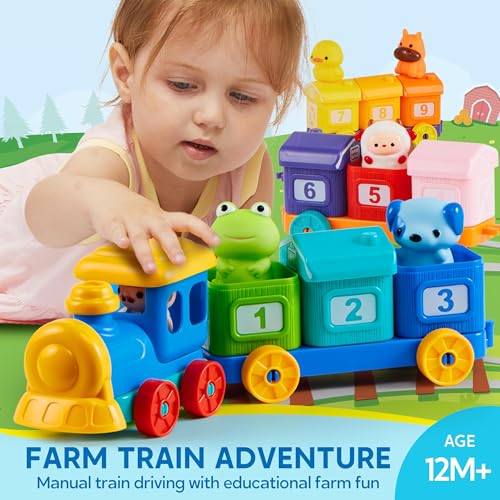


Play-Act Learning Toy for Toddlers 1 2 3 Years Old, Counting, Matching & Sorting Montessori Learning Farm Train Including 9 Farm Animals, Birthday Gift for Baby Boys Girls
- Colorful Sorting Experience: Explore colors and numbers while enjoying the vibrant sorting activity with 10 nu
- Open Train for Interactive Play: The train features a detachable roof, allowing children to place figures insi
- Explore Colors and Numbers: Engage in loading, unloading, stacking, and sorting with the numbered barns, foste
3. Fine Motor Skills: The Groundwork for Writing and Self-Care
Fine motor development at 3 directly predicts handwriting readiness at 5. Occupational therapists consistently point to grip strength, pincer control, and hand-eye coordination as the trio that underpins not just writing, but also self-dressing, feeding, and tool use.
Activities 13–18
13. Playdough and clay. Rolling, squeezing, pinching, and pressing build hand strength and bilateral coordination simultaneously.
14. Bead threading. String large wooden beads onto a thick lace. Progress to smaller beads as dexterity improves.
15. Child-safe scissor practice. Cutting along straight lines, then curves, then shapes. Use paper with thick printed lines so children get clear visual feedback.
16. Colouring within lines. Not for perfection — for deliberate pencil control. Let your child choose the colours entirely.
17. Guided letter tracing. Step-by-step letter formation, with animated feedback, keeps children engaged without frustration. The LeapFrog Mr Pencil's Scribble Write and Read walks children through uppercase and lowercase letters one stroke at a time, then transforms each letter into an animated character — a clever reward loop.
18. Pouring and transferring. Fill a jug with water and let your child pour it between containers. Spooning dried lentils from bowl to bowl works just as well and is far less wet.



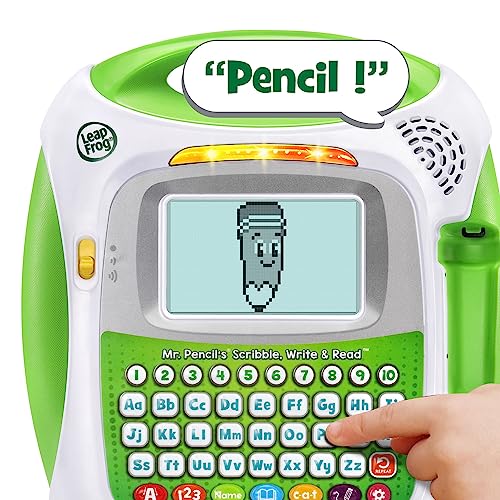

LeapFrog Mr Pencil's Scribble Write and Read, Green
- Your new pal, Mr. Pencil shows kids how to write uppercase and lowercase letters step-by-step, then transforms
- Trace numbers by following the dotted lines, then watch them transform into objects you can count
- Customize by entering a child’s first, middle and last name so they can practice writing it
4. Creative and Sensory Play: Fuelling Imagination and Emotional Regulation
Creative play is not a break from learning — it is learning. Research published by the American Psychological Association links imaginative play in early childhood to improved executive function, emotional regulation, and social perspective-taking.
Activities 19–23
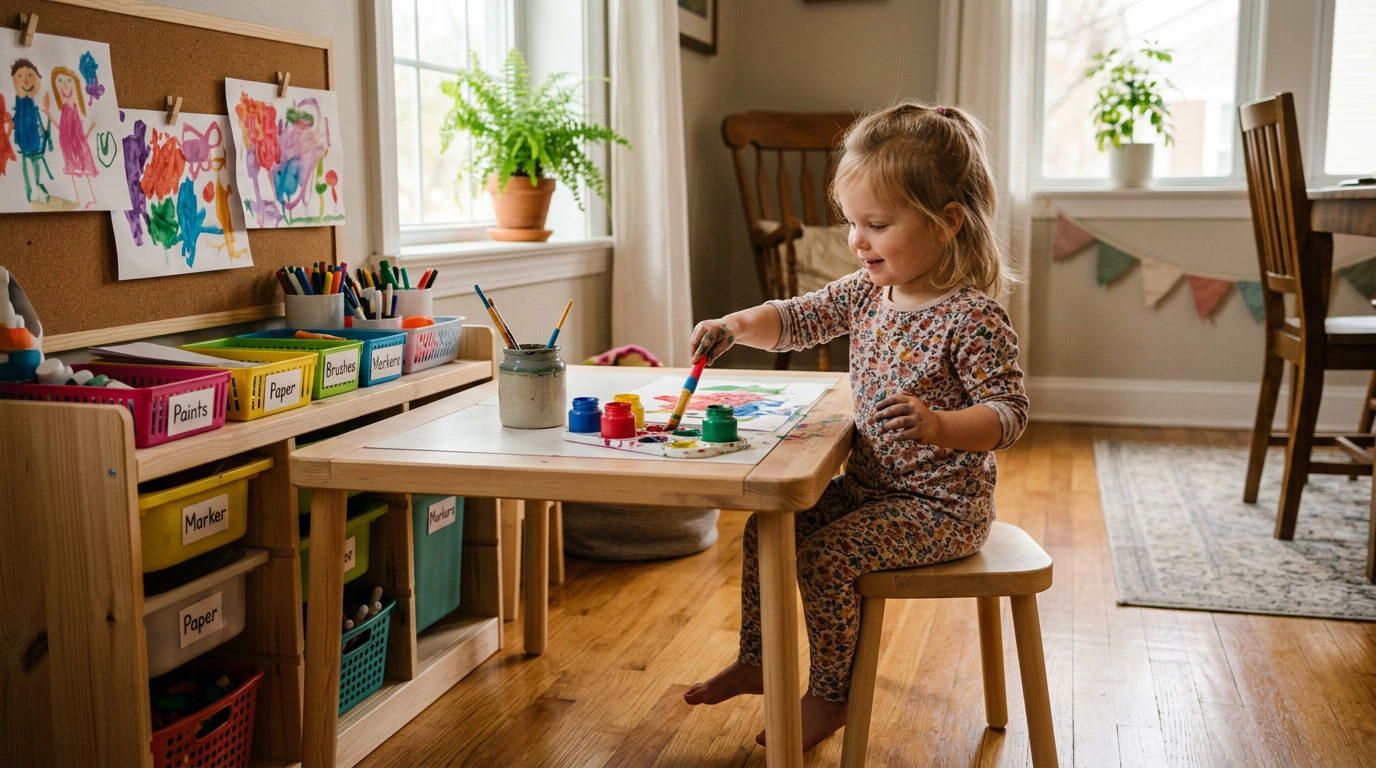
19. Open-ended art. Finger painting, collage with torn paper, printing with vegetables. Process over product — resist the urge to guide toward a recognisable outcome.
20. Sensory bins. Fill a container with dried rice, sand, or water beads. Add scoops, funnels, and small figures. Sensory play calms the nervous system and builds tactile discrimination.
21. Pretend play / role play. Playing "doctor," "shop," or "kitchen" develops Theory of Mind — the understanding that other people have thoughts and feelings different from our own. This is a milestone the WHO identifies as central to social-emotional development.
22. Puppet shows. Make simple sock puppets and act out a story together. Children often express emotions through puppets that they cannot yet articulate directly.
23. Music and movement. Freeze dance, drumming on pots, singing action songs. Rhythm and movement integrate auditory and proprioceptive processing, supporting self-regulation.
5. Social-Emotional Skills: Sharing, Empathy, and Self-Regulation
Social-emotional learning (SEL) at age 3 is the foundation of lifelong mental health. The Harvard Center on the Developing Child describes early emotional skill-building as one of the highest-return investments in a child's long-term wellbeing.
Activities 24–27
24. Emotion charades. Pull faces and ask your child to name the feeling: happy, sad, surprised, worried. Then swap — they make the face, you guess.
25. Turn-taking games. Board games, simple card games, and the Chuckle & Roar Alphabet Matching Memory Game all require waiting, watching, and respecting another player's turn — a genuinely hard skill at 3.
26. Problem-solving role play. "Your friend has the toy you want. What could you do?" Walk through options together. Children who practise verbal problem-solving show fewer behaviour incidents in preschool settings.
27. Feelings books. Titles like The Colour Monster or In My Heart give children vocabulary for internal states. Read them when your child is calm, not mid-meltdown.
6. Independence and Life Skills: Building Confidence Through Competence
Independence activities at 3 are not about pushing children to grow up faster — they are about giving children the experience of capability, which is the bedrock of healthy self-esteem.
Activities 28–30
28. Dressing themselves. Start with loose clothing and no buttons. Lay clothes out in the order they go on. Celebrate the attempt, not the result.
29. Basic hygiene routines. Hand-washing with a song (two rounds of "Happy Birthday" = 20 seconds), tooth brushing, and toilet independence. Consistent routines reduce resistance because the child knows what comes next.
30. Simple gardening. Plant a seed in a small pot. Water it daily. The slow reveal of a seedling teaches patience, responsibility, and cause-and-effect — all in one activity.
Comparing Learning Tools for 3-Year-Olds at a Glance
| Learning Tool Type | Best Developmental Domain | Key Benefit | Main Limitation | Recommended Product | Price Range |
|---|---|---|---|---|---|
| Interactive writing toy | Fine motor + literacy | Step-by-step letter formation with animated feedback | Requires batteries | LeapFrog Mr Pencil's Scribble Write and Read | ~$30 |
| Sorting / counting toy | Early maths + colour recognition | Hands-on, screen-free, multi-variable sorting | Smaller pieces need supervision | Play-Act Montessori Learning Farm Train | ~$22 |
| Touch-and-learn activity book | Broad school readiness | Covers letters, numbers, shapes, and weather in one tool | Limited to pre-set activities | LeapFrog Prep for Preschool Activity Book | ~$22 |
| Wooden fishing game | Fine motor + letter/number recognition | Affordable, screen-free, builds hand-eye coordination | Letters only, no phonics audio | NASHRIO Magnetic Wooden Fishing Game | ~$9 |
| Toddler laptop / tablet hybrid | Broad literacy + numeracy | Portable, 5 learning modes, familiar device format | Screen-based | LeapFrog 2-in-1 LeapTop Touch | ~$30 |
| Alphabet memory card game | Literacy + focus + turn-taking | Builds visual discrimination and social skills simultaneously | No audio component | Chuckle & Roar Alphabet Matching Memory Game | ~$10 |
Expert Insights on Toddler Learning and Play
The LeapFrog 2-in-1 LeapTop Touch is a good example of a tool that supports serve-and-return: it prompts a response, waits, and gives feedback — mimicking the conversational loop children need.
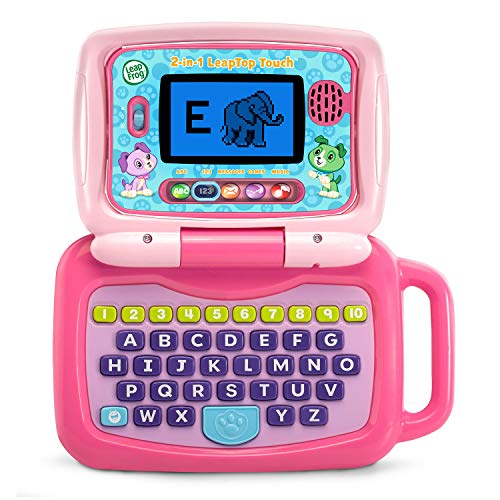


LeapFrog 2-in-1 LeapTop Touch, Pink
- 2-in-1 laptop toy for preschoolers features a screen that flips to convert from keyboard to tablet mode
- Learning laptop features a keyboard with letters A-Z and numbers 1-10, or swivel and transform it into a touch
- Five learning modes include ABCs, numbers, games, music and messages
Conclusion
Three is a year of magnificent questions, wild imagination, and a hunger to understand everything. You don't need a perfectly curated activity schedule or an expensive curriculum — you need curiosity of your own, a willingness to get on the floor, and the knowledge that the ordinary moments (counting the stairs, talking through a picture book, letting them pour their own water) are where the real development happens.
As the Harvard Center on the Developing Child reminds us, it's the quality of everyday interactions — not the quantity of toys — that shapes a child's lifelong learning architecture.
Save this guide, share it with your co-parent or childminder, and revisit it as your child grows. The activities that feel too easy today will look remarkably different in six months.
Sources & References
- Centers for Disease Control and Prevention (CDC). "Developmental Milestones: 3 Years." 2024. https://www.cdc.gov/ncbddd/actearly/milestones/milestones-3yr.html
- American Academy of Pediatrics (AAP). "Reading Aloud to Children: The Evidence." Pediatrics, 2014. https://publications.aap.org/pediatrics/article/134/2/404/32801
- American Academy of Pediatrics (AAP). "Media and Young Minds." Pediatrics, 2016. https://publications.aap.org/pediatrics/article/138/5/e20162591/60503
- National Association for the Education of Young Children (NAEYC). "Math in the Early Years." 2022. https://www.naeyc.org/resources/topics/math
- Harvard University Center on the Developing Child. "Serve and Return." 2023. https://developingchild.harvard.edu/science/key-concepts/serve-and-return/
- National Reading Panel. "Teaching Children to Read: An Evidence-Based Assessment." U.S. Department of Health and Human Services, 2000.
- American Psychological Association. "The Importance of Play in Promoting Healthy Child Development." 2007. https://www.apa.org/pubs/journals/releases/amp-624598.pdf
- World Health Organization (WHO). "Guidelines on Physical Activity, Sedentary Behaviour and Sleep for Children Under 5 Years of Age." 2019. https://www.who.int/publications/i/item/9789241550536
Frequently Asked Questions
At what age should I start structured learning activities with my toddler?
How much screen time is appropriate for a 3-year-old?
My 3-year-old won't sit still for any activity. Is something wrong?
Should I be worried if my 3-year-old isn't interested in letters yet?
How do I encourage sharing without forcing it?
Are Montessori-style toys worth the investment at age 3?
How do I make learning activities fun when my toddler just wants to play?
Was this helpful?
Thanks — your feedback helps us pick what to write next.