Physical Development: From Sitter to Mover
Between 7 and 9 months, your baby moves through one of the most dramatic developmental leaps of their first year — gaining mobility, deepening emotional bonds, and laying the groundwork for language, all within just 12 weeks.
In this article
Picture this: you set your baby down on the play mat, turn to grab your coffee, and look back to find them halfway across the room. Somehow, between last Tuesday and right now, they figured out how to move. That moment — equal parts pride and mild panic — is the 7-to-9-month window in a nutshell.
This three-month stretch is one of the most milestone-dense periods in all of childhood. According to the Centers for Disease Control and Prevention (CDC), the 9-month well-child visit is one of the most clinically significant in the first year precisely because so many developmental domains converge at once: gross motor, fine motor, cognition, communication, and social-emotional skills are all in rapid flux simultaneously.
In this guide, you'll understand:
1. Physical Development: From Sitter to Mover
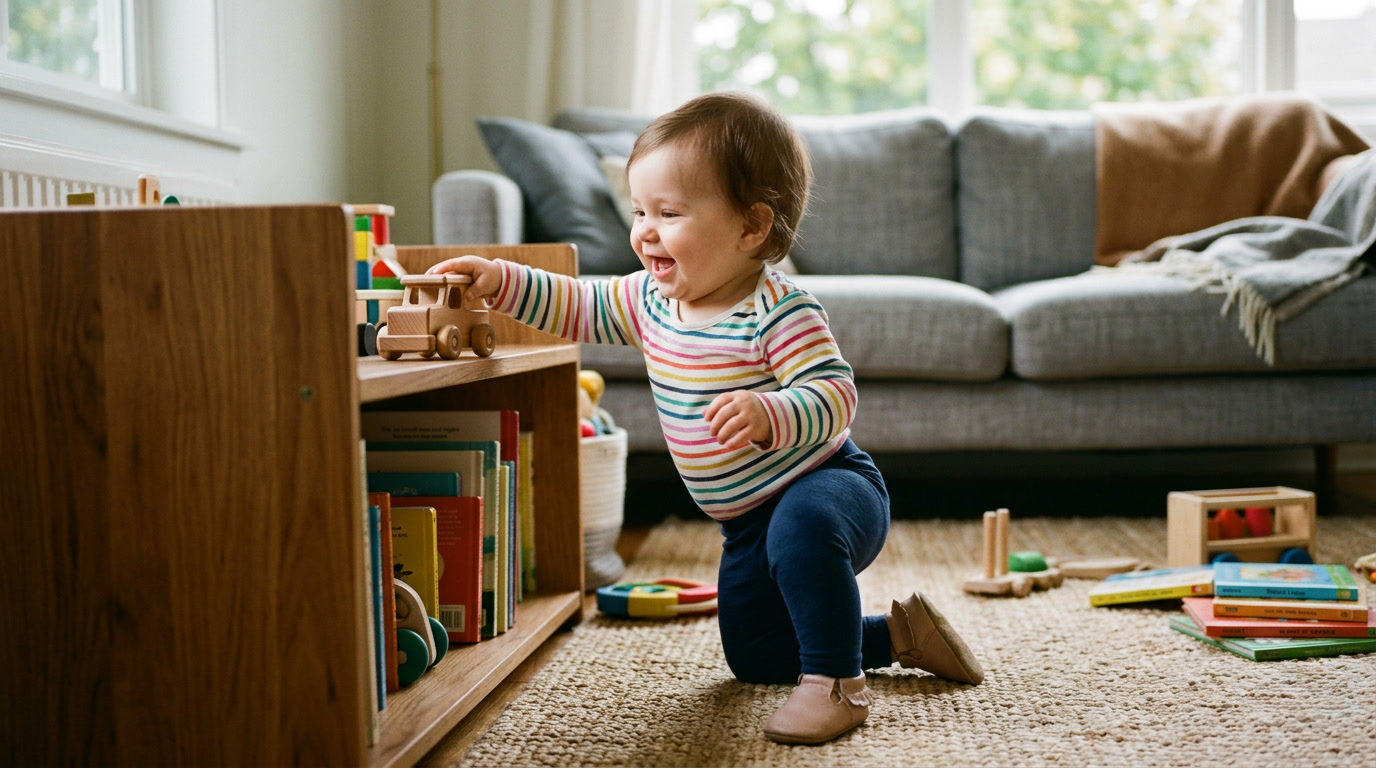
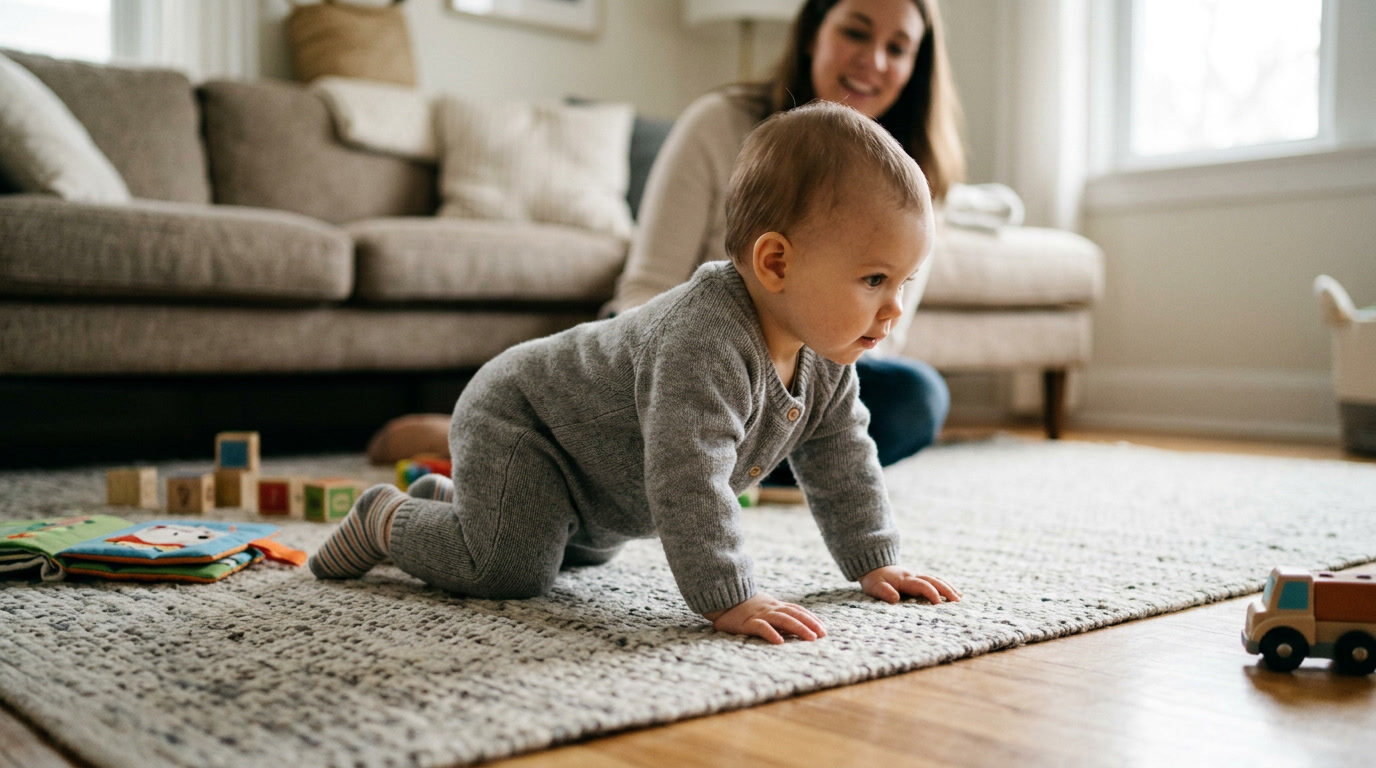
Your baby's body is doing something extraordinary right now: building the muscular control needed to defy gravity. By 7 months most babies can sit steadily without support, and by 9 months the majority are crawling, cruising along furniture, or experimenting with standing while holding on.
Gross Motor Milestones to Watch For
Fine Motor Milestones
Tummy Time Still Matters
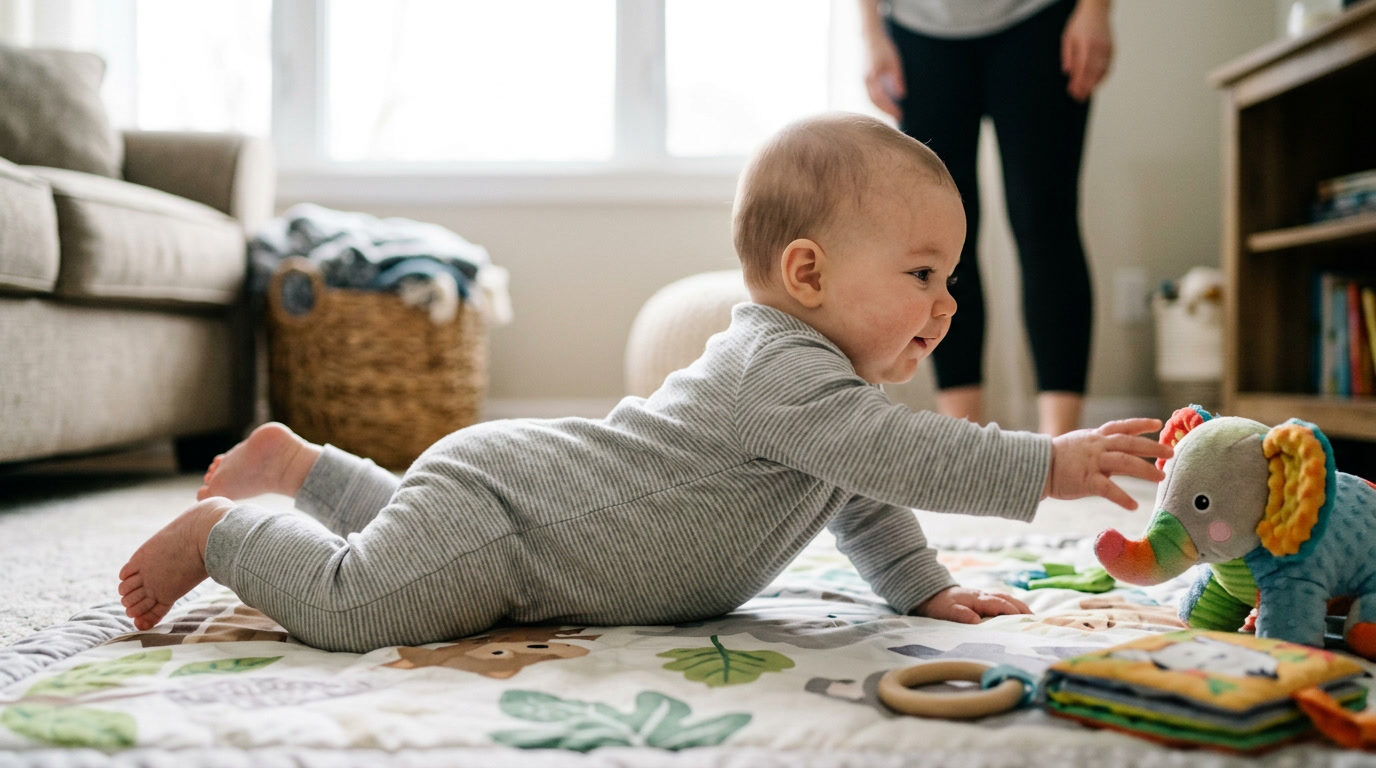
Even once your baby is sitting and crawling, daily tummy time continues to strengthen the neck, shoulder, and core muscles that support everything from standing to feeding. Aim for short, frequent sessions — even 3–5 minutes several times a day adds up.
A self-propelled toy like the GMAOPHY Musical Crawling Ladybug is a clever way to motivate reluctant crawlers: its 360° movement gives babies a moving target to chase, naturally encouraging them to push forward on all fours.

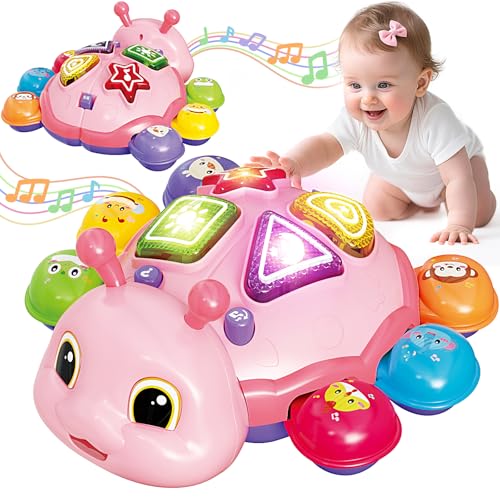
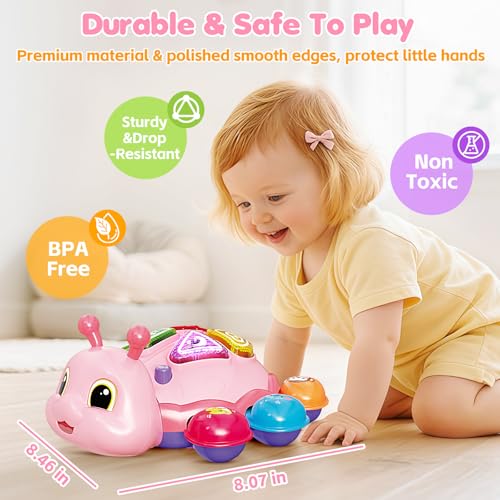
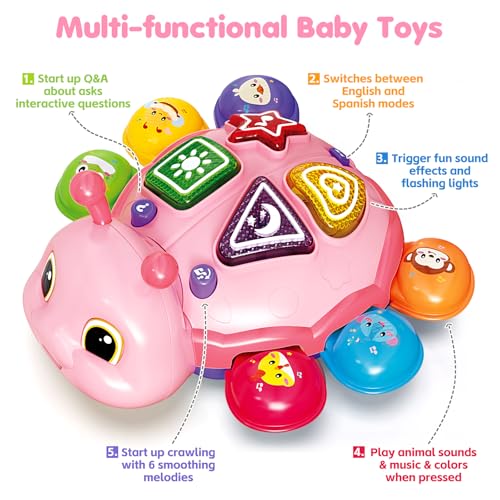
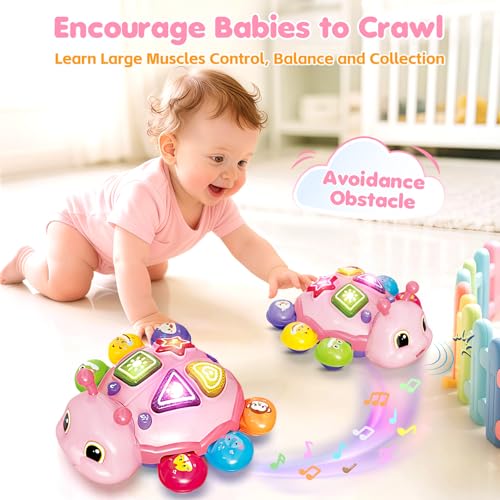
Baby Crawling Toys for 6-12 Months, Musical Toys for Infants 7 8 9 10 11 Months, Early Learning Educational Toy with Sound, Tummy Time Development Toys, Christmas Birthday Gifts for 1 Year Old, Pink
- Baby Crawling Encourage Baby to Crawl or Sit Up: The Musical ladybug toy for babies 6-12 months is smart and m
- Bilingual Interactive Toy: Our ladybug baby toy is super cool because it helps little ones learn in both Engli
- Infant Light-Up Musical Toys: This little beetle crawls around, sings, lights up. With its cool obstacle-avoid
When to flag it: If your baby cannot sit with minimal support by 9 months, shows no interest in weight-bearing on their legs, or has not begun some form of intentional movement, mention it at your next well-child visit — or call sooner if you're concerned.
2. Cognitive Development: The World Becomes a Puzzle
Your baby's brain is now processing the world with a new operating principle: things still exist even when you can't see them. This concept — object permanence — typically emerges between 6 and 9 months and changes everything about how your baby plays and thinks.
What Object Permanence Actually Looks Like
Before this shift, "out of sight" genuinely meant "out of existence" for your baby. Now, if you hide a toy under a cloth, they'll lift the cloth to find it. If you leave the room, they know you still exist somewhere — which is precisely why they protest.
Infants between 8 and 12 months begin to demonstrate A-not-B search behaviour, actively searching for hidden objects and showing surprise when those objects are not where they expected them to be.
— American Psychological Association, Developmental Psychology Review (2019)
Cause-and-Effect Thinking
Alongside object permanence, your baby is running constant experiments:
This is not random. It is early scientific reasoning, and it deserves your encouragement.
Open-ended sensory play supports this beautifully. The YOGINGO Baby Tissue Box Toy mimics the deeply satisfying cause-and-effect loop babies crave: pull a scarf out, another appears. It also builds fine motor control and colour recognition simultaneously.

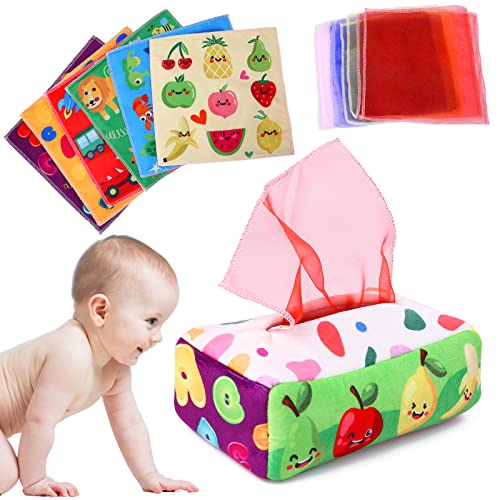


YOGINGO Baby Toys 6 to 12 Months - Tissue Box Toy Montessori for Babies 6-12 Months, Soft Stuffed High Contrast Crinkle Infant Sensory Toys, Boys&Girls Kids Early Learning Gifts
- 【✅Fun Montessori Sensory Toys】Fabric tissue box is a sensory early development toy for infants and toddlers, b
- 【✅Learning Toys Box for baby】Our baby tissue box toy provides 3 multi-themed crinkle papers & 8 colorful silk
- 【✅Safe Material for Babies】Babies usually like to put everything into their mouths, to protect the safety of b
A multi-activity set like the Somastung 6-in-1 Montessori Toy Set — with stacking rings, sorting shapes, and a suction-cup spinner — gives your baby several different cause-and-effect puzzles to work through as their abilities grow across these three months.
3. Emotional and Social Development: Attachment in Action
The emotional landscape between 7 and 9 months is richer — and more intense — than most parents expect. Your baby is not becoming "clingy" in a problematic sense; they are becoming securely attached, which is exactly what healthy development looks like.
Stranger Anxiety and Separation Distress
Between 8 and 10 months, most babies develop a clear preference for familiar caregivers and a wariness of unfamiliar faces. This is called stranger anxiety, and it emerges because your baby now has a mental model of who belongs in their world — a genuine cognitive achievement dressed up as inconvenient crying.
Separation anxiety — the distress when you leave the room — peaks around 9–10 months and can persist into toddlerhood. It is directly linked to the development of object permanence: your baby knows you exist somewhere, and they want you there.
What You Can Do
When to flag it: If your baby shows no preference for familiar caregivers over strangers by 9 months, or does not respond to their own name when called, raise this at your next paediatric appointment.
4. Speech and Language: Babbling With Purpose
Your baby won't say their first recognisable word until around 10–14 months on average, but the language architecture being built right now is what makes that word possible. The 7-to-9-month window is when babbling becomes genuinely sophisticated.
What to Listen For
By 9 months, infants are beginning to narrow their phonetic perception to the sounds of their native language, a process sometimes called 'perceptual narrowing.' This is why early, rich language exposure matters so much.
— National Institute on Deafness and Other Communication Disorders (NIDCD) (2022)
How to Support Language Development
The single most evidence-backed strategy is also the most natural: talk to your baby constantly. Narrate your day. Name objects. Respond to their babble as if it were a real conversational turn — because neurologically, it is.
When to flag it: If your baby is not babbling at all by 9 months, is not responding to their name, or seems not to be tracking sounds and voices, discuss this with your paediatrician. Early speech-language referral is always worth pursuing if there's doubt.
5. Health and Nutrition: Feeding a Baby on the Move
Between 7 and 9 months, breast milk or infant formula remains the primary nutrition source — but solid foods are becoming increasingly important, both nutritionally and developmentally. The American Academy of Pediatrics (AAP) recommends continuing breast milk or formula as the primary drink through 12 months, with solids introduced from around 6 months.
Where Most Babies Are at 7–9 Months
Key Nutrients to Prioritise
Iron is the nutrient most likely to be insufficient at this age. Breast milk is relatively low in iron, and babies' foetal iron stores begin to deplete around 6 months. Offer iron-rich foods at every meal: meat, poultry, fish, lentils, fortified cereals, and leafy greens.
Zinc, vitamin D, and healthy fats (from avocado, oily fish, full-fat dairy) are also important for brain development and immune function.
Common concerns at this stage:
When to flag it: Poor weight gain, persistent vomiting after feeds, or a baby who refuses all solids by 9 months warrants a conversation with your paediatrician or a paediatric dietitian.
6. Play and Learning: Choosing Toys That Actually Develop Skills
The best toys for 7-to-9-month-olds are open-ended, sensory-rich, and just challenging enough to require effort without causing frustration. Here's a practical breakdown of what works at this stage — and why.
| Toy Type | Developmental Target | Best For | Main Limitation | Recommended Product | Price |
|---|---|---|---|---|---|
| Stacking rings | Fine motor, hand-eye coordination, cause-and-effect | 6–12 months | Limited play variety long-term | Sassy Stacks of Circles Ring Set | ~$10 |
| Sensory tissue box | Fine motor, curiosity, sensory exploration | 6–18 months | No gross motor element | hahaland Baby Tissue Box Toy | ~$17 |
| Multi-activity Montessori set | Cognitive flexibility, sorting, shape recognition | 6–18 months | Higher cost | Smallzi 6-in-1 Montessori Set | ~$26 |
| Crawling-motivation toy | Gross motor, spatial awareness, auditory stimulation | 6–12 months | Requires floor space | GMAOPHY Musical Crawling Ladybug | ~$27 |
| Stacking/sorting combo set | Shape sorting, stacking, teething, cognitive | 6–18 months | More pieces to manage | Somastung 6-in-1 Montessori Set | ~$35 |
| Fabric sensory box | Sensory, colour recognition, fine motor | 6–18 months | Less durable than hard toys | YOGINGO Baby Tissue Box Toy | ~$10 |


hahaland Baby Tissue Box Toy - Baby Toys 6-12 Months Montessori Toys for 6 Month Old Must Haves - Babies Boy Girl Gifts 6 7 8 9 10 12 Month Old Sensory Pulling Play Scarf Toys 1 Year Old Birthday Gift
- INCLUDED EVERYTHING BABY WOULD ACTUALLY LOVE - This toy set includes a soft tissue box, 3 different textured &
- ENHANCE FINE MOTOR SKILLS & CURIOSITY - It offers various ways for babies to explore, allowing them to easily
- DIFFERENT TEXTURES, FUN SOUNDS & BRIGHT COLORS - The toy offers a captivating multi-sensory experience with it
The Sassy Stacks of Circles Ring Set deserves a special mention: with nearly 65,000 reviews and a 4.8-star rating, it remains one of the most enduring infant toys on the market for good reason. Each ring has a different texture and weight, which means your baby is processing sensory information and building fine motor control simultaneously.


Sassy Stacks of Circles Stacking Ring STEM Learning Toy, Age 6+ Months, Multi, 9 Piece Set
- Straight post accepts different sized rings, strengthening hand-eye coordination
- Chunky rings make it easy for baby to grasp, strengthening fine motor skills
- Each ring features a different texture and weight; Textural variety is great for mouthing.
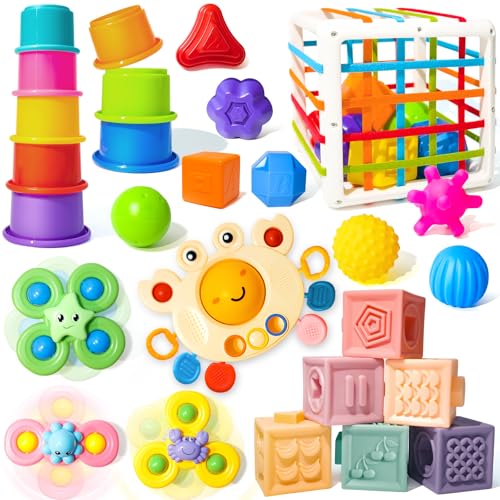


Montessori Toys for Babies 0-3-6-12 Months, 6 in 1 Baby Toys 4 5 6 7 8 9 Month Old, Baby Blocks Stacking Toys, Infant Baby Sensory Development Learning Toys Gifts for 1 2 3 Year Old Boys Girls
- 6 IN 1 MONTESSORI BABY TOYS - Give your baby the best start in life with our specially designed infant toys se
- YOUR BABY'S SAFETY IS OUR TOP PRIORITY - Worried about baby teether toys not being safe for babies? No more wo
- BEST BABY GIFTS FOR GROWING - Searching for the perfect baby Boy/Girl gifts for toddlers' Birthdays, Christmas
Expert Insights
There is a particular quality to these three months that parents often describe only in retrospect: the feeling that your baby went from being someone you cared for to someone who is actively, unmistakably engaging with you. They reach for your face. They laugh at your jokes. They cry when you leave and light up when you return. That is not incidental — it is the architecture of attachment being built in real time, and you are the most important part of it.
The milestones matter, the nutrition matters, the toys matter — but what matters most is the ordinary magic of showing up: talking, playing, responding, and being present. That is what your baby's brain is built for, and you are already doing it.
If this guide helped, save it for the months ahead — and share it with another parent who's in the thick of this beautiful, bewildering season.
Sources & References
- Centers for Disease Control and Prevention (CDC). "Developmental Milestones: 9 Months." 2023. https://www.cdc.gov/ncbddd/actearly/milestones/milestones-9mo.html
- American Academy of Pediatrics (AAP). "Infant Food and Feeding." 2023. https://www.aap.org/en/patient-care/healthy-active-living-for-families/infant-food-and-feeding/
- National Institute on Deafness and Other Communication Disorders (NIDCD). "Speech and Language Developmental Milestones." 2022. https://www.nidcd.nih.gov/health/speech-and-language
- Harvard University Center on the Developing Child. "Serve and Return Interaction Shapes Brain Circuitry." 2023. https://developingchild.harvard.edu/science/key-concepts/serve-and-return/
- American Academy of Pediatrics (AAP). "Vitamin D & Iron Supplements for Babies: AAP Recommendations." 2022. https://www.healthychildren.org/English/ages-stages/baby/feeding-nutrition/Pages/Vitamin-Iron-Supplements.aspx
- World Health Organization (WHO). "Infant and Young Child Feeding." 2023. https://www.who.int/news-room/fact-sheets/detail/infant-and-young-child-feeding
- Pathways.org. "7–9 Month Motor Milestones." 2023. https://pathways.org/growth-development/7-9-months/moves/
- Pathways.org. "7–9 Month Communication Milestones." 2023. https://pathways.org/growth-development/7-9-months/communicates/
Frequently Asked Questions
When should my baby start crawling?
When should my baby start crawling?
Is stranger anxiety normal at 8 months?
How much solid food should a 7-month-old eat?
My baby isn't babbling much. Should I be worried?
What are the best toys for a 7-to-9-month-old?
How do I know if my baby's development is on track at 9 months?
Should I be concerned about my baby's weight gain between 7 and 9 months?
Was this helpful?
Thanks — your feedback helps us pick what to write next.