Why STEM Education Matters More Than Ever Right Now
STEM education — Science, Technology, Engineering, and Mathematics — builds the thinking skills children need for a fast-changing world, and it works best when it starts early, stays playful, and grows with your child from toddlerhood through the teen years.

In this article
Why STEM Education Matters More Than Ever Right Now
Picture a five-year-old who insists on knowing why the ice cube melts, how the light switch works, and what would happen if she added more baking soda to the vinegar. That child is already doing STEM. The question is whether the adults around her will fan that flame — or accidentally let it go out.
According to the U.S. Bureau of Labor Statistics, STEM occupations are projected to grow roughly twice as fast as all other occupations through 2031. But here's what that statistic misses: STEM education isn't just job prep. The World Economic Forum consistently ranks complex problem-solving, critical thinking, and creativity among the top skills every future worker will need — skills that STEM learning builds from the very first block tower.
In this guide you'll find:
1. What STEM Education Actually Means (and Why It's Not Just "Science Class")
STEM is an interdisciplinary way of learning — not four separate subjects bolted together. At its best, a single STEM activity weaves all four strands at once: a child designing a bridge (engineering) has to measure materials (mathematics), test whether it holds weight (science), and sometimes use a digital tool to document results (technology).
The four strands, plainly explained
- Science — observing the natural world, asking questions, forming hypotheses, and testing them. Think: "Why does the plant grow toward the window?" - Technology — using and creating tools, from a simple lever to a line of code. It's not just screens; a pulley is technology. - Engineering — the design-and-build loop: identify a problem → brainstorm → build → test → improve. Lego towers and cardboard-box robots both count. - Mathematics — the shared language of the other three. Counting, measuring, pattern-spotting, and data reading underpin every STEM activity.
You'll also hear STEAM (adding Arts) and STREAM (adding Reading). Both are legitimate expansions. Arts integration, in particular, has strong evidence behind it: design thinking and creative problem-solving are core engineering skills, not extras.
2. The Right Age to Start: A Stage-by-Stage Roadmap (Birth to 17)
You can begin STEM-friendly interactions from day one — and you don't need a kit to do it.
Babies and toddlers (0–3): Cause and effect is the whole curriculum
Infants are natural scientists. Every time your baby drops a spoon from the high chair and watches you pick it up, she's running a physics experiment with a very reliable test subject (you). The American Academy of Pediatrics (AAP) emphasises that sensory-rich play in the first three years directly supports cognitive development, including early mathematical and scientific reasoning.
Early childhood (3–7): The golden window for curiosity
Research published in Child Development and cited by the National Science Foundation identifies ages 3–7 as a particularly sensitive period for scientific thinking — children this age spontaneously generate hypotheses and test them during free play. This is the age to introduce structured-but-playful STEM activities.


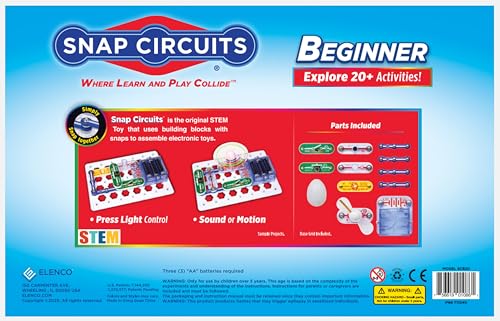


Snap Circuits Beginner, Electronics Exploration Kit, Stem Kit for Ages 5-9 (SCB-20)
- SO MANY TOYS IN A SNAP: A safe and fun way to introduce children ages 5+ to electrical engineeing! The child-f
- SAFE FOR YOUNGER KIDS The Snap Circuits Beginner is the perfect way to introduce children starting at age 5 to
- EXPERIMENTS THEY'LL LOVE The Beginner kit includes hours of wonder-inspiring experiments! Children will learn
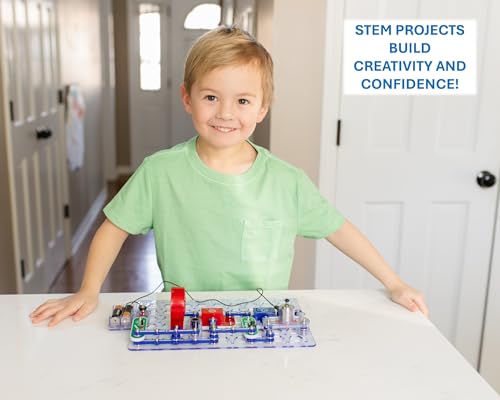
The Snap Circuits Beginner Kit is purpose-built for this window: simple enough for a five-year-old, satisfying enough to hold attention across 21 projects. Seeing a light actually turn on because of a circuit they built is a formative "I can do this" moment.
Middle childhood (8–12): Projects, depth, and real stakes
Children in this band can handle multi-step projects, abstract concepts, and genuine failure. This is when STEM kits with real components — circuits, motors, chemistry sets — pay off most. They're also ready to understand that STEM connects to real-world problems: climate, disease, food supply.

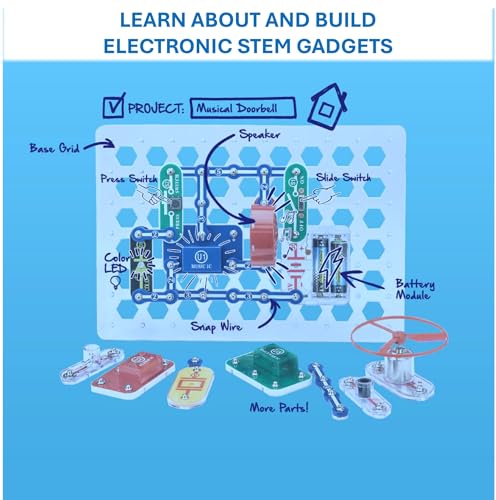
Snap Circuits Jr. SC-100 Electronics Exploration Kit, Over 100 Projects, Full Color Project Manual, 28 Parts, STEM Educational Toy for Kids 8 +
- SO MANY TOYS IN A SNAP: Make dozens of cool electronic gadgets - all from one box! A safe and fun way to intro
- PROJECTS THEY'LL LOVE: So many fun electric-powered projects you can make and play! Ages 8 to 108 will love bu
- GREAT GIFT Give the gift of learning and fun this holiday season! Snap Circuits kits will keep kids busy and h
The Snap Circuits Jr. SC-100 steps up from the beginner version with 100+ projects and genuine electronics concepts. Pair it with a root-viewer gardening kit to cover the biology side: the Root Viewer Kit by PLANTMEW lets children watch six different seed varieties germinate underground in real time — a living experiment that runs for weeks.
Tweens and teens (12–17): Identity, application, and career awareness
Adolescents need STEM to feel meaningful and chosen, not imposed. The risk at this age is that earlier gaps in confidence — especially for girls and underrepresented groups — solidify into "I'm just not a math person." Hands-on, creative projects counter that narrative.
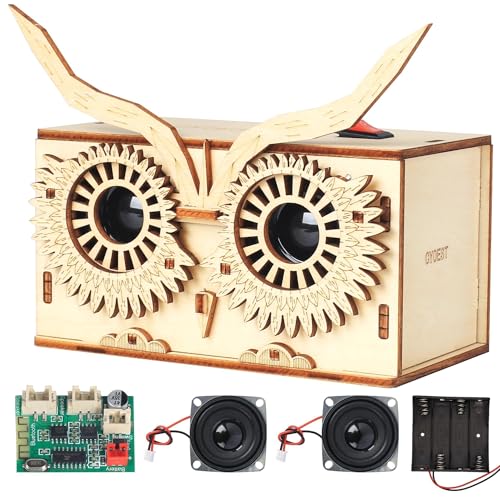
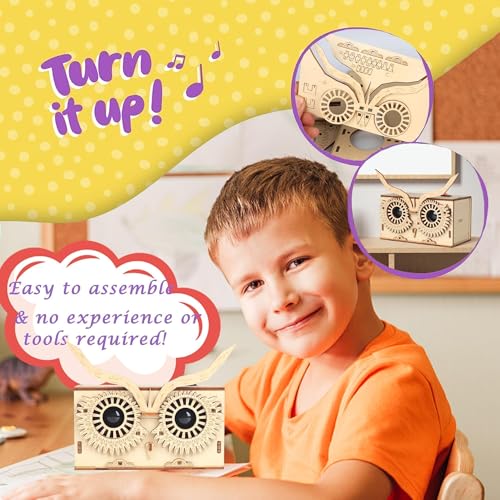
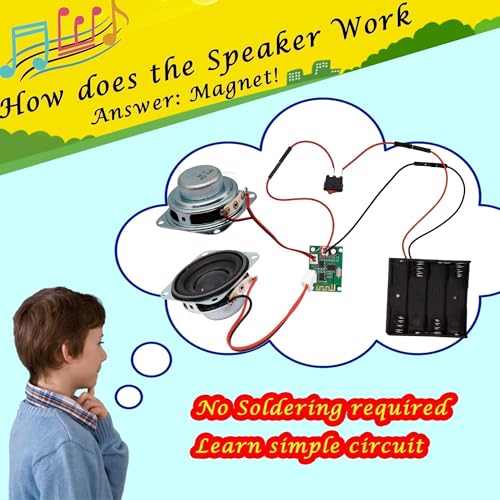
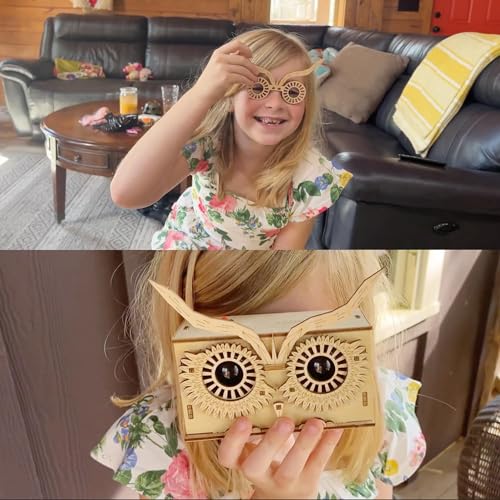
DIY Bluetooth Speaker Kit, Stem Projects for Kids Ages 8-12, Science Kits for Kids Age 12-14, STEM Learning Project, Science Gift for Boys Teens Age 10 11 12 13 14 15 16
- Discover the World of Sound with Owl Bluetooth Speaker Kit: Explore audio technology with our Owl Bluetooth Sp
- Safe STEM Project for Kids: Safety is our priority. Our Owl Bluetooth Speaker Kit uses quality components, inc
- Suitable Gift Choice for All Teens: Stylish and practical, our Owl Bluetooth Speaker Kit makes a unique gift f
The DIY Bluetooth Speaker Kit by SCAEMO is a strong fit here: teens build a working speaker from components, learning about circuits, acoustics, and electronics — and end up with something genuinely cool they made themselves. That ownership matters enormously at this age.
3. STEM at Home: Everyday Moments You're Probably Already Missing
You don't need to buy anything to do STEM at home. The kitchen, garden, and bathroom are fully equipped laboratories.
Science in the kitchen
Cooking is applied chemistry. Why does bread rise? What happens when you add acid (lemon juice) to milk? Let your child predict, observe, and explain.Engineering in the living room
Give your child a pile of cardboard, tape, and a challenge: "Build something that holds five books." The design loop — plan, build, test, improve — is pure engineering.Technology without screens
Programming thinking doesn't require a computer. Write a "robot recipe" for making a sandwich (every step must be explicit — robots don't infer). This teaches algorithmic thinking.Mathematics everywhere
Baking (fractions), grocery shopping (estimation, comparison), sport (statistics, geometry) — maths is already woven into daily life. Pointing it out is the intervention.For screen-free structured STEM play, the Learning Resources STEM Explorers Pixel Art Challenge is excellent: it teaches coding concepts and spatial reasoning through tactile pixel-art building — no device required.
4. Choosing STEM Toys and Kits That Actually Deliver
The STEM toy market is enormous and uneven. Some kits genuinely build skills; others slap "STEM" on the box and deliver little more than a colouring activity.

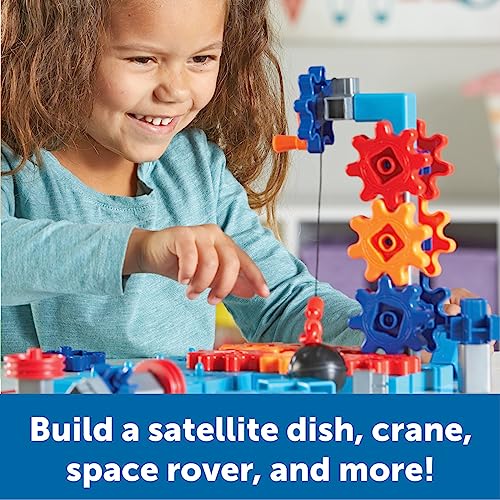
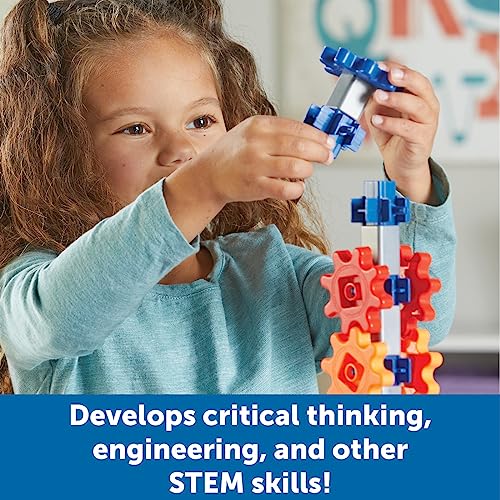
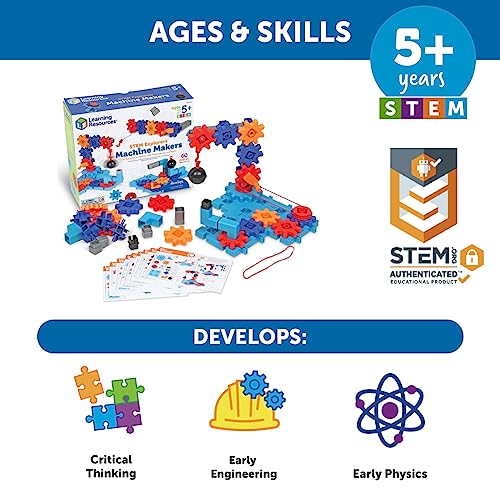
Learning Resources STEM Explorers Machine Makers - 60 Pieces, Ages 5+, Building Montessori Toys, Engineering Activities, Fine Motor Skills
- Solve STEM Challenges: Kids build their own twisting, turning machines as they solve this STEM building toy’s
- Inspired By Real-World Engineering: Whether they're building a satellite dish, crane, space rover, or other ma
- Build Critical Thinking Skills: As they test and tweak their designs, kids will also use this STEM building to
Look for kits that include open-ended challenges, not just step-by-step assembly. The Learning Resources STEM Explorers Machine Makers set, for example, presents nine engineering challenges — children have to figure out how to build a crane or satellite dish, not just follow a diagram. That problem-solving gap is where the real learning happens.
What to look for on the label
What to skip
- Kits that are 95% assembly and 5% play - "Educational" apps with passive video content dressed as interactivity - Toys that do the impressive thing for the child rather than with them
| STEM Kit / Activity | Best Age Range | Primary STEM Focus | Key Benefit | Recommended Product | Price |
|---|---|---|---|---|---|
| Beginner circuits kit | 5–9 years | Technology / Engineering | Safe intro to real electronics | Snap Circuits Beginner SCB-20 | $19.99 |
| Advanced circuits kit | 8–12 years | Technology / Engineering | 100+ projects, grows with child | Snap Circuits Jr. SC-100 | $26.99 |
| Pixel art / coding concepts | 5–10 years | Maths / Technology | Screen-free coding logic, fine motor | STEM Explorers Pixel Art Challenge | $20.28 |
| Root viewer gardening kit | 5–12 years | Science (Biology) | Real-world botany, patience, observation | Root Viewer Kit by PLANTMEW | $19.95 |
| Machine builders set | 5–10 years | Engineering / Physics | Open-ended design challenges | STEM Explorers Machine Makers | $24.99 |
| DIY Bluetooth speaker | 10–16 years | Technology / Physics | Teen-relevant, functional end product | DIY Bluetooth Speaker Kit | $9.99 |
5. Closing the STEM Gap: Gender, Equity, and What Parents Can Do
Girls and children from lower-income households are still underrepresented in STEM careers — not because of ability, but because of access, messaging, and confidence.
What research tells us about closing the gap
The AAUW's landmark report Why So Few? (2010, updated findings ongoing) identified specific, actionable factors:
6. The Future of STEM Education: What's Coming and How to Prepare Your Child
STEM education is not static. Several shifts are already reshaping what children will need to know.
Coding is becoming foundational literacy
More than 70 countries now include coding in their national school curricula, according to the OECD. But coding education is most effective when it starts with computational thinking — logic, sequencing, decomposition — before syntax. The Pixel Art Challenge approach (physical, sequential, pattern-based) is exactly this kind of early foundation.
AI literacy is the new frontier
Children entering primary school today will work alongside artificial intelligence tools throughout their careers. The goal isn't to fear AI or worship it — it's to understand it well enough to use it critically and ethically. This starts with simple conversations: "How do you think the app knew what song you'd like?"
STEAM integration is growing
Arts integration in STEM — design thinking, creative prototyping, visual communication — is increasingly recognised as essential rather than supplementary. Schools adopting STEAM models report stronger engagement, particularly among students who previously felt excluded from STEM.
Expert Insights
Every Discovery Starts at Home
The most powerful STEM laboratory your child will ever have access to is the one they live in — a home where questions are welcomed, mistakes are analysed rather than punished, and curiosity is treated as the asset it truly is.
You don't need a science degree. You don't need a dedicated playroom. You need to pause when your child asks "why," and say "let's find out" more often than you say "because that's just how it is."
The innovators of tomorrow aren't being built in classrooms alone — they're being built at kitchen tables, in back gardens, and in the small moments when a caring adult treats a child's question as worth taking seriously.
Save this guide, share it with your co-parent or childminder, and revisit it as your child grows — the section that matters most will change with every birthday.
Sources & References
- U.S. Bureau of Labor Statistics. "STEM Occupations: Past, Present, and Future." Occupational Outlook Quarterly, 2023. https://www.bls.gov/opub/btn/volume-6/stem-crisis-or-stem-surplus-yes-and-yes.htm
- World Economic Forum. "Future of Jobs Report 2023." https://www.weforum.org/reports/the-future-of-jobs-report-2023/
- American Academy of Pediatrics. "The Power of Play: A Pediatric Role in Enhancing Development in Young Children." Pediatrics, 2018. https://doi.org/10.1542/peds.2018-2058
- American Association of University Women (AAUW). "Why So Few? Women in Science, Technology, Engineering and Mathematics." 2010 (findings updated). https://www.aauw.org/resources/research/why-so-few/
- Levine, S.C., et al. "Early Puzzle Play: A Predictor of Preschoolers' Spatial Transformation Skill." Developmental Psychology, 2012. https://doi.org/10.1037/a0025913
- Gunderson, E.A., et al. "Parent Praise to 1- to 3-Year-Olds Predicts Children's Motivational Frameworks 5 Years Later." Child Development, 2013. https://doi.org/10.1111/cdev.12064
- OECD. "PISA 2022 Results: Creative Minds, Creative Schools." 2023. https://www.oecd.org/pisa/
- Darling-Hammond, L. "Powerful Learning: What We Know About Teaching for Understanding." Jossey-Bass / Learning Policy Institute, 2008.
- Vandermaas-Peeler, M., et al. "Parental Guidance with Scientific Inquiry in Early Childhood." Journal of Applied Developmental Psychology, 2018. https://doi.org/10.1016/j.appdev.2018.01.006
Frequently Asked Questions
At what age should I start STEM education with my child?
Does my child need expensive kits to benefit from STEM learning?
My daughter says she's "not a science person." What do I do?
How is STEM different from STEAM?
How much screen time is appropriate for technology-based STEM learning?
What STEM skills are most important for future careers?
How can I support STEM learning if I'm not confident in these subjects myself?
Was this helpful?
Thanks — your feedback helps us pick what to write next.