Unstructured Play and IQ: What the Science Actually Shows
Unstructured, child led play is one of the most powerful and underused tools for building intelligence, creativity, and emotional resilience across every stage of childhood.
In this article
Here is a number that should stop you mid-scroll: the American Academy of Pediatrics (AAP) reports that the time children spend in free, unstructured play dropped by more than 50 percent between 1981 and 2003, and the decline has continued since. We have filled that gap with tutoring, organised sports, screen time, and scheduled activities, all with the best intentions. Yet the neuroscience increasingly points in a different direction. The hours your child spends mucking around in the garden, building a fort, or inventing a game with no rules are not wasted time. They are, arguably, the most productive hours of the day.
In this article you will understand:
1. What Unstructured Play Actually Is (and What It Is Not)
Unstructured play is any activity that is self directed, spontaneous, and free from adult imposed rules or outcomes. The child chooses what to do, how to do it, and when to stop. Nobody is keeping score and nobody is teaching a lesson.
This is different from structured play (a football drill, a board game with fixed rules, a guided art class) and from free time spent consuming content passively (watching a video, scrolling through a tablet). Both of those have value in the right doses, but neither produces the neurological effects of genuine free play.
What counts as unstructured play?
What these activities share is that the child is the author. The moment an adult says "now build a bridge" or "let's see who can stack the most blocks," it shifts from unstructured to structured. Both have a place, but they are not the same thing neurologically.


MIKNEKE 81 Wooden Loose Parts Sensory Bin Filler Toys, Mandala Rainbow Stacker Open Ended Toys, 27 Colors Sensory Training Educational Toys
- COLOR AND SHAPE RECOGNITION: 27 Colors 7 shapes Rainbow Mandala loose parts, allows children to design more cr
- OPEN-ENDED GAME: Let Kids give full play to their imagination and design various modelling without restriction
- ECO-FRIENDLY MATERIALS: Blocks are made from high-quality wood, all materials 100% non-toxic safety.
2. The Neuroscience: What Free Play Does to a Developing Brain
Free play lights up the prefrontal cortex, the region responsible for planning, impulse control, flexible thinking, and decision making. This is important because the prefrontal cortex is the last part of the brain to fully mature (not until the mid-twenties), which means it is exquisitely sensitive to the quality of experiences during childhood.
Research from the National Institute for Play, led by psychiatrist Stuart Brown, has shown that play activates the same neural circuits involved in positive risk taking, creativity, and social bonding. Separately, neuroscientist Jaak Panksepp's work on PLAY circuits in the mammalian brain demonstrated that the urge to play is a primary emotional drive, as fundamental as hunger or fear, and that suppressing it carries real cognitive costs.
Executive function is the real prize
When a child invents a scenario, they have to hold multiple ideas in mind at once (working memory), switch between roles (cognitive flexibility), and resist the urge to break their own story (inhibitory control). These three abilities together form what psychologists call executive function, and executive function in early childhood is one of the strongest predictors of academic achievement, earnings, and health outcomes in adult life, according to longitudinal data from the Harvard Center on the Developing Child.
The science of child development and the core capabilities of adults point to the same conclusion: providing children with safe, stable, nurturing relationships and environments is one of the most powerful things we can do both for their development and for the long term productivity of our society.
— Harvard Center on the Developing Child (2016)
Understanding how creative play physically builds the toddler brain helps explain why those apparently aimless afternoons in the sandpit are doing more heavy lifting than any flashcard session.


Brain Flakes 500 Piece Set, Ages 3+, Interlocking Plastic Disc Toy for Creative Building, Educational STEM Learning, Construction Block Play for Kids, Teens, Adults, Boys, and Girls
- The Signature Yellow Cap Storage Jar - Contains 500+ pcs in 12 colors; Includes an idea booklet with instructi
- For Ages 3 to 99 - BRAIN FLAKES discs click together easily for children ages 3+; Aids in the development of f
- Why BRAIN FLAKES - A great STEM toy for developing spatial intelligence and thinking; Construct large structur
3. Age by Age: What Unstructured Play Looks Like From Birth to the Teens
The neuroscience applies across all ages, but the form free play takes changes dramatically. Here is a practical breakdown by stage.
Newborns and young babies (0 to 12 months)
Even in the first year, babies engage in proto-play. Kicking a mobile, batting at a hanging toy, and gazing at a caregiver's face while making sounds are all self directed exploratory behaviours. The key is "serve and return," the back and forth interaction the AAP identifies as the building block of brain architecture. You don't need to entertain your baby constantly; giving them a moment on their tummy with something interesting to look at is unstructured play at its earliest. Our guide to what builds baby's brain goes deeper on this if you want the detail.
Toddlers (1 to 3 years)
Toddlers are natural scientists. They drop things to see what happens, fill and empty containers, and test gravity repeatedly with zero interest in efficiency. Open ended materials work best here. Wooden rings, nesting cups, loose blocks, sand, water, and cardboard boxes all invite exploration without directing it.
Preschool and early school age (3 to 7 years)
This is peak pretend play territory. A cardboard box becomes a spaceship. A stick becomes a wand. The narrative complexity of pretend play at this age is staggering; children are simultaneously writing, directing, and acting in their own productions. Research from psychologist Paul Harris at Harvard shows that children who engage in rich pretend play develop stronger language skills and a more sophisticated understanding of other people's minds (theory of mind), which is the root of empathy.
Middle childhood (7 to 12 years)
At this age children can organise their own complex games, negotiate rules, resolve disputes, and manage the emotional intensity of competition. Physical outdoor play becomes especially important. Research published in the journal Pediatrics has linked regular outdoor free play to improved attention and reduced ADHD symptoms, independent of activity level.
Teenagers (13 to 17 years)
Free play doesn't disappear at adolescence; it transforms. Jamming with a band, writing fiction without a grade attached, building something in the garage, free running, or improvising in a drama group are all forms of unstructured play. The brain still needs self directed creative time, and teens who get it consistently report higher wellbeing and stronger intrinsic motivation at school.
4. How Unstructured Play Builds IQ (and What "IQ" Actually Means Here)
IQ is a narrow measure, but when researchers talk about play boosting intelligence they are pointing at something broader: cognitive flexibility, working memory, creative thinking, and the ability to transfer knowledge from one context to another. These are the real world skills that IQ tests partially capture.
A landmark study by researchers at the University of Colorado found that children with more unstructured time were significantly better at self directed executive function tasks than those with heavily scheduled days. The mechanism appears to be that when children manage their own time, set their own goals, and navigate their own problems, they strengthen the exact neural networks that underpin intelligent, adaptive behaviour.
The creativity connection
Creativity and intelligence are not the same thing, but they overlap substantially. Psychologist Kyung Hee Kim at William & Mary College analysed over 300,000 scores on the Torrance Tests of Creative Thinking and found a steady decline in children's creativity scores from 1990 to 2008, running parallel to the well documented decline in free play time. Causation is hard to prove cleanly, but the correlation is striking and the mechanistic explanation is plausible.
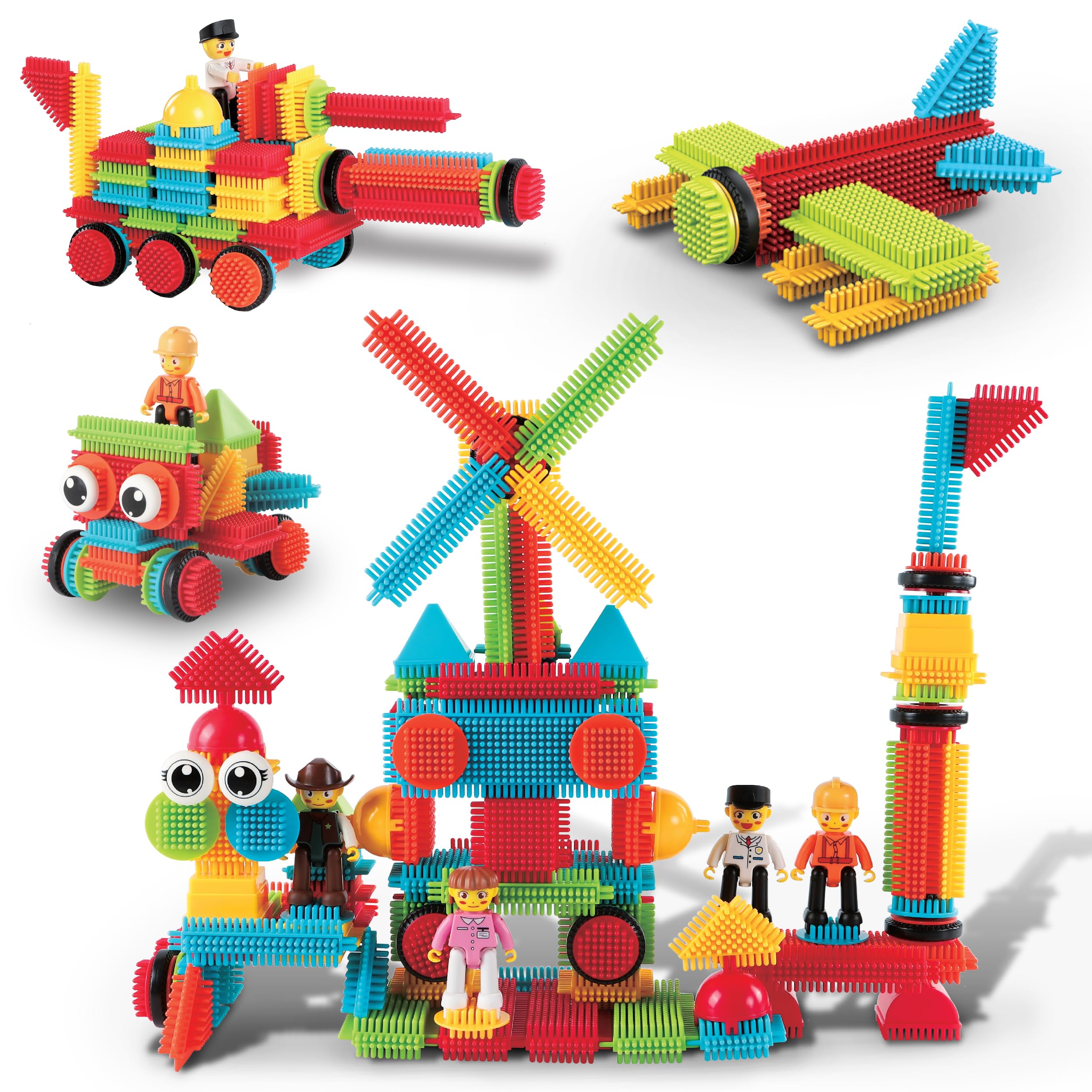
Open ended building materials are particularly effective here. A set of loose parts like the PicassoTiles Hedgehog Building Blocks or the LiKee Wooden Shape Puzzles invite open ended exploration precisely because there is no single right answer. The child is always the designer.


PicassoTiles 120pcs Hedgehog Interlocking Building Blocks Tiles Construction Toy Set Learning Playset STEAM Development Preschool Kindergarten Toy for Kids Age3+ PTB120
- FRUSTRATION-FREE BUILDING - PicassoTiles Hedgehog shape blocks offer easy connectivity and simple to disconnec
- EDUCATIONAL TOY - Never too early to start developing kids' creativity. Children can acquire strong sense of c
- LEARNING IS FUN - Encourage creativity for STEM (science, technology, engineering, art, and mathematics) educa
5. The Open Ended Materials Advantage
Not all toys are equal when it comes to supporting unstructured play. The research and clinical experience both point firmly toward open ended materials: things that can be used in multiple ways, that don't make sounds or flash lights to direct the child's attention, and that respond to the child's actions rather than driving them.
What makes a material "open ended"?
Classic examples include wooden blocks, loose parts (shells, pebbles, wooden shapes), play dough, sand and water, fabric, cardboard, and simple building systems. The Agirlgle Rainbow Stacking Rings exemplify this well: toddlers use them to sort by colour, older children use them to build patterns, and there is no instruction book telling them they are doing it wrong.
Why battery operated "educational" toys often underdeliver
Toys that play music, announce colours, or reward correct answers do the cognitive work for the child. The child becomes a passive recipient rather than an active problem solver. Professor Kathy Hirsh-Pasek at Temple University has demonstrated in multiple studies that infant directed toys with lots of electronic features actually produce less parent child conversation and less exploratory play than simple objects. Less conversation in play means slower language development. The packaging says "educational"; the science says open ended.


LiKee Open Ended Wooden Shape Puzzles (36 Blocks&60 Cards) for Toddlers 3+ Years Old, Montessori Development Toys Preschool Education Activity Travel Toy Board Games for Kids 4-8 Yrs
- Contains 36 wooden shape pieces, 60 pattern cards and 2 iron tins for storing the pieces
- kids can try to build what is shown on the cards or create their own designs
- Great for developing spatial awareness, color & shape recognition, hand-eye coordination, and problem-solving
6. Protecting Unstructured Play in a Structured World
This is the section parents find hardest, because the obstacles are real. Scheduling pressure, safety concerns about outdoor independence, screen time defaults, and the anxiety that unscheduled time is wasted time all work against free play.
How to defend free play time practically
Understanding how to cultivate curiosity in your child is the natural companion to protecting free play. Curiosity and open time reinforce each other.
Play is the work of childhood. It is not a break from learning; it is how children learn.


Montessori Toys Wooden Color Sorting Stacking Rings Toy Rainbow Wooden Peg Dolls Counting Toys Circular Building Blocks Stacking Game Preschool Learning Education Fine Motor Skill Toys for Toddlers
- EARLY LEARNING EDUCATIONAL TOY: Help your child develop fine motor skills, hand-eye coordination, and problem-
- ECO-FRIENDLY AND NON-TOXIC: Made from natural solid wood with non-toxic paint, our Color Sorting Toy is safe f
- SENSORY AND CREATIVE PLAY: This Wooden Toy provides hours of sensory play and encourages creativity and imagin
Unstructured Play vs Structured Activity: At a Glance
| Play Type | Best Age | Primary Cognitive Benefit | Main Limitation | Recommended Product | Price Range |
|---|---|---|---|---|---|
| Open ended building (blocks, loose parts) | 18 months onward | Spatial reasoning, problem solving, creative thinking | Requires some mess tolerance | LiKee Wooden Shape Puzzles | $8–13 |
| Pretend and role play | 2 to 8 years | Theory of mind, language, narrative thinking | Hard to sustain in small spaces | MIKNEKE Wooden Loose Parts | $23 |
| Outdoor free exploration | All ages | Attention, sensory integration, physical confidence | Weather and safety constraints | Brain Flakes 500 Piece Set | $20 |
| Open ended stacking and sorting | 12 months to 4 years | Fine motor skill, colour and pattern recognition | Less engaging for older children | Agirlgle Rainbow Stacking Rings | $33 |
| Construction and STEAM building | 3 years to teen | Spatial intelligence, persistence, collaboration | Can edge toward structured if rules are imposed | PicassoTiles Hedgehog Blocks | $21 |
| Mandala and pattern making | 3 years onward | Attention, creative expression, self regulation | Very open ended; some children want more direction initially | LiKee Wooden Puzzle Set 36 Blocks | $8 |
What the Experts Say
There is a quiet kind of confidence that builds in children who have spent years directing their own play. They know how to start something, how to adapt when it goes wrong, and how to find meaning in the process rather than just the outcome. That is not a soft skill. That is intelligence in its most useful form. The good news is that it does not require a programme, a curriculum, or an investment of anything except time and the willingness to step back. Give your child a box of open ended materials, a patch of outdoor space, and permission to be completely in charge. Then get out of the way. That is the whole intervention.
If this article was useful, save it, share it with another parent, or come back to it the next time you feel guilty about an afternoon of "doing nothing." Nothing is doing a lot.
Sources & References
- American Academy of Pediatrics. "The Importance of Play in Promoting Healthy Child Development and Maintaining Strong Parent-Child Bonds." Pediatrics, 2023. https://publications.aap.org
- Harvard Center on the Developing Child. "Building the Brain's 'Air Traffic Control' System: How Early Experiences Shape the Development of Executive Function." 2016. https://developingchild.harvard.edu
- Ginsburg, K.R. and the Committee on Communications, AAP. "The Importance of Play in Promoting Healthy Child Development." Pediatrics, 2007. Vol 119(1):182–191.
- Brown, Stuart. "Play: How It Shapes the Brain, Opens the Imagination, and Invigorates the Soul." Avery, 2009.
- Kim, Kyung Hee. "The Creativity Crisis: The Decrease in Creative Thinking Scores on the Torrance Tests of Creative Thinking." Creativity Research Journal, 2011. 23(4):285–295.
- Diamond, Adele. "Executive Functions." Annual Review of Psychology, 2013. 64:135–168.
- Hirsh-Pasek, Kathy et al. "Putting Education in 'Educational' Apps: Lessons From the Science of Learning." Psychological Science in the Public Interest, 2015. 16(1):3–34.
- Faber Taylor, Andrea and Kuo, Frances. "Children With Attention Deficits Concentrate Better After Walk in the Park." Journal of Attention Disorders, 2009. 12(5):402–409.
- Harris, Paul L. "The Work of the Imagination." Blackwell, 2000.
- Panksepp, Jaak. "Affective Neuroscience: The Foundations of Human and Animal Emotions." Oxford University Press, 1998.
Frequently Asked Questions
How much unstructured play does my child actually need each day?
Is outdoor play better than indoor play for brain development?
My child says they are bored during free play. Is that a problem?
Does screen time count as unstructured play?
Are expensive toys worth it for unstructured play?
How do I stop myself from jumping in and "helping" during free play?
Does unstructured play help children with attention difficulties or ADHD?
Was this helpful?
Thanks — your feedback helps us pick what to write next.