How Much Sleep Do 5–8 Year-Olds Actually Need?
Children aged 5–8 need 9–11 hours of sleep per night, and a consistent, dark, cool bedroom environment is the single most effective tool parents have to protect that sleep.
In this article
Picture this: it's 8:45 pm on a Tuesday. Your 7-year-old has had a drink of water, remembered a "very important" question about dinosaurs, and is now explaining why her foot itches. You've been trying to end the day for 45 minutes. Sound familiar?
You're not alone — and the stakes are real. According to the Centers for Disease Control and Prevention (CDC), more than one in three school-age children in the United States does not get enough sleep on school nights. Chronic short sleep at this age is linked to attention difficulties, emotional dysregulation, obesity risk, and weakened immune function.
The good news? Most sleep problems in 5–8 year-olds are solvable with environment, routine, and a little science on your side.
In this guide you'll understand:
1. How Much Sleep Do 5–8 Year-Olds Actually Need?
Your child needs between 9 and 11 hours of sleep every single night — not as an average across the week, but on school nights too.
The American Academy of Sleep Medicine (AASM), whose guidelines are endorsed by the American Academy of Pediatrics (AAP), sets the recommendation clearly: children aged 6–12 should sleep 9–11 hours in every 24-hour period. For a 5-year-old still bridging the preschool-to-school transition, 10–13 hours (including any nap) is appropriate.
Why the range matters
Children at the lower end (9 hours) are often functioning below their cognitive peak. Research published in The Lancet Child & Adolescent Health (2020) found that children sleeping fewer than 9 hours per night showed significantly higher rates of mental health problems, greater impulsivity, and lower academic performance compared with peers sleeping 9–11 hours.
Working backwards from wake time
If your child's school bus arrives at 7:30 am and they need 30 minutes to get ready, they must be awake by 7:00 am. Count back 10 hours and your target bedtime is 9:00 pm — or earlier if your child trends toward needing more sleep.
2. Building a Bedtime Routine That Actually Works
A consistent pre-sleep routine is the most evidence-backed behavioural tool available to parents — and it costs nothing.
A 2009 study published in SLEEP (Mindell et al.) involving 405 mothers and children found that a consistent bedtime routine was associated with significantly improved sleep onset, fewer night wakings, and better daytime mood. The effect was seen within just three nights of implementation.
The 20–30 minute window
Routines don't need to be elaborate. The goal is a predictable sequence of low-stimulation activities that signal to your child's brain: sleep is coming. A simple framework:
1. Bath or wash up (5–10 min) — warm water raises then drops core body temperature, promoting sleepiness 2. Pyjamas + teeth (5 min) 3. One book or quiet conversation (10 min) 4. Lights out with a brief check-in ("I'll check on you in 5 minutes")
The power of "same time, same order"
The sequence matters as much as the clock. When steps happen in the same order every night, children's bodies begin anticipating sleep before the routine even ends — this is classical conditioning working in your favour.
3. The Sleep Environment: Darkness, Temperature, and Noise
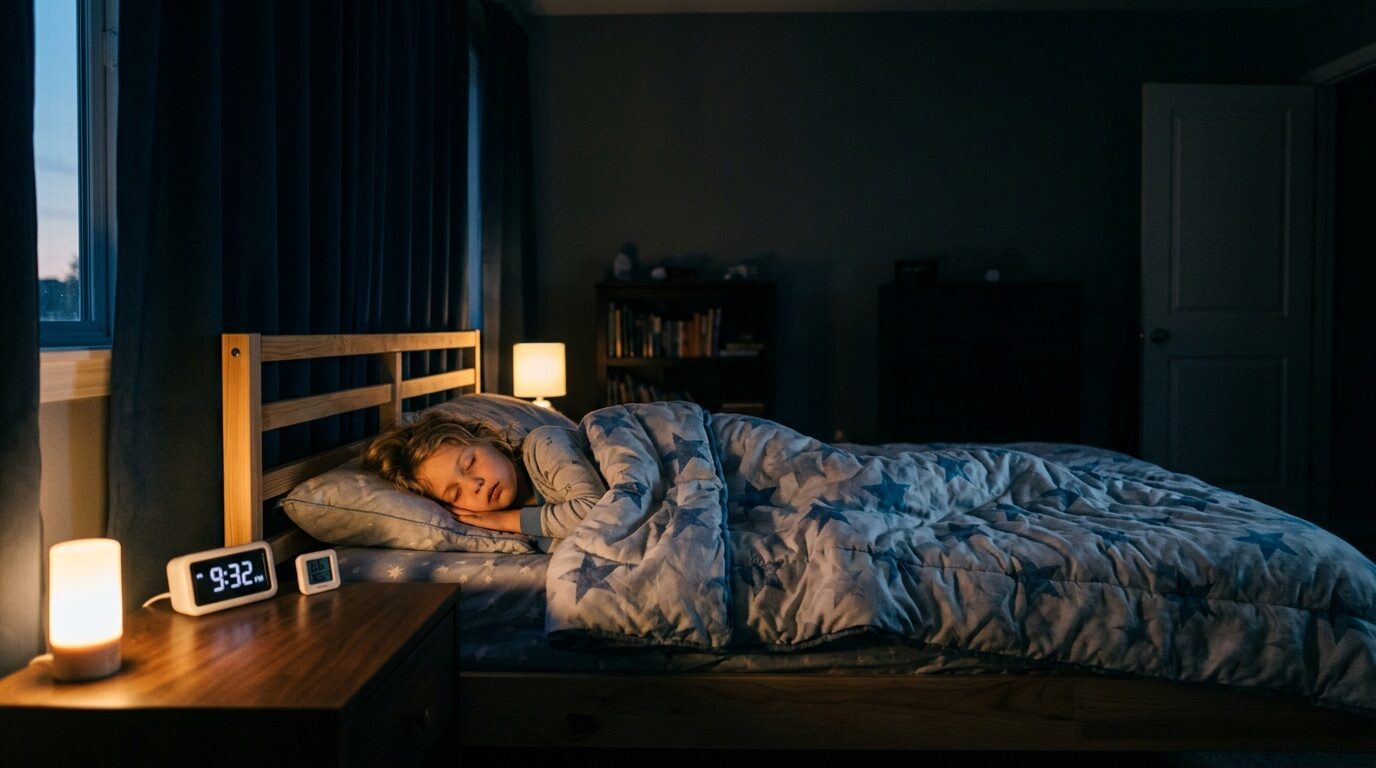
Your child's bedroom environment can either accelerate or sabotage sleep — and darkness is the single most powerful lever.
Melatonin, the hormone that initiates sleep, is suppressed by light — particularly blue-spectrum light. Even low ambient light from a street lamp or a hallway nightlight can delay melatonin release in children, whose eyes are more sensitive to light than adults'.
Why blackout curtains are a genuine sleep tool
A darkened room isn't just comfortable — it's physiologically important. In summer, when sunrise can occur before 5:30 am in many regions, a bright room will trigger early waking regardless of how late your child went to bed. In winter, the bedroom may still be lit by streetlights or passing cars.

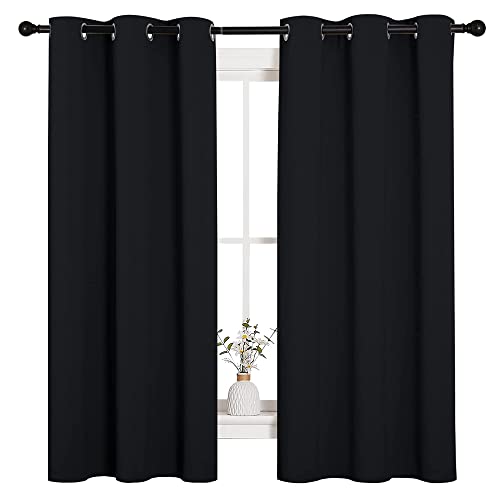

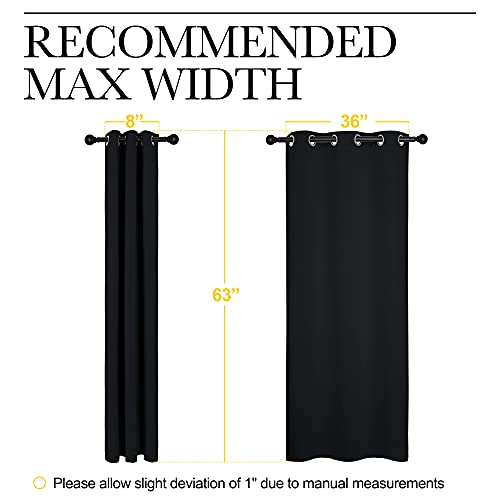

NICETOWN Halloween Pitch Black Solid Thermal Insulated Grommet Blackout Curtains/Drapes for Bedroom Window (2 Panels, 42 inches Wide by 63 inches Long, Black)
- READY MADE: Set includes 2 BLACKOUT CURTAINS PANELS of 42" wide x 63" length with 6 grommets top each. Quality
- SERVE WELL: Curtains impede 85%-99% light and UV rays(Dark color curtains work well). Noise-reducing, better T
- ENERGY SMART: Triple weave blackout fabric balances room temperature by insulating against summer heat and win
For a no-fuss, high-performance option, the NICETOWN Blackout Curtains block 85–99% of incoming light using triple-weave technology — and at under $10, they're the most cost-effective upgrade you can make to your child's sleep space tonight. If your child prefers something with a little personality, the BGment Star Blackout Curtains offer the same thermal insulation with a fun navy-and-silver star print that 5–8 year-olds tend to love.
Temperature and noise
4. Screens, Melatonin, and the One Rule Worth Enforcing
Screens within 60 minutes of bedtime measurably delay sleep onset in children aged 5–8 — this is one of the most consistently replicated findings in paediatric sleep research.
Electronic media use near bedtime is associated with inadequate sleep duration, poor sleep quality, and excessive daytime sleepiness in school-age children.
— American Academy of Pediatrics (2016)
The AAP's 2016 Family Media Plan guidelines recommend keeping screens out of children's bedrooms entirely and establishing a device "curfew" at least one hour before bed. This applies to tablets, smartphones, televisions, and handheld gaming devices.
Why it's not just about blue light
Blue light suppression of melatonin is real, but it's not the whole story. Content matters too. Fast-paced, emotionally stimulating content — even a "calm" cartoon — activates the sympathetic nervous system and raises cortisol, making it physiologically harder to fall asleep even after the screen is off.
Practical strategies
5. Nighttime Fears and Separation Anxiety: A Normal Part of This Stage
Fear of the dark, monsters under the bed, and not wanting to sleep alone are developmentally normal in 5–8 year-olds — and they peak around ages 6–7.
At this stage, children's cognitive development enables them to imagine threats that aren't present. This is the same brain growth that makes them better at reading, maths, and empathy — it also makes them excellent at scaring themselves in the dark.
What helps (and what doesn't)
Helps:
Doesn't help:
For children who genuinely struggle to sleep alone, a structured behavioural approach called the bedtime pass (Moore et al., 2007, published in SLEEP) gives children one physical "pass" per night to leave their room for a brief, calm interaction. Research shows it reduces curtain calls by over 80% within two weeks.
6. Early Waking, Night Waking, and When to See a Doctor
Most early waking in 5–8 year-olds has an environmental cause — light, noise, or an overtired child who fell asleep too late and is cycling into light sleep earlier than expected.
Common fixable causes of early waking
For a girl's room, the XiDi Rainbow Unicorn Blackout Curtains offer 88% light reduction with a design children actually get excited about — making the "we're adding curtains" conversation much easier. For a more neutral or boy-friendly option, the LORDTEX Dinosaur & Star Blackout Curtains block over 90% of light and are OEKO-TEX certified, so you're not trading sleep quality for chemical safety concerns.
When to talk to your paediatrician
Most sleep difficulties respond to the strategies in this guide within 2–4 weeks. Seek professional advice if you notice:
7. Blackout Curtain Options for 5–8 Year-Olds: At a Glance
Choosing the right blackout curtain for a school-age child's room involves balancing light-blocking performance, child-friendly design, and budget. Here's how the available options compare:
| Curtain Option | Light Blocking | Best For | Key Feature | Recommended Product | Price Range |
|---|---|---|---|---|---|
| Budget solid blackout | 85–99% | Any room, maximum darkness | Triple-weave, noise-reducing | NICETOWN Blackout Curtains | ~$10 |
| Navy star print (boys) | Up to 80% | Boys' rooms, nursery crossover | Shiny foil star pattern | BGment Star Curtains | ~$20 |
| Solid navy thermal | Up to 80% | Boys' rooms, neutral spaces | Thermal insulated, energy-saving | BGment Navy Blackout Curtains | ~$14 |
| Baby pink solid | 80–95% | Girls' rooms, light-sensitive sleepers | Triple-layer 225GSM fabric | MIULEE Pink Blackout Curtains | ~$14 |
| Rainbow unicorn print | 88% | Girls' rooms, child buy-in | Sheer + blackout dual layer, bows | XiDi Rainbow Unicorn Curtains | ~$14 |
| Dinosaur & star print | 90%+ | Boys' or girls' rooms, eco-conscious | OEKO-TEX certified, wide panels | LORDTEX Dinosaur & Star Curtains | ~$40 |



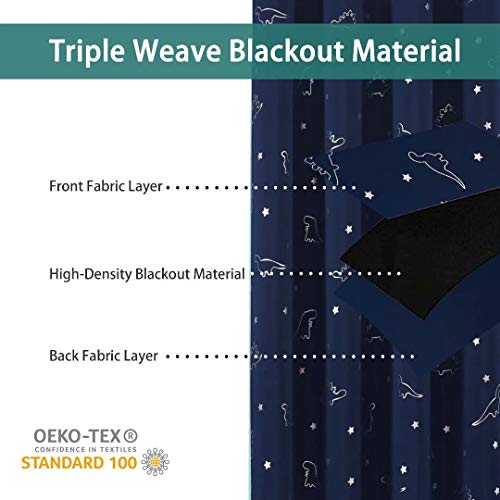

LORDTEX Dinosaur and Star Foil Print Blackout Curtains for Kids Room - Thermal Insulated Curtains Noise Reducing Window Drapes for Boys and Girls Bedroom, 52 x 63 Inch, Navy, Set of 2 Panels
- WHAT'S IN THE PACKAGE? Each set includes 2 navy kids curtain panels, each panel measures 52-inch width by 63-i
- PREMIUM BLACKOUT MATERIAL: Our kids blackout curtains is made of 100% polyester fabric and have the same color
- ENERGY EFFCIENT AND THERMAL INSULATED CURTAINS: These kids bedroom curtains not only protect furniture, toys a
Expert Insights
Conclusion
Sleep is one of the greatest gifts you can give your 5–8 year-old — and unlike many things in parenting, the evidence on how to protect it is remarkably clear. A dark room, a predictable routine, screens off an hour before bed, and a consistent wake time. That's the framework. It won't always go smoothly, and there will be nights when the dinosaur question wins. But when you protect your child's sleep consistently, you're protecting their learning, their emotional balance, and their health in ways that compound quietly every single day.
Good sleep doesn't happen to children — it's built for them, one consistent night at a time.
If this guide helped you, save it for the next time bedtime feels impossible — and share it with another parent who's still negotiating at 9 pm.
Sources & References
- American Academy of Sleep Medicine (AASM). "Recommended Amount of Sleep for Pediatric Populations." Journal of Clinical Sleep Medicine, 2016. https://aasm.org/resources/pdf/pediatricsleepdurationconsensus.pdf
- Centers for Disease Control and Prevention (CDC). "Sleep in Middle and High School Students." Data & Statistics, 2023. https://www.cdc.gov/healthyschools/features/students-sleep.htm
- American Academy of Pediatrics (AAP). "American Academy of Pediatrics Supports Childhood Sleep Guidelines." 2016. https://www.aap.org/en/news-room/news-releases/aap/2016/aap-supports-childhood-sleep-guidelines/
- Cheng, S., et al. "Sleep duration and academic performance among school-age children." The Lancet Child & Adolescent Health, 2020. https://doi.org/10.1016/S2352-4642(20)30308-X
- Mindell, J.A., et al. "A nightly bedtime routine: impact on sleep in young children and maternal sleep and mood." SLEEP, 32(5), 599–606. 2009. https://doi.org/10.1093/sleep/32.5.599
- Moore, B.A., et al. "The Bedtime Pass: An Approach to Bedtime Crying and Leaving the Room." SLEEP, 30(7), 2007.
- American Academy of Pediatrics (AAP). "Media and Young Minds." Pediatrics, 138(5), 2016. https://doi.org/10.1542/peds.2016-2591
- American Academy of Pediatrics (AAP). "Diagnosis and Management of Childhood Obstructive Sleep Apnea Syndrome." Pediatrics, 130(3), 2012. https://doi.org/10.1542/peds.2012-1671
- National Sleep Foundation. "Bedroom Environment and Sleep." sleepfoundation.org. https://www.sleepfoundation.org/bedroom-environment
Frequently Asked Questions
How do I know if my 6-year-old is getting enough sleep?
My 7-year-old keeps coming out of her room after bedtime. What should I do?
Is it normal for my 5-year-old to still be afraid of the dark?
Should my 8-year-old have a later bedtime on weekends?
Do blackout curtains really make a difference to children's sleep?
My son snores every night. Should I be worried?
How do I handle my child's early morning waking when it's still dark in winter but light in summer?
Was this helpful?
Thanks — your feedback helps us pick what to write next.