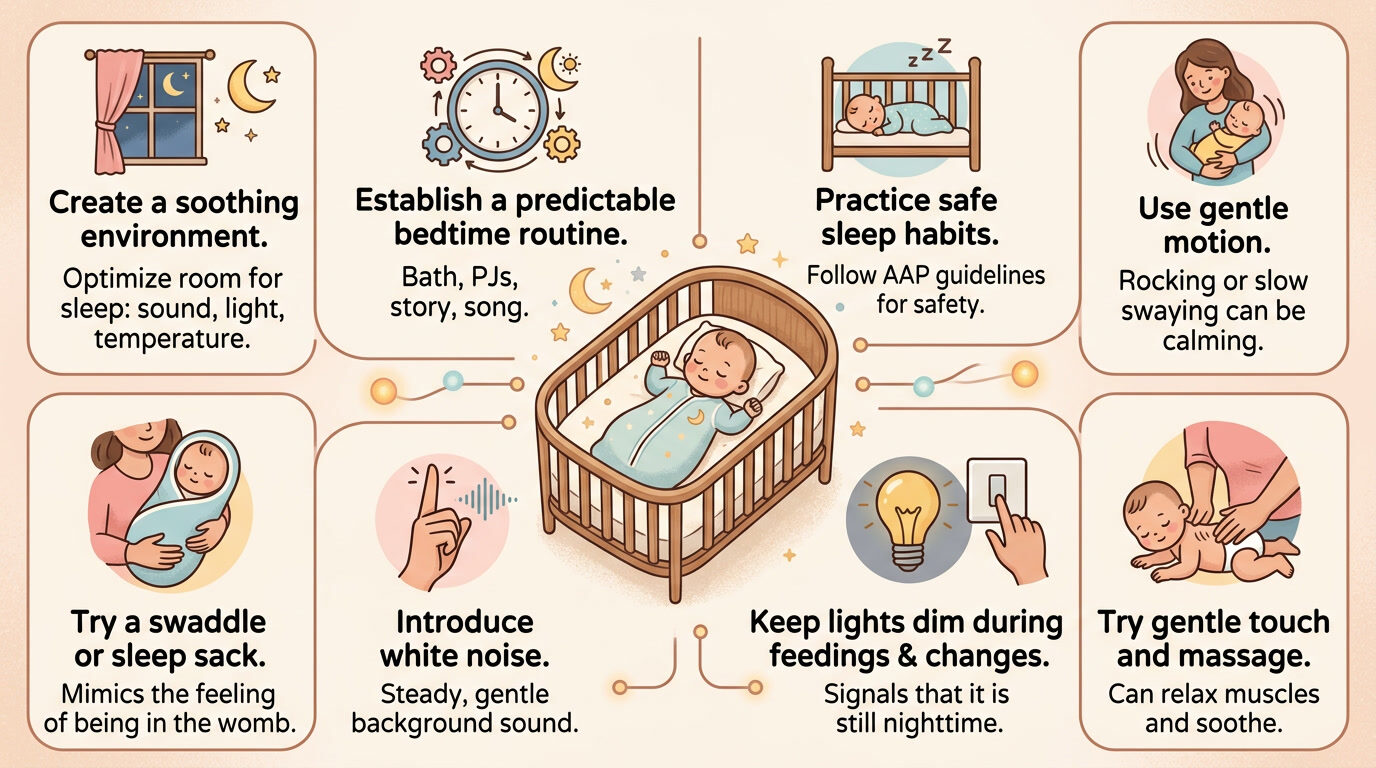
8-Month Sleep Regression: What's Happening and How to Fix It
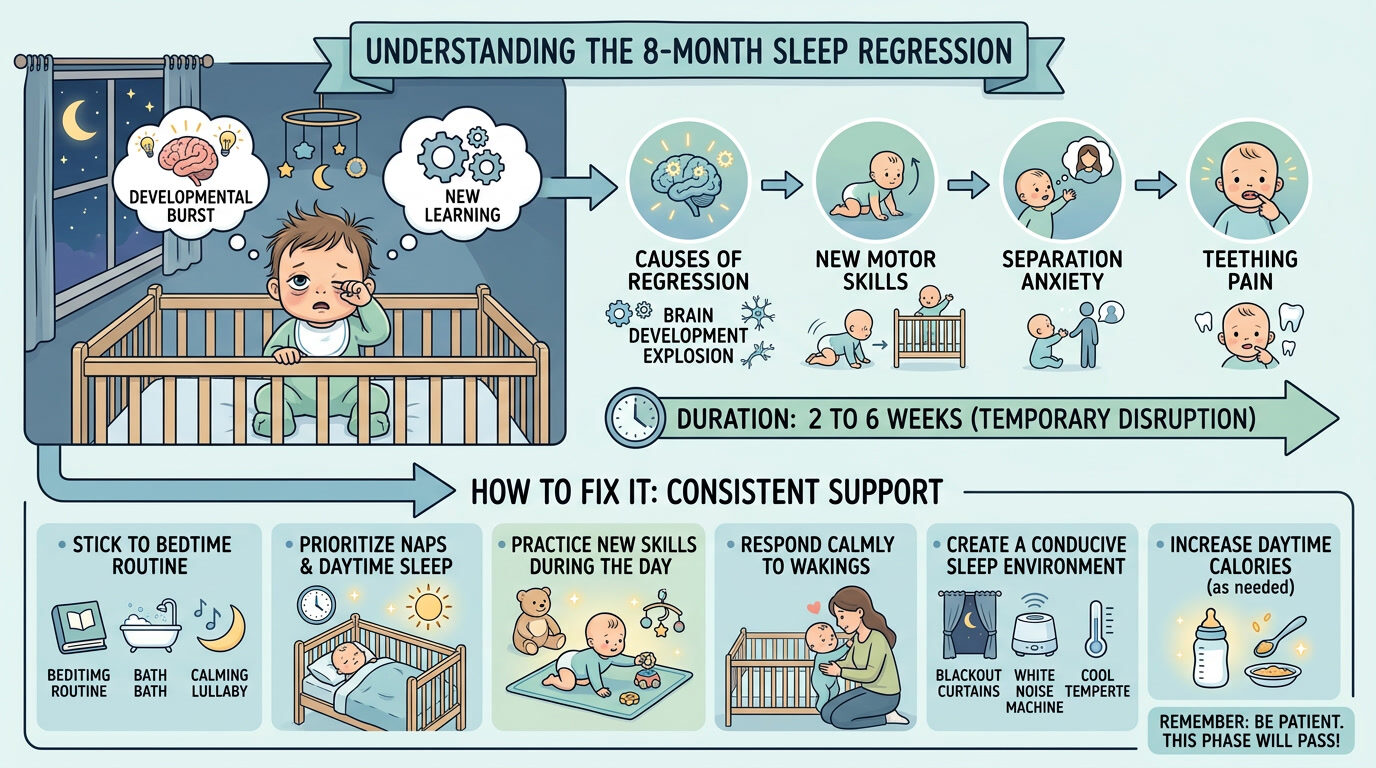
The 8 month sleep regression is a real, temporary disruption caused by a burst of brain development, new motor skills, and the onset of separation anxiety — and most babies push through it within 2 to 6 weeks with consistent support.
In this article
It happens without warning. Your baby, who had been sleeping pretty well, suddenly starts waking two, three, four times a night. Naps that used to be reliable fall apart. Bedtime, which was manageable, turns into a tearful standoff. You're exhausted, confused, and wondering what on earth went wrong.
You haven't done anything wrong. What you're living through is the 8 month sleep regression, and it's one of the most disruptive sleep periods in the entire first year. According to the American Academy of Pediatrics, healthy sleep is one of the single most important factors in infant brain development and caregiver mental health — which means what happens in these few weeks genuinely matters.
By the time you finish reading this, you'll understand:
Let's get into it.
1. Why the 8 Month Sleep Regression Actually Happens
The 8 month sleep regression is not a phase of bad behaviour. It is a direct consequence of your baby's brain growing at a truly astonishing rate, and once you understand that, everything makes a little more sense.
Between 8 and 10 months, babies experience one of the largest neurological growth spurts of their entire childhood. The prefrontal cortex, the part of the brain involved in memory, object permanence, and emotional processing, is forming new connections at a pace it will never quite match again. At the same time, the motor cortex is lighting up as babies start to pull to stand, crawl, or cruise along furniture. These are not separate events happening in the background. They are happening inside your baby's brain while they're trying to sleep, and they make staying asleep genuinely hard.
Object permanence changes everything
Before about 7 to 8 months, "out of sight" genuinely meant "out of mind" for your baby. You left the room and, in a very real sense, you ceased to exist. Now that object permanence is kicking in, your baby knows you are still somewhere. They know the room they fell asleep in is not where they want to be. And they know how to let you know about it.
Motor skill practice doesn't stop at bedtime
When a baby is learning to crawl or pull to stand, the motor cortex keeps rehearsing those patterns during sleep. You may actually see your baby rolling, pushing up on hands and knees, or standing up in the cot mid-night, sometimes without fully waking, and then crying because they can't get back down. This is so common it has its own informal name among sleep researchers: "sleep disruption through motor practice."
Separation anxiety arrives right on schedule
The third piece of this puzzle is separation anxiety, which peaks right around 8 to 9 months according to developmental research from the National Institute of Child Health and Human Development. This is not clinginess or spoiling. It is a healthy, predictable sign that your baby has formed a deep attachment to you, which is exactly what you wanted.
All of these are signs of healthy attachment, not sleep regression caused by something you did.
2. Is This Really the 8 Month Regression? How to Tell
Not every rough week at 8 months is a sleep regression, and telling the difference matters because the response is different for each cause.
The 8 month sleep regression has a recognisable fingerprint. It comes on relatively suddenly (often within a day or two), it affects both nights and naps, and the baby seems developmentally normal and physically well between wake-ups. They're not pulling at their ears. They're not running a temperature. They're not off their feeds. They're just sleeping terribly.
Here's how it stacks up against the other usual suspects:
Teething
Teething pain is real, but it tends to cause shorter, sharper distress rather than prolonged night waking. Your baby may have swollen, red gums, be drooling more than usual, or be chewing on everything in sight. The crying during a teething episode usually has a different, more urgent quality. That said, teething and sleep regression can absolutely overlap at this age — because 8 months is prime teething territory. For hands-on comfort during those wakeful nights, a good teething relief option can help take the edge off during the day so your baby arrives at bedtime a little less wound up.
Growth spurts
Growth spurts typically show up as increased hunger rather than sleep disruption per se. Your baby may want more feeds, seem fussier between meals, and sleep more (not less) during a growth spurt. If your baby is waking and isn't satisfied with a feed, hunger is probably not the primary driver.
Illness
Illness is the one you must not miss. If your baby has a temperature above 38°C (100.4°F), is feeding significantly less than usual, has unusual crying that can't be soothed, or seems unwell to you during awake periods, this is not a regression. This is a reason to call your paediatrician or visit your GP today.
The regression itself
3. What Your Baby's Sleep Architecture Actually Looks Like Right Now
Understanding what's happening inside your baby's sleep cycles is genuinely useful, not just interesting, because it explains why certain strategies work and others don't.
Adult sleep cycles last roughly 90 minutes and move through light sleep, deep sleep, and REM in predictable waves. Infant sleep cycles at 8 months are shorter, around 45 to 50 minutes, and the proportion of light sleep (also called active sleep or REM) is significantly higher than in adults. This means your baby naturally surfaces to a light sleep state roughly every 45 minutes all night long.
In a baby who has learned to fall asleep independently, this light-sleep moment is not a problem. They stir, rouse slightly, and drift back off. In a baby who depends on a specific condition to fall asleep — being fed to sleep, rocked, or held — that light-sleep moment is where the trouble begins. They surface, register that the condition they fell asleep under is gone, and call for it back. This is what sleep researchers call a "sleep association," and it explains why a baby can go from sleeping a five-hour stretch to waking every 45 minutes seemingly overnight.
Why this matters right now specifically
Before the 8 month regression, many babies managed to string sleep cycles together even with a sleep association because their sleep was somewhat deeper and their awareness of environmental changes was lower. The neurological growth happening right now sharpens their awareness dramatically. The same sleep association that was manageable at 6 months becomes a significant problem at 8 months because your baby is now far more conscious of their environment during those light-sleep transitions.
The ability to self-soothe and return to sleep after brief awakening is one of the most important sleep skills a child develops in the first year.
— American Academy of Pediatrics, Healthy Child Program (2022)
Naps are affected differently
Naps at 8 months typically follow a two-nap schedule: one mid-morning and one early afternoon. Most babies this age can handle 2 to 2.5 hours of wake time between sleep periods before they start to become overtired. An overtired baby produces more cortisol, which paradoxically makes it harder to fall and stay asleep. This is one of the reasons the regression can spiral: bad nights lead to overtired days, which makes naps worse, which makes nights worse again.


Precious Little Sleep: The Complete Baby Sleep Guide for Modern Parents
- Health, Fitness & Dieting
- Diseases & Physical Ailments
- Sleep Disorders
4. Sleep Training at 8 Months: What the Research Actually Says
Sleep training is one of the most loaded phrases in parenting, but at 8 months it's worth having a clear-eyed look at what the evidence actually shows — because this age is genuinely a good time to help your baby learn to settle independently if they haven't already.
The American Academy of Pediatrics reviewed the evidence on infant sleep training in 2020 and concluded that behavioural sleep interventions are safe, effective, and do not cause psychological harm to infants or damage the parent-child relationship. That's a strong statement from a cautious organisation, and it's worth taking seriously.
The main approaches
Graduated extinction (often called the Ferber method)
This approach involves putting your baby down awake and checking in at progressively longer intervals if they cry. It is the most studied approach in the peer reviewed literature. Studies published in the journal Pediatrics show that babies trained using graduated extinction show no differences in stress hormones, attachment security, or emotional development compared to control groups at follow-up.
Extinction (sometimes called "cry it out")
This means putting your baby down awake and not returning until morning (or a set time), unless there is a safety concern. It works faster than graduated extinction for many families but requires a level of parental confidence that not everyone has, and that's completely valid.
Fading and chair method (sometimes called the "sleep lady shuffle")
You gradually move your physical presence further from the cot over a period of 10 to 14 days. This is slower but requires less sustained crying. It suits families who find the check-in model too disruptive (some babies escalate with each check-in).
Responsive settling
This sits at the more parent-present end of the spectrum. You pick up, settle, and put back down. It's gentler but slower, and at 8 months it requires real consistency to work because babies at this age are very good at learning that crying produces the desired response.
For parents who want a structured plan to follow, a book like Twelve Hours' Sleep by Twelve Weeks Old offers a step-by-step framework, while Healthy Sleep Habits, Happy Child by Dr Marc Weissbluth is one of the most clinically thorough sleep references available. If you're looking for something faster, Baby Sleep Training in 7 Days lays out a compressed programme for families at the end of their rope.
The science on sleep training is also worth reading alongside what we know about broader infant development. If you're curious how these sleep changes connect to your baby's cognitive growth, the piece on what actually builds baby's brain covers the developmental overlap in real depth.

Healthy Sleep Habits, Happy Child, 5th Edition: A New Step-by-Step Guide for a Good Night's Sleep
- Health, Fitness & Dieting
- Diseases & Physical Ailments
- Sleep Disorders
5. A Practical Daily Routine for the 8 Month Sleep Regression
Structure is your single most powerful tool right now. Babies this age are developing a genuine sense of sequence and predictability, which means a consistent daily routine genuinely reduces anxiety and makes sleep easier.
Here's what a realistic day looks like:
Sample schedule (adjust by 30 minutes either way for your baby)
6:30–7:00am Wake up, milk feed, some floor play 9:00–9:30am Nap 1 (45 to 90 minutes is typical) 10:30–11:00am Wake up, solid breakfast, active play 1:00–1:30pm Nap 2 (this is often the longer nap, up to 90 minutes) 3:00pm Wake up, milk feed, outdoor time if possible 5:00pm Solid dinner 6:00–6:30pm Start bedtime routine 7:00–7:30pm Asleep for the night
The bedtime routine deserves its own attention. At 8 months, routine is not just helpful, it is a sleep trigger. Your baby's brain learns to associate the sequence (bath, feed, story, song, cot) with the onset of sleep. Once that association is established, it does a significant amount of the settling work for you.
Night waking: what to do in the moment
This is where parents struggle most. Your baby wakes, cries, and every instinct you have says "go fix it." Here's a framework that works:
1. Wait 60 seconds before entering the room. Many babies will resettle. 2. If you go in, keep it brief, calm, and boring. This is not a social visit. 3. Avoid feeding unless it's been more than 4 hours since the last feed. 4. Avoid taking your baby out of the room. 5. Use the same settling method every single time.
The Moms on Call approach, outlined in Moms on Call Basic Baby Care, is practical and straightforward for families who want clear, scripted guidance on exactly how to handle these night wakings step by step.
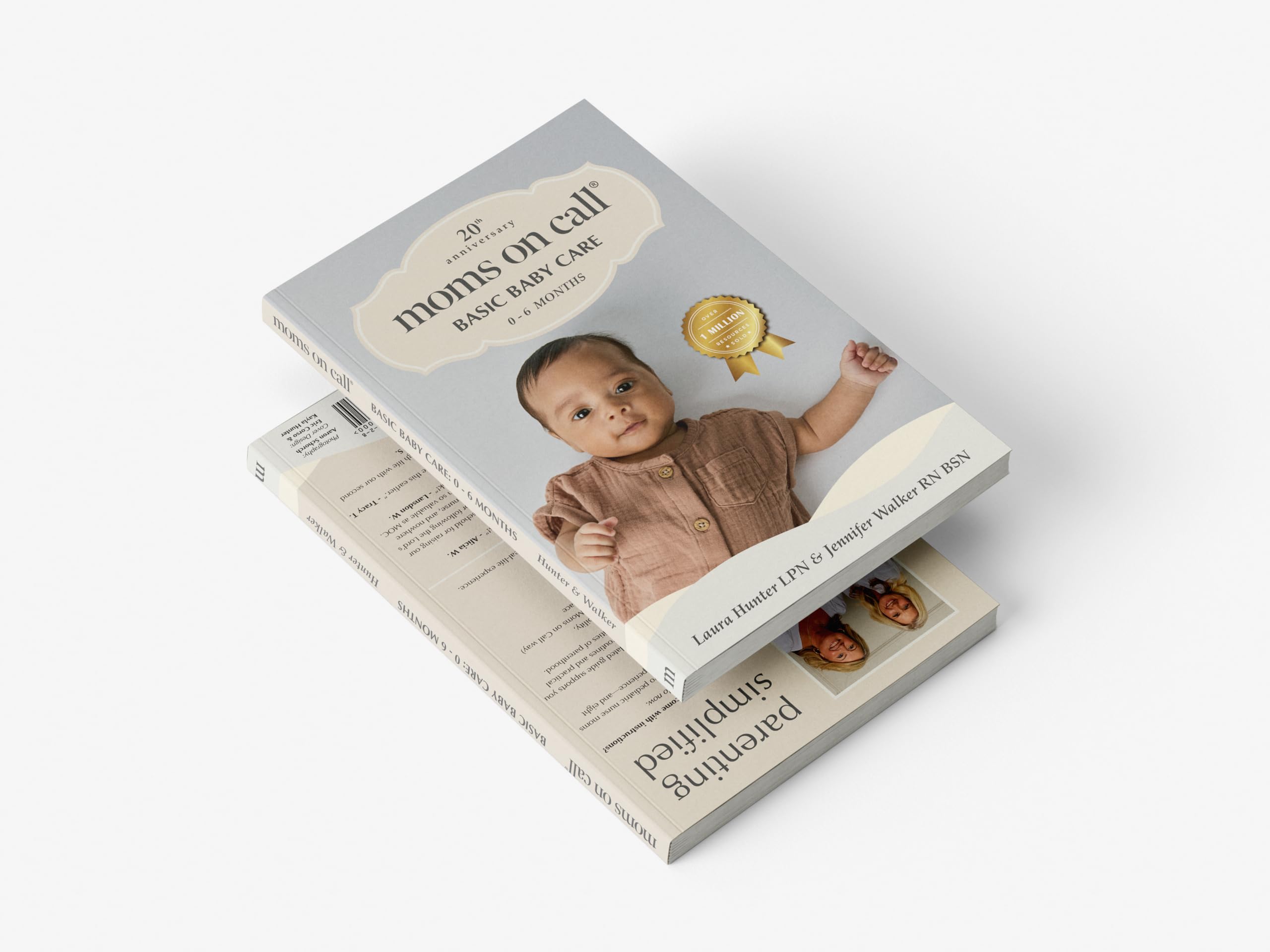
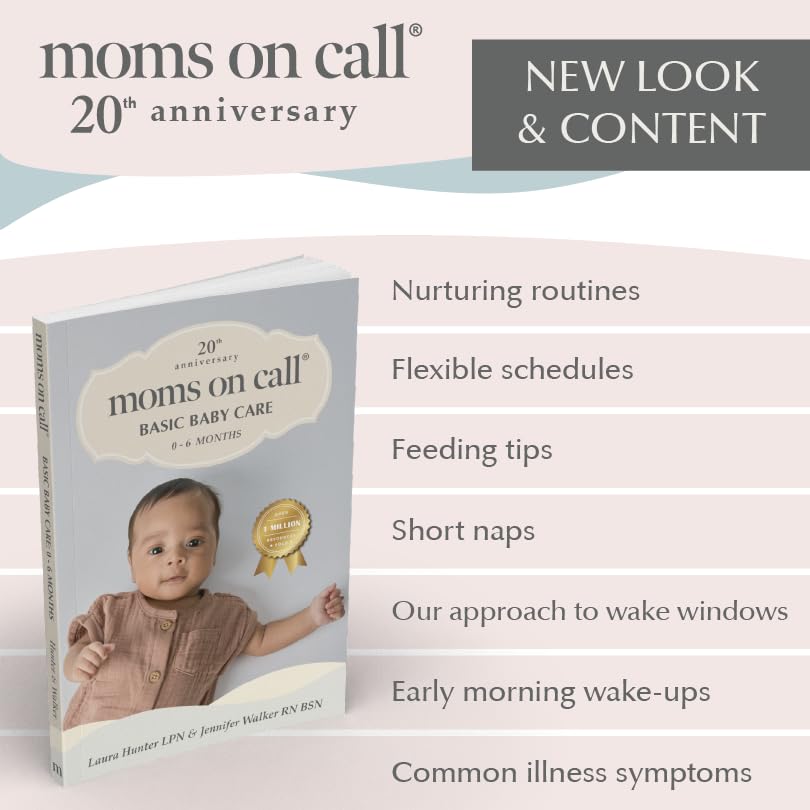
Moms on Call | Basic Baby Care 0-6 Months | Parenting Book 1 of 3 | 20th Anniversary Edition
- Health, Fitness & Dieting
- Women's Health
- Pregnancy & Childbirth
6. How Long Will This Last and What Comes Next
This is the question every exhausted parent asks, and the honest answer is: most babies come through the 8 month sleep regression within 2 to 6 weeks.
I know 6 weeks sounds like a long time when you're in it. But for most families, the sharpest disruption, the multiple wakings, the chaotic naps, the dramatic bedtimes, settles down within 3 to 4 weeks. What determines which end of that range you land on is largely how consistently you respond during the regression itself.
What makes it last longer
What helps it resolve faster
What comes after
Once this regression resolves, many babies enter a period of noticeably better sleep, sometimes the best sleep of their entire first year. The neurological growth that caused the disruption, once consolidated, actually supports better sleep regulation. You may find that your baby, for the first time, can genuinely settle back to sleep independently after a light-sleep transition.
There is another common disruption around 9 to 10 months as babies refine new motor skills, but it's typically shorter and less severe than the 8 month regression. You can read more about what's happening developmentally through this whole stretch in our overview of your baby's development milestones from 9 months to 1 year.
Longitudinal studies consistently show that infant sleep consolidates significantly between 9 and 12 months, particularly in infants whose caregivers apply consistent bedtime routines.
— Mindell JA et al., Sleep (2015)
For parents who want a comprehensive programme to carry them from this regression all the way through to 12 months, Babywise Sleep Solutions and Precious Little Sleep are both well regarded for their systematic, age-by-age approach.

Twelve Hours' Sleep by Twelve Weeks Old: A Step-by-Step Plan for Baby Sleep Success
- Health, Fitness & Dieting
- Diseases & Physical Ailments
- Sleep Disorders
7. Taking Care of Yourself Through the Regression
No article about the 8 month sleep regression is complete without acknowledging the person who is actually reading it at 3am, probably on their phone in a dark hallway.
Sleep deprivation in parents of infants is a genuine public health issue, not a badge of honour or a rite of passage. Research published in Sleep Medicine Reviews found that parents of infants with frequent night wakings show cognitive impairment equivalent to mild intoxication after several consecutive disrupted nights. That's not to alarm you. It's to validate what you already feel: this is genuinely hard, and it affects your ability to function.
Practical ways to protect yourself
Split the nights. If you have a partner, divide the night into shifts rather than both of you responding to every waking. Each of you gets one block of uninterrupted sleep, which is significantly more restorative than the same number of total hours broken across the night.
Nap when you can. The advice sounds patronising but the physiology is real. A 20 to 25 minute nap in the afternoon can partially compensate for reduced night sleep in ways that caffeine cannot.
Lower the bar on everything else. The house, the social commitments, the work tasks you could have finished last week. The regression is temporary. The cost of running yourself into the ground is not.
Ask for help and be specific. "I need help" is too vague for most people to act on. "Can you take the baby for two hours on Saturday morning so I can sleep?" is actionable.
Babywise Sleep Solutions: Begin as You Mean to Go with (To the Point)
- Medical Books
- Internal Medicine
- Pediatrics
Sleep Method Comparison: What Works at 8 Months
| Sleep Method | Best For | How It Works | Typical Duration to Results | Crying Involved | Recommended Resource | Price Range |
|---|---|---|---|---|---|---|
| Graduated extinction (Ferber) | Babies who escalate without check-ins | Put down awake; check in at increasing intervals | 3 to 7 nights | Moderate | Precious Little Sleep | $12–13 |
| Full extinction (cry it out) | Families who can stay consistent; babies who escalate with check-ins | Put down awake; no returns until morning | 2 to 5 nights | Higher initially | Baby Sleep Training in 7 Days | Free with Kindle Unlimited |
| Fading/chair method | Anxious parents; attachment-conscious families | Gradual withdrawal of parental presence over 10 to 14 nights | 10 to 14 nights | Lower | Healthy Sleep Habits, Happy Child | $11 |
| Responsive settling | Families not ready for formal training | Pick up, settle, put down; consistent and predictable | 3 to 6 weeks | Lowest | Moms on Call Basic Baby Care | $28 |
| Scheduled night waking | Babies with very predictable wake times | Wake baby just before usual wake time; gradually extend | 1 to 2 weeks | Very low | Twelve Hours' Sleep by Twelve Weeks Old | $14 |
| Structured programme (Babywise) | Parents who prefer a schedule-first approach | Feed-wake-sleep cycle from early on; structured day drives night | Varies | Low to moderate | Babywise Sleep Solutions | N/A |
Expert Insights on the 8 Month Sleep Regression
Conclusion
If there's one thing I want you to take away from all of this, it's that you are not failing. The 8 month sleep regression feels personal because it's happening in your house, to your baby, at 3am when everything feels enormous. But it is biology. It is your baby's brain doing exactly what a healthy 8 month old brain is supposed to do.
You will come out the other side of this. Most families do, within a few weeks, with their sanity and their attachment to their baby fully intact. The habits you build right now, consistent settling, appropriate wake windows, a reliable bedtime routine, will serve your family long after this regression is a distant memory.
If there is a single thing you do differently tonight, let it be this: put your baby down awake, wish them goodnight, and give them the chance to show you what they can do.
Save this article, share it with your partner, and bookmark it for the next time someone tells you it'll never end. It will.
Sources & References
- American Academy of Pediatrics. "Healthy Sleep Habits: How Many Hours Does Your Child Need?" HealthyChildren.org. 2022. https://www.healthychildren.org/English/healthy-living/sleep/Pages/healthy-sleep-habits-how-many-hours-does-your-child-need.aspx
- Mindell JA, Leichman ES, Composto J, Lee C, Bhullar B, Walters RM. "Development of infant and toddler sleep patterns: real-world data from a mobile application." Journal of Sleep Research. 2016;25(5):508-516.
- Mindell JA, Kuhn B, Lewin DS, Meltzer LJ, Sadeh A. "Behavioral treatment of bedtime problems and night wakings in infants and young children." Sleep. 2006;29(10):1263-1276.
- Price AM, Wake M, Ukoumunne OC, Hiscock H. "Five-year follow-up of harms and benefits of behavioral infant sleep intervention: randomized trial." Pediatrics. 2012;130(4):643-651.
- Gradisar M, Jackson K, Spurrier NJ, et al. "Behavioral Interventions for Infant Sleep Problems: A Randomized Controlled Trial." Pediatrics. 2016;137(6):e20151486.
- National Institute of Child Health and Human Development. "Emotional and Social Development: 8 to 12 Months." Eunice Kennedy Shriver NICHD. 2023. https://www.nichd.nih.gov
- Weissbluth M. "Healthy Sleep Habits, Happy Child." 5th Edition. Ballantine Books. 2015.
- Karp H. "The Happiest Baby on the Block." Bantam Books. 2002.
- Galland BC, Taylor BJ, Elder DE, Herbison P. "Normal sleep patterns in infants and children: a systematic review of observational studies." Sleep Medicine Reviews. 2012;16(3):213-222.
- Harrison Y. "The relationship between daytime exposure to light and night-time sleep in 6-12-week-old infants." Journal of Sleep Research. 2004;13(4):345-352.
Frequently Asked Questions
How long does the 8 month sleep regression last?
Should I sleep train during the 8 month regression or wait until it's over?
My baby keeps standing up in the cot and can't get back down. What do I do?
Is it okay to feed my baby at night during the regression?
My baby was sleeping through before this. Will they go back?
Does the 8 month sleep regression affect naps too?
When should I call the doctor?
Was this helpful?
Thanks — your feedback helps us pick what to write next.