Best Baby Skincare for Eczema-Prone Skin: 2026 Guide
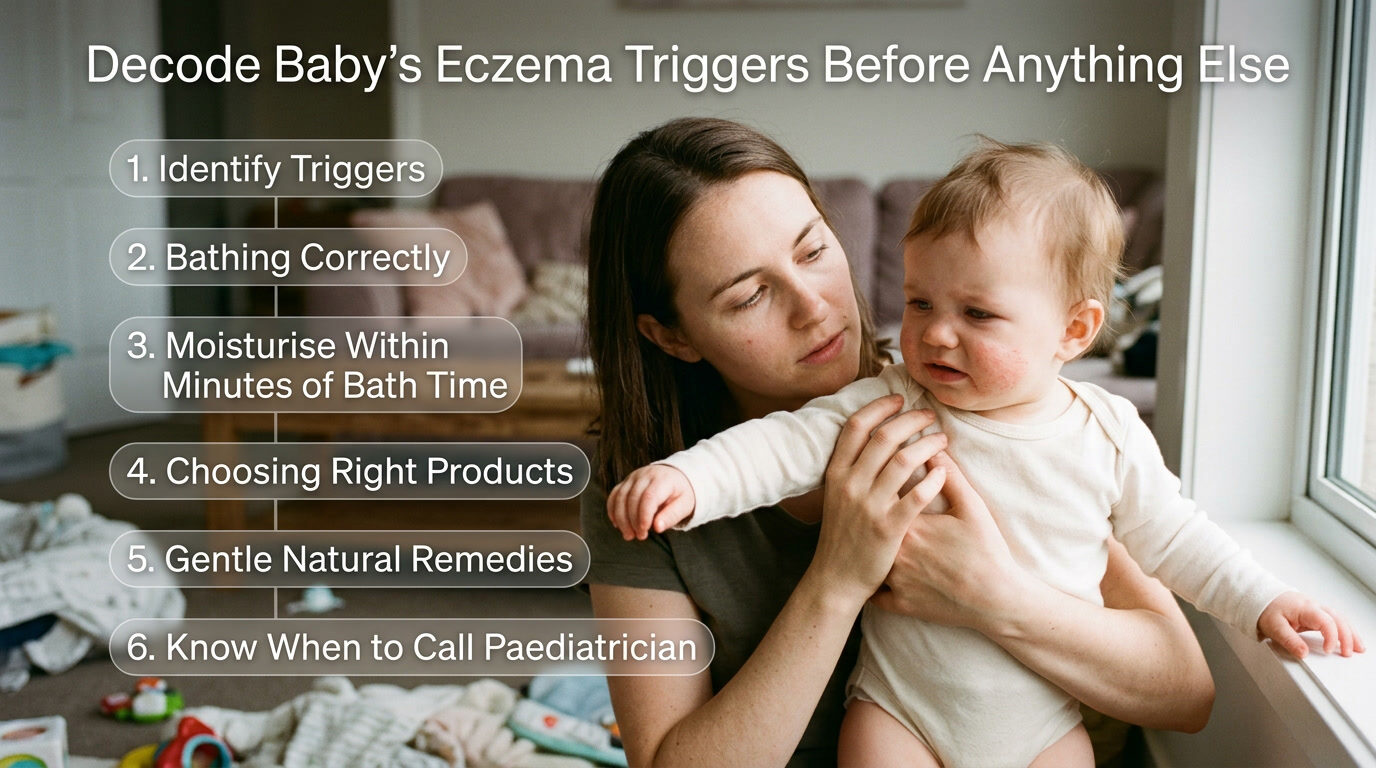
For babies with eczema prone skin, the most effective daily routine combines a fragrance free, ceramide or colloidal oatmeal moisturiser applied within three minutes of bathtime, gentle lukewarm soaks, and consistent trigger avoidance.
In this article
About one in five children in the UK and US will develop eczema before their fifth birthday, according to the National Eczema Association. That makes it the most common chronic skin condition in childhood, and for many parents, the diagnosis arrives as a confusing, exhausting surprise. You're standing in a pharmacy aisle staring at forty products, your baby is scratching their cheeks raw at 2 am, and every label seems to promise the same thing.
This article will cut through that noise. Here's what you'll understand by the end:
Let's start with the skin itself.
1. What Eczema Actually Does to Your Baby's Skin
Eczema is not just dry skin. It's a dysfunction of the skin barrier, and once you understand that, every treatment decision starts to make sense.
Healthy skin has a tightly packed outer layer that keeps moisture in and irritants out. In babies with eczema, that layer has gaps. Moisture escapes constantly, which is why the skin feels dry and rough even after you've just moisturised. At the same time, allergens, bacteria, and environmental triggers get in through those gaps, setting off an immune response that causes the redness, swelling, and itch.
The itch-scratch cycle makes things worse. Babies scratch (or rub their faces on bedding), which damages the barrier further, which makes the itch worse. Breaking that cycle, especially overnight, is one of the most practical things you can do right now.
What triggers a flare?
Common triggers in babies include:
- Synthetic fabrics (polyester, nylon) rubbing against skin - Saliva and drool around the mouth and chin - Dry winter air or central heating - Certain foods (in a minority of eczema babies, usually when eczema is severe and early onset) - Sweat and heat - Strongly fragranced products, including baby wipes, laundry detergents, and fabric softeners
2. The Ingredients That Actually Work (and What to Skip)
When you're reading a product label for your baby's eczema prone skin, three ingredients have the most consistent evidence behind them.
Colloidal oatmeal
The US Food and Drug Administration classifies 1% colloidal oatmeal as an over the counter skin protectant for eczema. It works in several ways: it forms a physical film over the skin to reduce water loss, it has mild anti-inflammatory properties, and it relieves itch. Clinical studies published in the Journal of Drugs in Dermatology have shown meaningful improvement in eczema severity scores after regular use.


CeraVe Baby Eczema Relief Cream, 1% Colloidal Oatmeal Cream With Vitamin E & Ceramides, Soothes & Calms Itchy Skin, Developed With Pediatric Dermatologist, Fragrance Free, 5oz
- [ 1% COLLOIDAL OATMEAL ] This baby cream for eczema helps relieve itching due to eczema, ensuring baby's skin
- [ VITAMIN E ] Baby eczema lotion with Vitamin E nourishes the skin, leaving it hydrated, smoother, and softer,
- [ MVE DELIVERY TECHNOLOGY ] This eczema baby cream provides all-day hydration, ensuring quick absorption witho
Ceramides
Ceramides are lipid molecules that are naturally present in the skin barrier. Babies with eczema have measurably lower ceramide levels. Replacing them topically helps patch those gaps and restore normal barrier function. Look for products that list ceramide NP, ceramide AP, or ceramide EOP on the label.
Vitamin E and B5
These support skin repair and water retention. They're rarely the star of the show, but they're useful supporting ingredients when combined with oatmeal or ceramides.
What to avoid
3. Building a Daily Skincare Routine That Actually Gets Done
Consistency matters more than perfection. A simple routine you actually do twice a day beats an elaborate one you abandon by Wednesday.
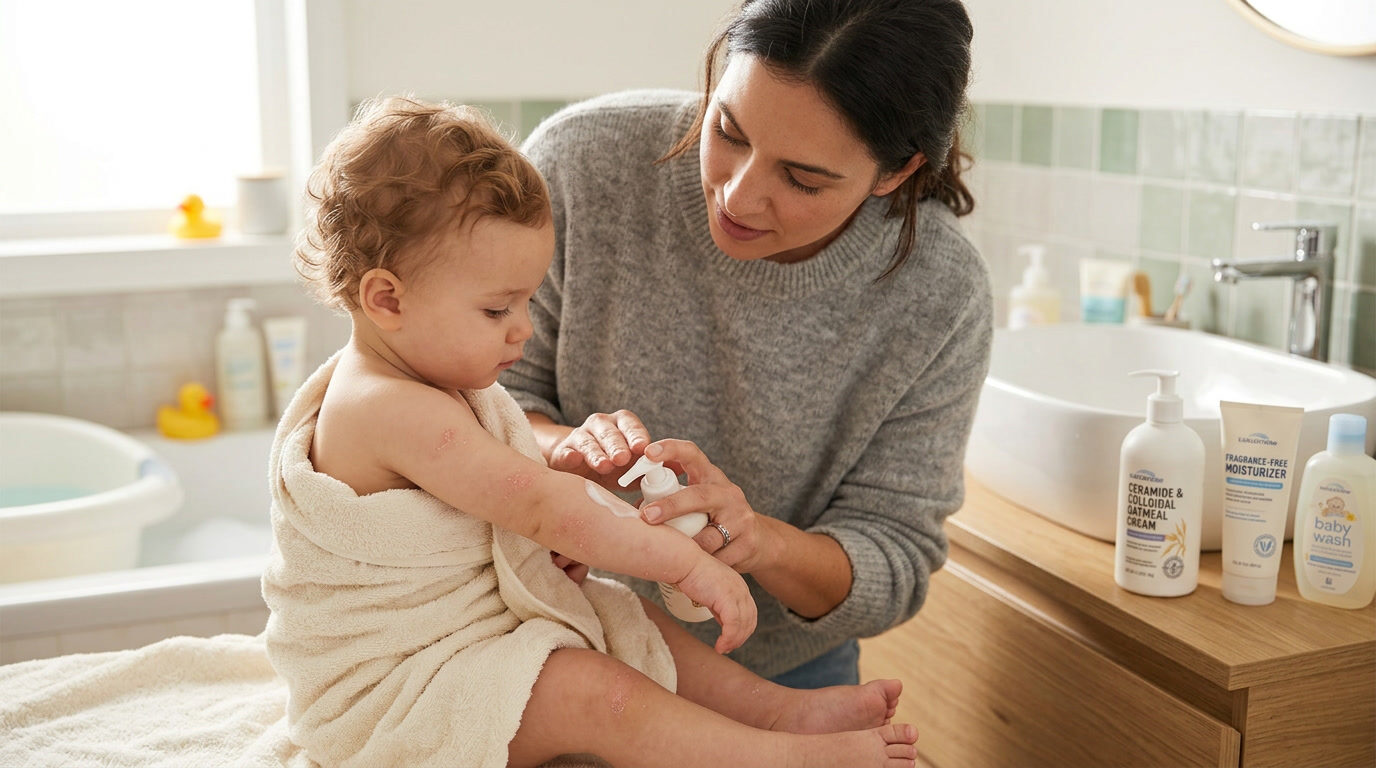
The American Academy of Pediatrics (AAP) recommends what's often called "soak and seal": a short lukewarm bath followed immediately by moisturiser applied within two to three minutes, while the skin is still slightly damp.
Bath time
- Keep it short: five to ten minutes maximum - Lukewarm water only (test with your elbow, not your hand) - Use a gentle, fragrance free wash; skip bubble baths entirely - Pat dry with a soft towel, don't rub

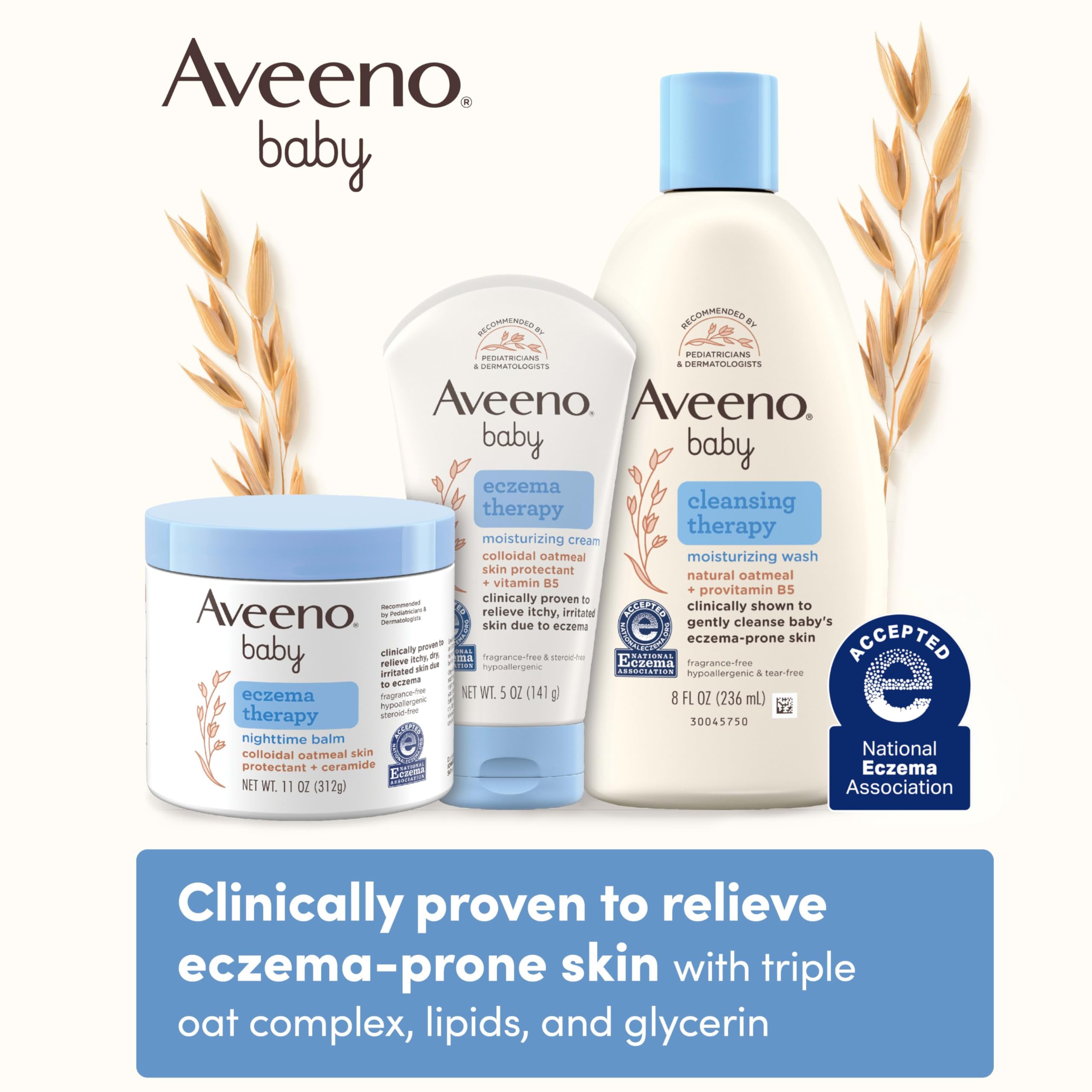


Aveeno Baby Eczema Therapy Nighttime Body Balm, Moisturizing Treatment for Face and Body, with Ceramides, Triple Oat Complex, Soothes Dry, Itchy Skin, Hypoallergenic, Fragrance and Steroid Free, 11oz
- Nighttime Eczema Treatment Balm: Clinically proven Aveeno Baby Eczema Therapy Nighttime Balm soothes and relie
- Protective Barrier Boost: This hypoallergenic baby eczema balm forms a lightweight barrier that locks in moist
- Triple Oat Complex & Glycerin Infusion: Soothing prebiotic and antioxidant-rich Triple Oat Complex combines wi
Moisturising
Apply a generous amount of moisturiser immediately after patting dry. For babies with active eczema, you want something thicker than a lotion: a cream or an ointment. Ointments (like petrolatum-based products) give the most occlusion but can feel greasy; creams are a good middle ground for most families.
Evening routine
Nighttime is when a lot of scratching happens and when an occlusive balm can do serious work while your baby sleeps. The Aveeno Baby Eczema Therapy Nighttime Body Balm is worth knowing about here: its triple oat complex plus ceramide formula is designed specifically for overnight use, and many parents find it meaningfully reduces morning flares.
For daytime application between baths, focus on the hands, face, and any areas that are actively dry or red. You don't need to do a full body application every time.
4. The Best Baby Eczema Products in 2026: A Paediatrician's Shortlist
There are dozens of products on shelves, but a handful come up again and again in clinical conversations because they combine the right ingredients with a track record of tolerability.


TUBBY TODD All Over Ointment - Baby Eczema Cream, Everyday Multi-Purpose Sensitive, Dry, Irritation Baby Skin Relief Cream, Steroid & Gluten Free, Fragrance Free, 3.5 oz & 8oz, 2 Pack
- SOOTHES ECZEMA & SENSITIVE SKIN: Tubby Todd’s baby body cream is packed with 1% Colloidal Oatmeal to naturally
- PEDIATRICIAN & DERMATOLOGIST TESTED: Safe for even the most delicate skin, this baby ointment is gentle enough
- BOTANICAL-RICH FORMULA: Infused with plant-based ingredients like Jojoba Esters, Camellia Leaf Extract, and Av
Tubby Todd All Over Ointment is a genuinely thoughtful formulation. It leads with 1% colloidal oatmeal and backs it up with jojoba esters, camellia leaf extract, and avocado fruit extract. Fragrance free, steroid free, and tested by paediatricians and dermatologists. The ointment texture makes it particularly useful for dry, cracked patches rather than all over daily use. At $58 for the two pack it's a premium choice, but the 8oz jar goes a long way.


Aveeno Baby Eczema Therapy Moisturizing Cream, Natural Colloidal Oatmeal & Vitamin B5, Baby Cream for Dry, Itchy, Irritated Skin Due to Eczema, Paraben- & Steroid-Free, 12 fl. oz
- 12-fluid ounces of Aveeno Baby Eczema Therapy Moisturizing Cream to soothe dry, itchy, irritated skin due to e
- Breakthrough baby eczema cream combines soothing natural colloidal oatmeal skin protectant with vitamin B5 to
- Hypoallergenic and non-greasy moisturizing baby cream is clinically proven to reduce itching, dryness and irri
Aveeno Baby Eczema Therapy Moisturising Cream is one of the most clinically studied baby eczema products on the market. The 12oz version is the one I'd suggest for families who are moisturising twice a day because you go through it faster than you think. The colloidal oatmeal plus vitamin B5 combination is clinically proven to reduce itch and dryness, it's non-greasy, and it's widely available.
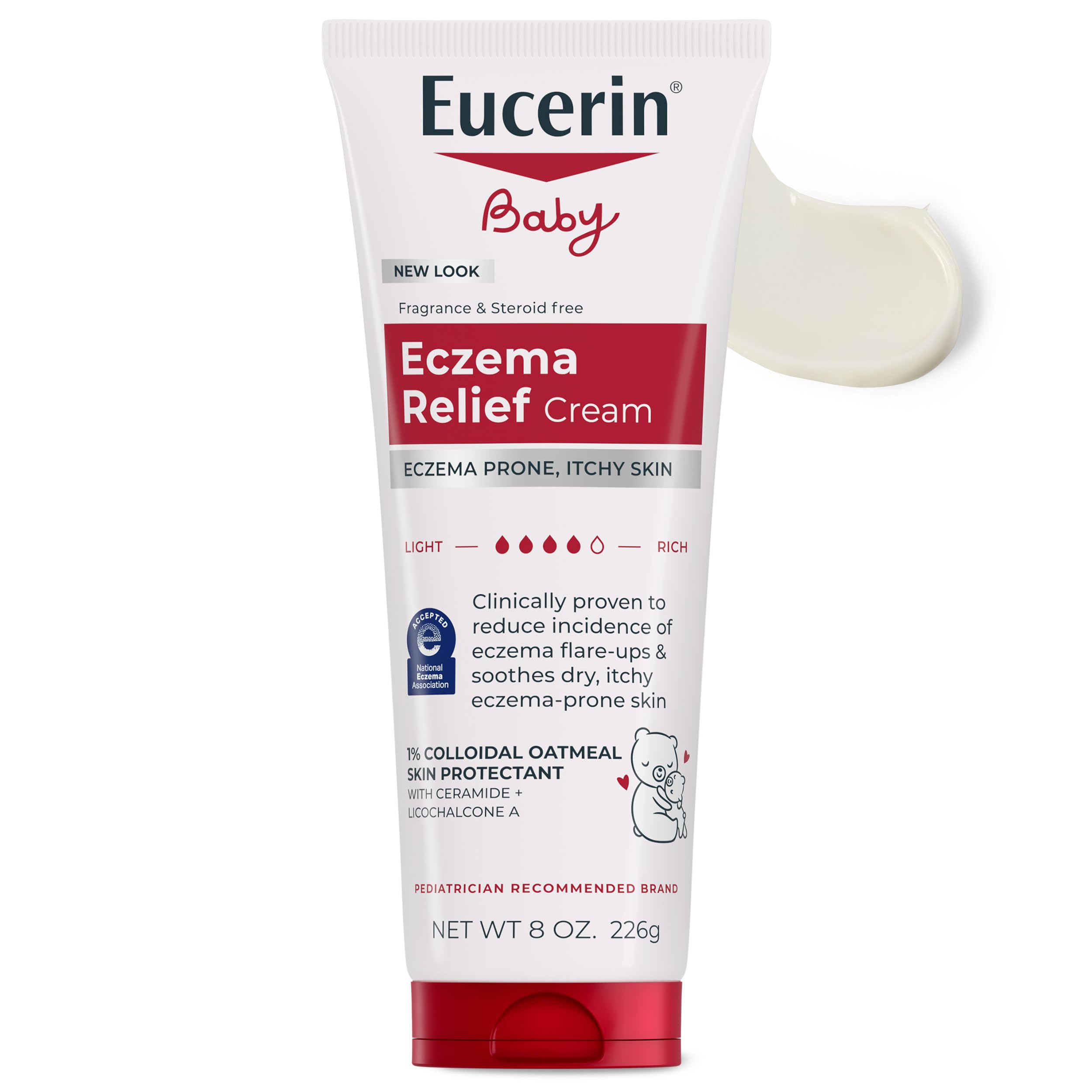
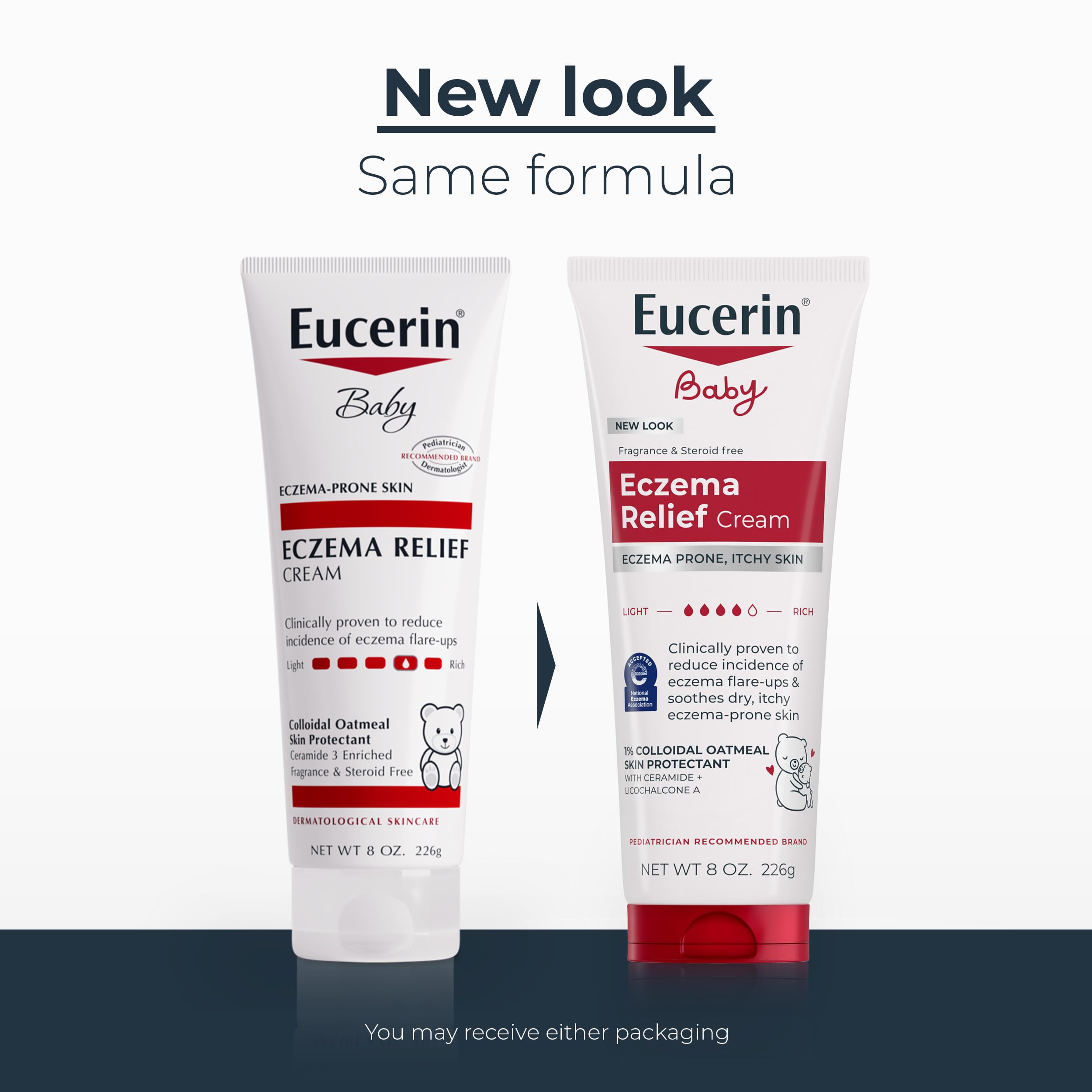
Eucerin Baby Eczema Relief Body Cream, Fragrance Free Baby Eczema Cream with Colloidal Oatmeal, Ceramide-3 and Licorice Root Extract, 8 Oz Tube
- Colloidal Oatmeal, Ceramides and Licorice Root: This Eucerin eczema cream for baby is formulated with Colloida
- Clinically Proven Formula: Eucerin Baby Eczema Relief Cream contains a clinically proven moisturizing formula
- Free Of: This Eucerin Baby cream for eczema treatment is steroid free and fragrance free, and is appropriate f
Eucerin Baby Eczema Relief Body Cream stands out because of its licorice root extract, which has demonstrated anti-inflammatory properties in peer reviewed research. Combined with colloidal oatmeal and ceramide 3, this is a particularly good option for babies whose eczema tends to be red and inflamed rather than primarily dry. Rated 4.8 stars across nearly 6,000 reviews, it's the highest rated product in this group.
For the smaller tube option, Aveeno Baby Eczema Therapy 7.3oz is a practical choice for travel or for keeping in a nappy bag.
5. Fragrance: The Invisible Trigger Most Parents Miss
If there's one change that makes the most immediate difference for eczema prone babies, eliminating fragrance from your home is probably it.
Fragrance is the leading cause of contact allergy in children and adults, according to the American Contact Dermatitis Society. Critically, "fragrance" on a label can represent a blend of up to several hundred individual chemical compounds, none of which need to be individually disclosed. "Natural fragrance" and "essential oils" carry the same risk; lavender, for example, is a common sensitiser.
Fragrance is the most common contact allergen in both children and adults. For a child with atopic dermatitis, eliminating fragrance from all leave-on and rinse-off products is often one of the most impactful first steps.
— American Contact Dermatitis Society (2022)
Where fragrance hides
Switching to fragrance free baby wipes alone has resolved recurring facial eczema in several of my patients. It's worth doing before anything else.
6. When Home Skincare Isn't Enough: Signs to Call Your Doctor
Most mild to moderate eczema responds well to the routine above. But there are specific signs that mean your baby needs professional assessment, and knowing them saves you from both unnecessary worry and delayed treatment.
See your GP or paediatrician if:
Your doctor may prescribe a mild topical steroid for short term use during flares. This is safe and appropriate when used as directed. Many parents are understandably cautious about steroids, but undertreated eczema causes its own harm: broken skin, infection risk, poor sleep, and distress for both baby and parent.
Understanding where eczema fits into your baby's broader development can be reassuring too. Skin health connects to sleep quality, feeding comfort, and overall wellbeing. If you want context on where your baby is developmentally, the baby development milestones explained resource on this site is a helpful companion read.
7. Comparison: Which Eczema Product Suits Your Baby Best?
| Skin Type / Situation | Key Ingredient Focus | Texture | Best For | Recommended Product | Price Range |
|---|---|---|---|---|---|
| Mild daily dryness, all over use | Colloidal oatmeal + vitamin B5 | Light cream | Everyday twice daily moisturising | Aveeno Baby Eczema Therapy 7.3oz | $12–13 |
| Moderate eczema, all over use (large family size) | Colloidal oatmeal + vitamin B5 | Light cream | Families going through product quickly | Aveeno Baby Eczema Therapy 12oz | $17–18 |
| Red, inflamed flares | Colloidal oatmeal + ceramide 3 + licorice root | Cream | Inflamed, reactive eczema | Eucerin Baby Eczema Relief | $17–18 |
| Overnight or cracked dry patches | Colloidal oatmeal + ceramides + triple oat complex | Thick balm | Nighttime occlusive treatment | Aveeno Baby Nighttime Balm | $19–20 |
| Budget friendly, barrier focused | Colloidal oatmeal + ceramides + vitamin E | Light cream | First purchase or backup product | CeraVe Baby Eczema Relief | $11–12 |
| Premium, botanical formula | Colloidal oatmeal + jojoba esters + avocado extract | Ointment | Stubborn dry patches, botanical preference | Tubby Todd All Over Ointment | $58 (2 pack) |
8. Expert Insights on Managing Baby Eczema in 2026
Conclusion
Watching your baby scratch and being unable to immediately fix it is genuinely distressing. But eczema is manageable, and the evidence is clear enough that you don't need to spend hours second-guessing every label. Keep it simple: a gentle lukewarm bath, a fragrance free wash, and a generous application of a ceramide or oatmeal based cream within minutes of getting out. Do that twice a day, every day, and you will see a difference.
The single most important insight to take away is this: consistency beats complexity. One good product used reliably will always outperform ten premium products used randomly.
If this article helped you feel more confident about your baby's skin, save it for the next time a flare starts and share it with the parent in your group who's also searching for answers at midnight.
Sources & References
- National Eczema Association. "Eczema Facts." 2023. https://nationaleczema.org/eczema/
- American Academy of Pediatrics (AAP). "Eczema (Atopic Dermatitis) in Babies and Children." 2022. https://www.healthychildren.org/English/health-issues/conditions/skin/Pages/Eczema.aspx
- Lynde CW, Andriessen A, Barankin B, et al. "Moisturizers and Ceramide-Containing Moisturizers May Offer Concomitant Therapy with Benefits." Journal of Clinical and Aesthetic Dermatology, 2014.
- American Contact Dermatitis Society. "Fragrance Allergens." 2022. https://www.contactderm.org
- Fowler JF, Nebus J, Wallo W, Eichenfield LF. "Colloidal Oatmeal Formulations as Adjunct Treatments in Atopic Dermatitis." Journal of Drugs in Dermatology, 2012.
- National Eczema Society (UK). "About Eczema." 2023. https://eczema.org/information-and-advice/about-eczema/
- Paller AS, Mancini AJ. "Hurwitz Clinical Pediatric Dermatology." 5th ed. Elsevier, 2016.
- Lio PA. "Atopic dermatitis: Practical management strategies." Pediatric Annals, 2019.
- US Food and Drug Administration. "Colloidal Oatmeal: A Skin Protectant." OTC Monograph M018, 2020.
Frequently Asked Questions
Why does my baby's eczema get worse in winter?
Can I use coconut oil on my baby's eczema?
How do I know if my baby's eczema is infected?
At what age does baby eczema usually improve?
Should I do an elimination diet if I think food is triggering my baby's eczema?
Is it safe to use steroid cream on my baby?
Can I use the same eczema cream on my baby's face as on their body?
Was this helpful?
Thanks — your feedback helps us pick what to write next.