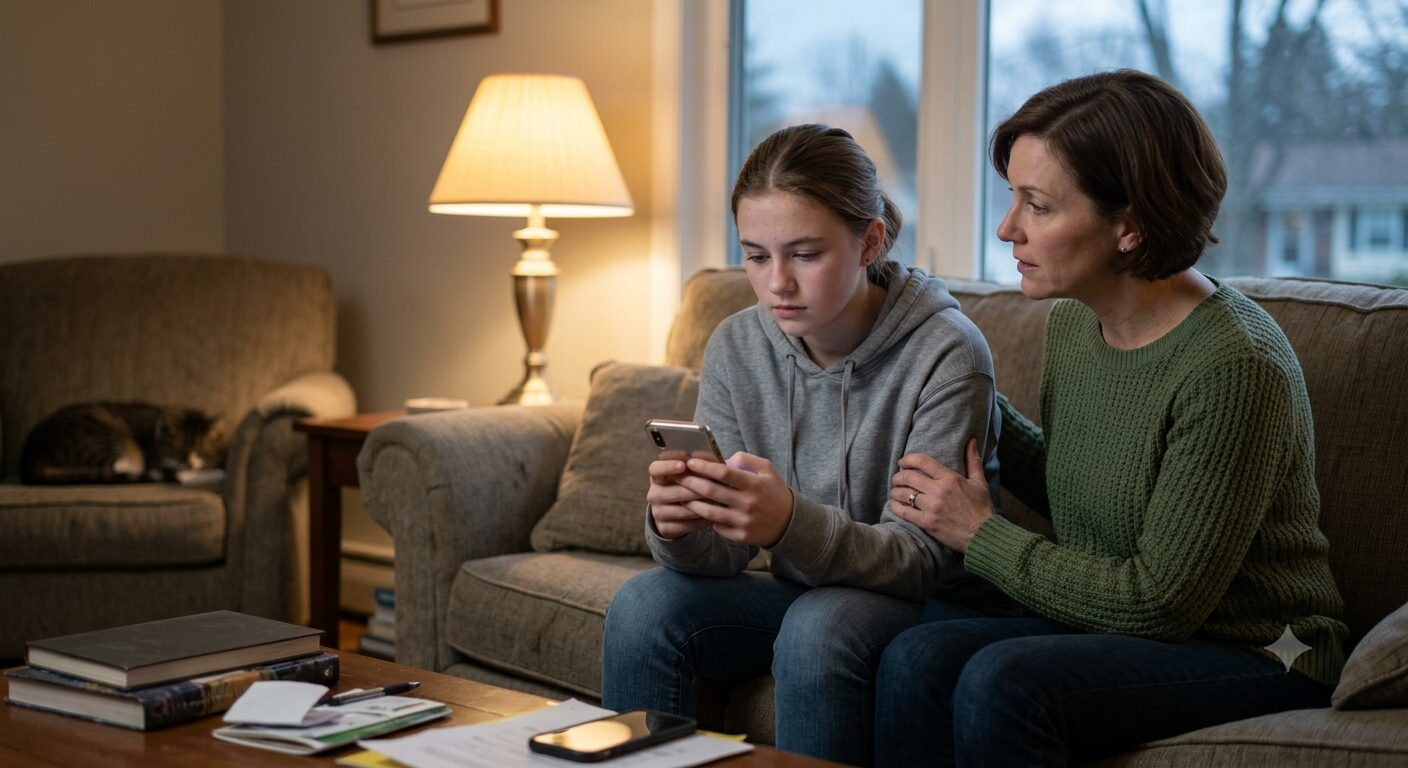
Teen Mental Health, Phones and Social Media: What Parents Need to Know
Social media and smartphones are genuinely reshaping teen mental health, but the picture is more nuanced than a simple "phones are bad" headline, and there are practical, evidence grounded steps parents can take right now.
In this article
Here is something that should stop you mid-scroll: in 2023, the U.S. Surgeon General issued a formal advisory calling social media "a profound risk of harm" to the mental health of children and adolescents. That is the same office that put warning labels on cigarettes. It is a striking statement, and it landed in the middle of an already heated debate that most parents feel every single day, usually around the dinner table, usually with a teenager who won't look up from their phone.
You are not imagining it. Something has shifted. But understanding what, exactly, has shifted, and what you can actually do about it, requires more than a doom-scrolling headline.
In this article, you will understand:
1. The Numbers Are Real: What the Data Actually Shows
The statistics on teen mental health are not a media panic. They are consistent across multiple large, independent data sets. Between 2012 and 2022, rates of major depressive episodes among U.S. adolescents roughly doubled, according to data tracked by the National Institute of Mental Health. Emergency department visits for self harm among teenage girls increased sharply from around 2011 onwards. The timing is not a coincidence: 2012 is roughly when smartphone ownership among teens crossed the 50 percent threshold in the United States, and when Instagram hit 100 million users.
Jean Twenge, a psychology professor at San Diego State University, has spent years tracking generational data and describes the post-2012 cohort of teenagers as "iGen," a generation whose social lives moved online during the most sensitive years of brain development. Her analysis, published in academic journals and summarised in her book "iGen," found that teens who spent five or more hours a day on their devices were 66 percent more likely to have at least one risk factor for suicide compared with those who spent one hour a day.
The arrival of the smartphone has radically changed every aspect of teenagers' lives, from the nature of their social interactions to the amount of sleep they're getting.
— Jean Twenge, Professor of Psychology, San Diego State University (2017)
The Monitoring the Future survey, run by the University of Michigan since the early 1970s, showed that teen happiness and life satisfaction began declining around 2012 and have not recovered. The UK's NHS Digital surveys tell a similar story: rates of probable mental disorder among 17 to 19 year olds rose from 10 percent in 2017 to 25.7 percent in 2023.
It is worth pausing here, because some researchers do push back. Amy Orben and Andrew Przybylski at the University of Oxford reanalysed large data sets and concluded that the relationship between screen time and wellbeing is real but modest, roughly equivalent in size to the association between wearing glasses and wellbeing. That is not nothing, but it is also not the whole story. More recent analyses, particularly those that separate passive scrolling from active social connection, tend to find stronger effects.
What the numbers look like in a real family
In a survey by Common Sense Media published in 2023, the average U.S. teenager spent 8 hours and 39 minutes per day on screens outside of school, with nearly half of that time on social media platforms. Girls consistently report higher social media use than boys, and they also show higher rates of depression and anxiety. That correlation holds across countries, which makes a purely cultural explanation harder to sustain.
2. Why the Teen Brain Is Especially Vulnerable Right Now
Adolescence is the single most dramatic period of brain development after the first two years of life, and the brain does not finish remodelling until the mid-twenties. This is not a metaphor. It is measurable on an MRI. The prefrontal cortex, which handles planning, impulse control and consequence awareness, is the last part to mature. The limbic system, which drives emotion, reward-seeking and social sensitivity, is already running at full speed during the teenage years.
Social media platforms are, in effect, a limbic system delivery mechanism. They are engineered to trigger the same dopamine pathways that evolved to make us care about social belonging and status. A like, a comment, a follow, a share: each of these produces a small neurochemical reward. For an adult, this is mildly distracting. For a brain that is biologically wired to prioritise peer approval above almost everything else, it is extraordinarily hard to resist.
Understanding why risk taking is biological in teens helps parents reframe a lot of what looks like defiance or recklessness. Your teenager is not being foolish. Their brain is doing exactly what evolution shaped it to do: seek social validation, scan for threats to belonging, and respond intensely to both. Social media just gives that ancient system a 24 hour, algorithmically optimised playground.
The teenage brain is not a defective adult brain. It is exquisitely tuned to learning from peers — and that makes it both brilliant and vulnerable in the age of social media.
— Sarah-Jayne Blakemore, Professor of Psychology and Cognitive Neuroscience, University of Cambridge (2018)
The sleep connection
One of the clearest mechanisms through which phones harm teen mental health is sleep disruption. The light emitted by phone screens suppresses melatonin production. But beyond the blue light issue, the emotional content of social media is itself activating. A teenager who checks Instagram at 11pm and sees a photo of a party they were not invited to will not fall asleep quickly after that. Their stress response is firing.
The American Academy of Sleep Medicine recommends that teenagers get 8 to 10 hours of sleep per night. Data from the CDC shows that more than 70 percent of U.S. high school students are getting less than that. Sleep deprivation in adolescents is not just tiredness: it is a direct driver of anxiety, depression, irritability and impaired learning. If you want to understand your teenager's mood, their sleep pattern is often the most important variable to look at.
3. Not All Screen Time Is Equal: The Patterns That Actually Cause Harm
Saying "screen time is bad" is a bit like saying "food is bad." The type, the amount, the context and the alternatives all matter. Research is increasingly pointing to specific patterns of use that are most strongly associated with poor mental health outcomes.
Passive scrolling versus active connection
Studies from the Oxford Internet Institute and others consistently find that passive consumption, scrolling through other people's content without interacting, is more strongly linked to poor wellbeing than active use, such as messaging friends, creating content, or video calling family. Passive scrolling is essentially a comparison machine. Your teenager is absorbing a curated highlight reel of other people's lives, bodies, relationships and achievements, often for hours at a time, usually alone, often late at night.
Social comparison and its cost
Social comparison is a normal human behaviour. We all do it. But social media accelerates and intensifies it in ways that have no historical precedent. Pre-smartphone, a teenager might have compared themselves to a few dozen peers they actually knew. Now they compare themselves to thousands of curated profiles, including celebrities, influencers and algorithmically selected "aspirational" content.
For girls in particular, research published in journals including JAMA Pediatrics has found strong associations between heavy Instagram use and body dissatisfaction, disordered eating and low self esteem. Experimental studies, where researchers have randomly assigned participants to deactivate social media accounts for a period, show measurable improvements in wellbeing, particularly for heavy users.
Fear of missing out (FOMO) and social exclusion
Being excluded from a group chat, being left out of plans that are openly documented on social media, or watching your friendship group bond without you in real time: these experiences are uniquely painful in the social media era. A teenager in 2025 cannot come home and mentally leave school behind. The social dynamics follow them into their bedroom, onto their pillow.
The 
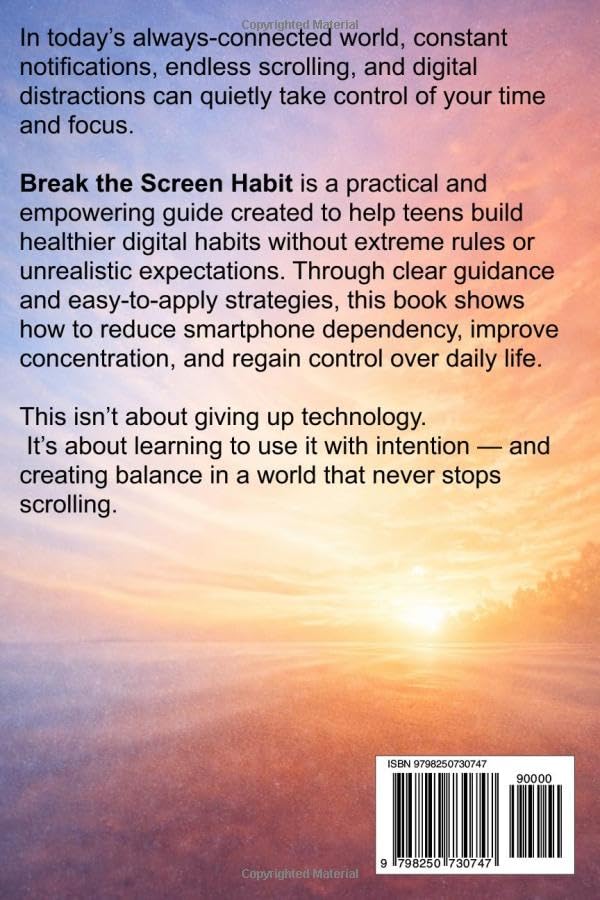
Break the Screen Habit: A Practical Guide for Teens to Reduce Smartphone Addiction, Build Focus, Improve Confidence, and Create a Healthy Digital Life
Break the Screen Habit: A Practical Guide for Teens to Reduce Smartphone Addiction, Build Focus, Improve Confidence, and Create a Healthy Digital Life
- Personal Transformation
- Image Unavailable Image not available forColor:
- Why smartphone addiction happens—and why it’s not your fault
4. The Platform Question: Are Some Apps More Harmful Than Others?
Not all platforms are created equal, and the research does suggest meaningful differences between them. Instagram, TikTok and Snapchat tend to generate the most concern among researchers, primarily because they are heavily image and video based, algorithmically curated for maximum engagement, and designed to create near-constant social comparison loops.
YouTube occupies a more complex position. Heavy YouTube use can mean hours of passive video consumption, which carries its own risks, but it is also where many teenagers learn skills, follow genuine interests and consume long form content that requires sustained attention. The platform is not inherently more benign, but the type of use matters.
Gaming deserves a separate mention. While gaming is often lumped in with social media, the mechanisms are different. For most teenagers, gaming is social (they play with friends), goal oriented (there is a clear task structure) and active rather than passive. Problem gaming, where a teenager is using games to escape from anxiety or depression, is a real issue and worth watching for, but the assumption that all gaming is harmful is not supported by the research.
The algorithm problem
This is perhaps the most important structural issue, and the one that individual family rules cannot fully solve. Social media algorithms are not neutral. They are optimised for time on platform, and the most reliable way to keep someone on a platform is to keep them emotionally activated. Outrage, anxiety and social drama keep people scrolling. Contentment and calm do not.
The consequence is that teenagers who begin searching for content about body image, mental health struggles, or relationship problems are algorithmically served more of the same, and more extreme versions of it. This is well documented: internal research at Meta (published as a result of the Haugen disclosures) showed that Instagram made body image issues worse for one in three teenage girls who already felt bad about their bodies.
The 
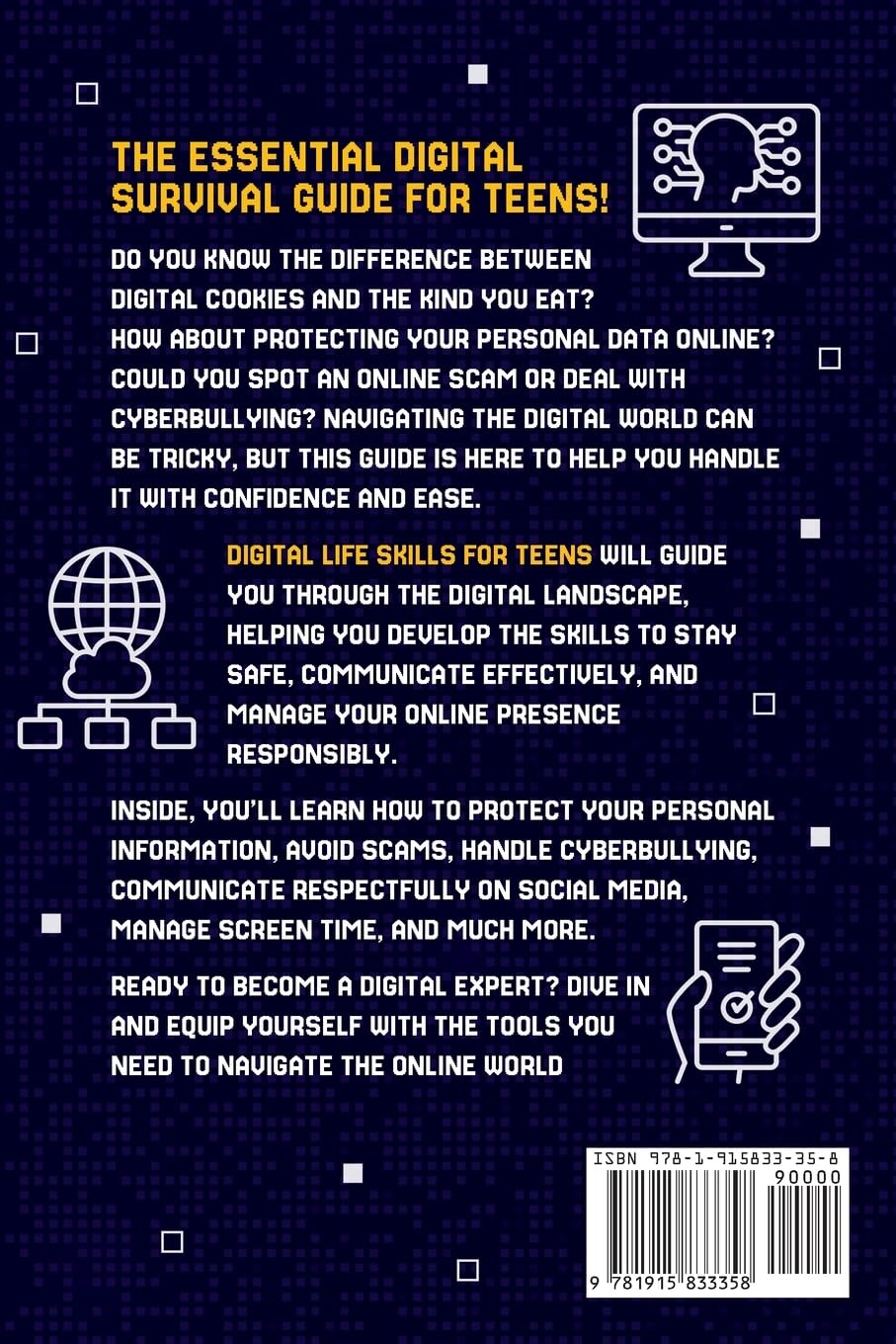
Digital Life Skills for Teens: How to Communicate, Behave, Stay Safe, and Find Balance in an Online World. The Essential Digital Survival Guide (Life Skills for Tweens & Teens)
Digital Life Skills for Teens: How to Communicate, Behave, Stay Safe, and Find Balance in an Online World. The Essential Digital Survival Guide (Life Skills for Tweens & Teens)
- Teen & Young Adult
- Education & Reference
- Science & Technology
5. What Actually Works: Conversations, Limits and Family Norms
There is a temptation, when you read the research on this topic, to want to confiscate every device in the house and send your teenager outside with a football. That impulse is understandable. It is also, in practice, likely to backfire.
Teenagers who feel policed rather than trusted tend to become more secretive about their digital lives, not less active in them. The research on parental mediation of screen time consistently finds that the most effective approach is not restriction alone but restriction combined with warmth, explanation and genuine conversation.
What good conversations actually sound like
The goal is not to win an argument about whether phones are bad. The goal is to keep a channel open so that your teenager will come to you when something goes wrong online, because something will go wrong online. That means conversations that are curious rather than prosecutorial.
Some openers that work in clinic and at home:
- "I've been reading about how social media companies design their apps to keep you on them. Does that match what you've noticed?" - "Have you ever felt worse after being on Instagram? I'm genuinely curious, not trying to make a point." - "What would you find hardest to give up if we had a no phone hour in the evenings?"
These conversations take time. They work better in the car, on a walk, or during a shared activity than face to face at the kitchen table, which can feel like a tribunal.
Parental warmth and open communication are the strongest protective factors for adolescent mental health, including in the context of digital life.
— American Academy of Pediatrics, Council on Communications and Media (2023)
Building that kind of relationship over time, with genuine interest in your teenager's inner life, is the foundation. You can read more about this in our overview of how strong bonds build healthier adults.
Household norms that research supports
The American Academy of Pediatrics recommends developing a family media plan rather than blanket rules, because what works depends on the individual teenager, the household and the context. That said, some norms have fairly strong support:
What does NOT have strong research support: complete bans on specific apps (teenagers route around them), software monitoring without the teenager's knowledge (destroys trust when discovered), and taking phones as punishment (phones now contain a teenager's entire social life, so this is experienced as extreme and often escalates conflict disproportionately).

Reset Your Teen: A 30-Day Action Plan to Reduce Screen Time and Improve Your Teen’s Mental Health
- Kindle Store
- Kindle eBooks
- Computers & Technology
6. Supporting a Teen Who Is Already Struggling
Everything discussed so far is about prevention and balance for teens who are broadly doing okay. But some teenagers are already in distress, and the phone question in that context looks different.
If your teenager is showing signs of significant anxiety, depression, or emotional dysregulation, social media reduction is not a substitute for mental health support. It may be one helpful component, but it is not the whole answer. The underlying vulnerabilities that make a teenager particularly susceptible to social media harm, low self esteem, pre-existing anxiety, a history of social difficulties, often need addressing directly.
Signs that warrant a conversation with your GP or paediatrician
If your teenager is showing any of these signs, please do not manage this with an app blocker. Get professional support. In the UK, that starts with your GP and may involve CAMHS (Child and Adolescent Mental Health Services). In the United States, your paediatrician is the right first call.
The role of protective factors
Research is consistent that certain things buffer teenagers against the harms of social media, even when they are heavy users:
The summer months, when school structure disappears, can be a particularly vulnerable period. Our family support guide for teen mental health this summer has specific, practical suggestions for keeping these protective factors in place when the school year ends.
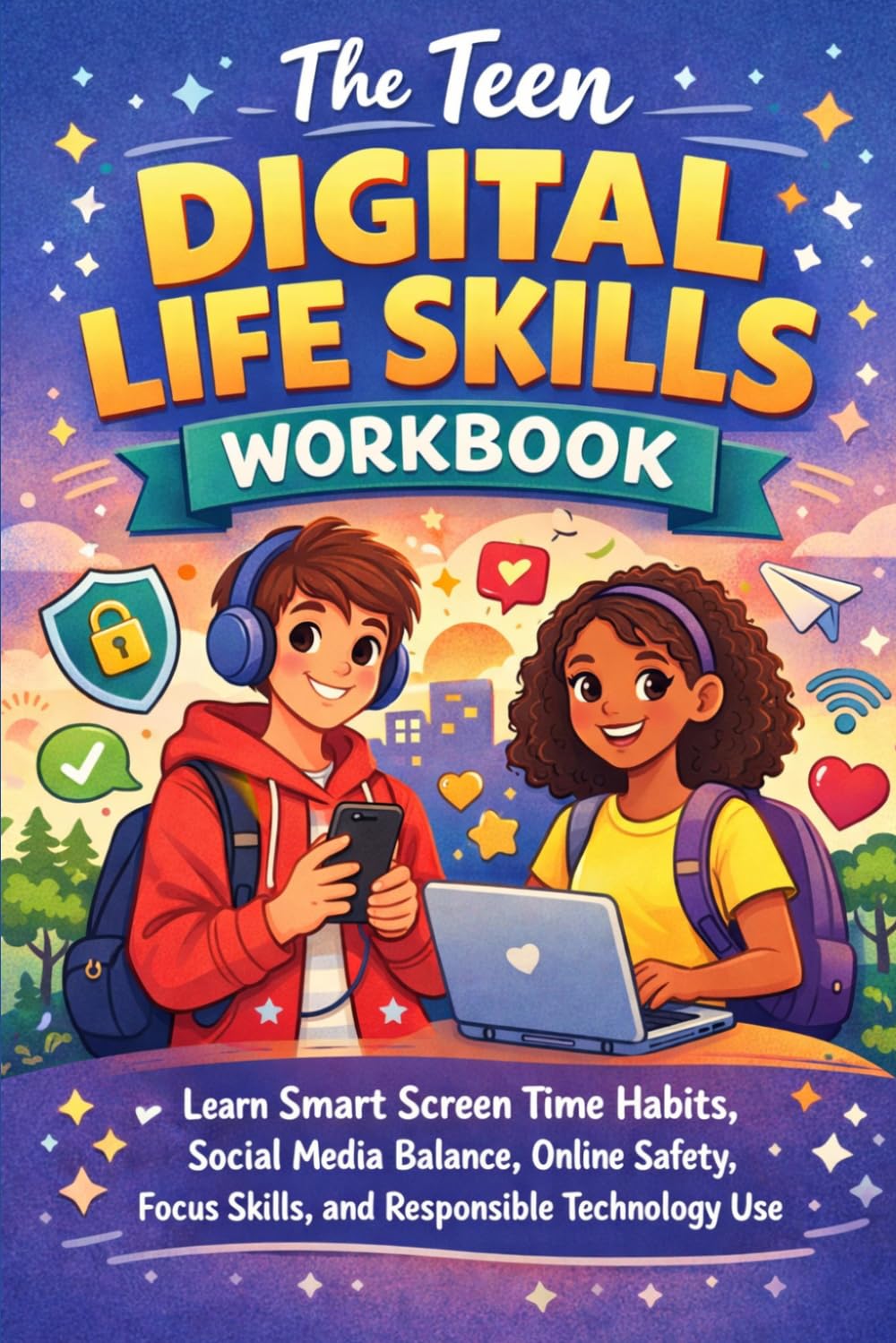

The Teen Digital Life Skills Workbook: Learn Smart Screen Time Habits, Social Media Balance, Online Safety, Focus Skills, and Responsible Technology Use
- Children's Books
- Growing Up & Facts of Life
- Difficult Discussions
Comparison: Approaches to Managing Teen Screen Time and Social Media
| Approach | Best For | Key Strengths | Main Limitations | Recommended Resource | Price Range |
|---|---|---|---|---|---|
| Family conversations and norms | All teens, especially 13-16 | Builds trust, keeps communication open, sustainable long term | Requires consistent parental effort and follow through | Reset Your Teen | Low cost |
| Structured workbook for the teen | Teens with some self awareness, 11-16 | Teen led, builds genuine insight and self regulation | Only works if teenager engages willingly | Teen Digital Life Skills Workbook | $10-18 |
| Digital literacy education | Teens aged 12-17 | Teaches platform awareness, online safety, long term habits | Does not address immediate emotional distress | Digital Life Skills for Teens | $11.99 |
| Screen habit reset programme | Teens with heavy use or early signs of dependence | Concrete 30 day structure, measurable targets | Short term focus; habits can drift back without maintenance | Reset Your Teen | Kindle price |
| Gaming balance tools | Teens who primarily use screens for gaming | Addresses specific mechanics of gaming overuse | Does not cover social media dynamics | Gaming Overload Workbook | $17.95 |
| Teen self help workbook on screen habits | Ages 11-14 specifically | Very age targeted, practical exercises | Narrower age range, less relevant for older teens | Own Your Screen Time | Competitive |
Expert Insights on Teen Mental Health and Digital Life
Conclusion
If you have read this far, you are clearly the kind of parent who thinks carefully about their teenager's wellbeing. That itself is one of the most important things you can offer. The research on teen mental health and social media is genuinely worrying in places, but it is also full of hope: the protective factors that buffer teenagers against these harms are things that most families can build, and they are fundamentally human. Connection, warmth, sleep, conversation, and the quiet knowledge that there is someone in your corner.
The phone is not the enemy. But the way we use it, and the norms we build around it as families, matter enormously. The most important thing you can do is stay curious, stay present and keep the conversation going even when it feels hard.
If there is one thing worth holding onto from everything here, it is this: a teenager who feels genuinely known and valued by their family is far more resilient than any app blocker will ever make them.
Save this article, share it with a partner or a friend who is wrestling with the same questions, and come back to it as your teenager moves through these years. The landscape will keep changing. The fundamentals will not.
Sources & References
- U.S. Department of Health and Human Services, Office of the Surgeon General. "Social Media and Youth Mental Health: The Surgeon General's Advisory." 2023. https://www.hhs.gov/surgeongeneral/reports-and-publications/social-media-youth-mental-health/index.html
- Twenge, J.M. "iGen: Why Today's Super-Connected Kids Are Growing Up Less Rebellious, More Tolerant, Less Happy — and Completely Unprepared for Adulthood." Atria Books, 2017.
- Orben, A. and Przybylski, A.K. "The association between adolescent well-being and digital technology use." Nature Human Behaviour. 2019. https://www.nature.com/articles/s41562-018-0506-1
- Common Sense Media. "The Common Sense Census: Media Use by Tweens and Teens, 2023." 2023. https://www.commonsensemedia.org/research/the-common-sense-census-media-use-by-tweens-and-teens-2023
- National Institute of Mental Health. "Major Depression." Data on prevalence trends among adolescents. 2023. https://www.nimh.nih.gov/health/statistics/major-depression
- NHS Digital. "Mental Health of Children and Young People in England, 2023." 2023. https://digital.nhs.uk/data-and-information/publications/statistical/mental-health-of-children-and-young-people-in-england
- Centers for Disease Control and Prevention. "Youth Risk Behavior Survey Data." 2023. https://www.cdc.gov/yrbs
- American Academy of Pediatrics. "American Academy of Pediatrics Council on Communications and Media: Children and Adolescents and Digital Media." Pediatrics. 2023.
- American Academy of Sleep Medicine. "Recommended Amount of Sleep for Pediatric Populations." Journal of Clinical Sleep Medicine. 2016.
- Haidt, J. "The Anxious Generation: How the Great Rewiring of Childhood Is Causing an Epidemic of Mental Illness." Penguin Press, 2024.
- Blakemore, S.J. "Inventing Ourselves: The Secret Life of the Teenage Brain." PublicAffairs, 2018.
- Haugen, F. Testimony before the U.S. Senate Subcommittee on Consumer Protection. October 2021.
- Prinstein, M. "Popular: The Power of Likability in a Status-Obsessed World." Viking, 2017. Public statements as APA Chief Science Officer, 2023.
- Monitoring the Future Survey, University of Michigan. Annual data reports 2012–2023. https://monitoringthefuture.org
Frequently Asked Questions
At what age should my teenager get a smartphone?
Is there a safe amount of time my teenager can spend on social media?
My teenager seems addicted to their phone. Is phone addiction real?
Should I monitor my teenager's social media accounts?
My teenager says all their friends are on social media and they'll be left out if I restrict it. Are they right?
What can I do if my teenager is being bullied online?
Is gaming as harmful as social media for teen mental health?
Was this helpful?
Thanks — your feedback helps us pick what to write next.