Pregnancy Diet and Chemical Exposure: What the Science Says
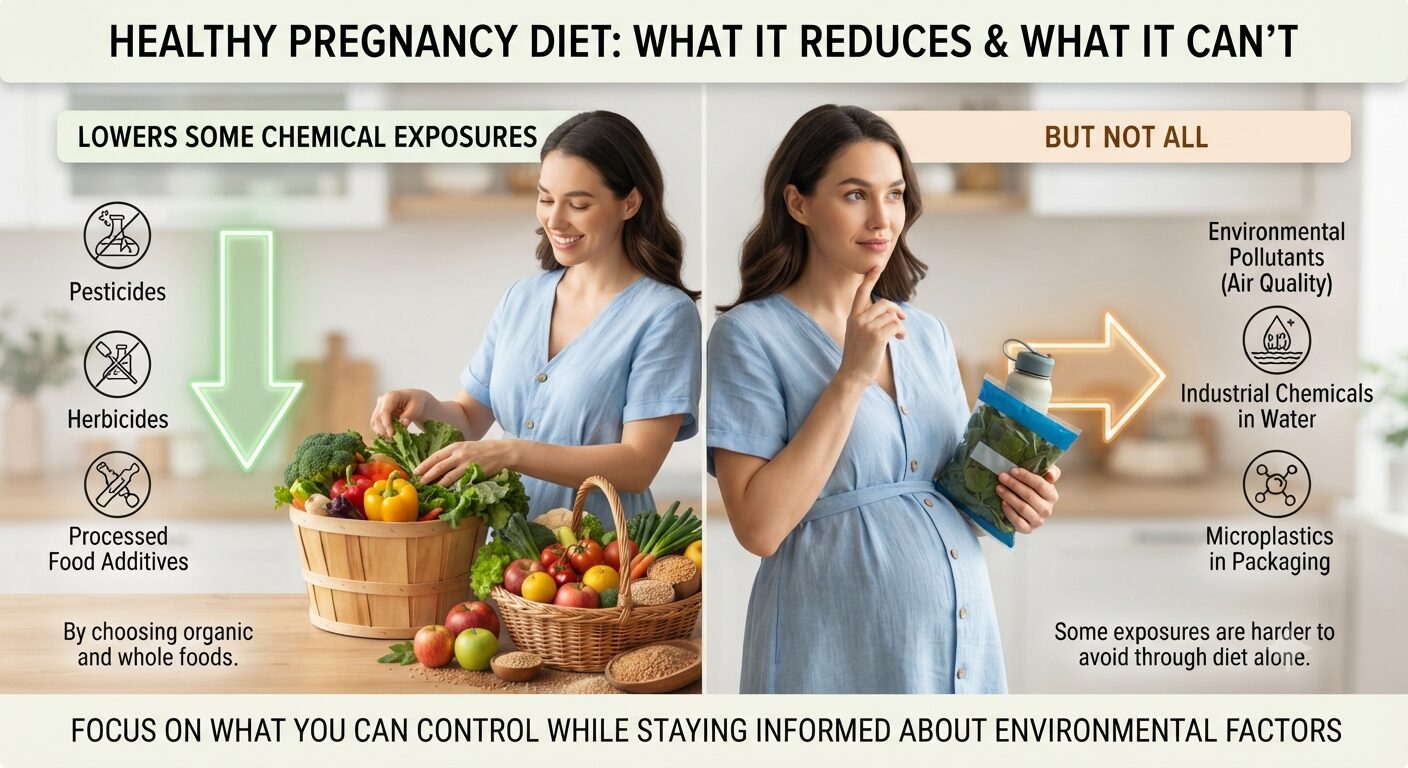
Eating a healthy diet during pregnancy can meaningfully lower your exposure to several harmful chemicals, but it does not eliminate all risks, and some exposure routes have little to do with food at all.

In this article
Introduction
Here is a number that tends to stop parents mid-sentence: the U.S. Centers for Disease Control and Prevention (CDC) has detected measurable levels of more than 200 synthetic chemicals in the blood or urine of the average American, including pregnant women. That figure comes from the National Biomonitoring Program, which has been tracking chemical body burden in the U.S. population for decades. The hopeful news buried in that same body of research is that what you eat genuinely moves the needle on some of those numbers.
But here is the honest part that a lot wellness content leaves out: diet matters a lot for certain chemicals and very little for others. Knowing the difference is genuinely useful. It means you can focus your energy where it counts rather than spending the next nine months anxious about everything on your plate.
In this article, you will understand:
1. Why Chemical Exposure During Pregnancy Deserves Honest Attention
The stakes during pregnancy are genuinely higher than at other life stages, and that is not alarmism. It is developmental biology.
A developing fetus is building organ systems, a brain, and an endocrine architecture from scratch. Many synthetic chemicals, particularly those that disrupt hormonal signalling, can interfere with that process at concentrations far lower than those that would cause obvious harm in an adult. The National Institute of Environmental Health Sciences uses the phrase "windows of susceptibility" to describe this: the same chemical at the same dose can have very different effects depending on exactly when during development it arrives.
What "exposure" actually means
Exposure does not automatically mean harm. Toxicologists are fond of saying that the dose makes the poison. What researchers look for is whether a chemical shows up in maternal blood or urine at levels associated with measurable health outcomes, things like altered thyroid function, lower birth weight, or changes in fetal neurodevelopment. The field of environmental epidemiology has spent the last two decades building that evidence base, and the picture it paints is nuanced.
A good starting point for understanding how nutrition shapes fetal development more broadly is this look at third trimester nutrition and colostrum, which covers what your body is already doing to protect and nourish your baby in those final months.
2. The Chemicals Diet Can Meaningfully Reduce
Diet is one of the most powerful levers you have for several specific classes of chemicals.
Organophosphate and pyrethroid pesticides
Organophosphate pesticides are among the most studied dietary contaminants in pregnancy. These chemicals are widely used in conventional agriculture and leave detectable residues on many fruits and vegetables. Because they are water soluble and metabolise relatively quickly, urine levels in people who switch to organic produce can drop within days.
A landmark study published in Environmental Health Perspectives followed pregnant women in California's Salinas Valley and found that higher urinary levels of organophosphate metabolites during pregnancy were associated with lower IQ scores in children at age 7. The researchers, from the UC Berkeley Center for Environmental Research and Children's Health, were careful to note the observational nature of the data, but the finding has been replicated in several independent cohorts since.
Prenatal and childhood exposures to organophosphate pesticides are associated with poorer cognitive development in children.
— Bouchard et al., Environmental Health Perspectives (2011)
The practical implication: eating organic versions of the fruits and vegetables with the highest pesticide residue loads can meaningfully reduce your organophosphate exposure without requiring you to go entirely organic. The Environmental Working Group publishes an annual "Dirty Dozen" list based on USDA pesticide residue data. In recent years it has consistently included strawberries, spinach, kale, peaches, pears, and apples at or near the top.


Real Food for Pregnancy: The Science and Wisdom of Optimal Prenatal Nutrition
- Health, Fitness & Dieting
- Women's Health
- Pregnancy & Childbirth
BPA and phthalates
Bisphenol A (BPA) and phthalates are endocrine disrupting chemicals that leach from certain food packaging, plastics, and canned food linings into the food itself. Studies including the ELEMENT cohort in Mexico City and the CHAMACOS cohort in California have found that higher prenatal phthalate exposure is associated with altered neurodevelopment and earlier puberty in children.
Dietary choices can shift these exposures significantly:
3. Seafood, Mercury, and the Balancing Act Every Pregnant Woman Faces
Seafood sits at the centre of one of the most genuinely complicated nutrition decisions in pregnancy, because the very food that provides the most brain building omega-3 fatty acids also carries the highest risk of mercury contamination.
Mercury, particularly in its organic form methylmercury, is a neurotoxin. It accumulates up the food chain, so large, long-lived predatory fish like shark, swordfish, king mackerel, and bigeye tuna contain far higher concentrations than small, short-lived species. The U.S. Food and Drug Administration (FDA) and the Environmental Protection Agency (EPA) issued updated joint advice in 2024 confirming that pregnant women should eat 8 to 12 ounces of lower mercury seafood per week but should avoid the four highest mercury fish entirely.
The low mercury options worth eating regularly
What to avoid entirely during pregnancy


The Whole 9 Months: A Week-By-Week Pregnancy Nutrition Guide with Recipes for a Healthy Start
- Health, Fitness & Dieting
- Women's Health
- Pregnancy & Childbirth
4. The Chemicals Diet Struggles to Touch
Here is the part that requires honesty, because some of the most concerning chemicals in the environment have very little to do with what ends up on your plate.
PFAS: the "forever chemicals"
Per- and polyfluoroalkyl substances (PFAS) are a family of more than 12,000 synthetic chemicals used in non-stick cookware coatings, waterproof clothing, food packaging, firefighting foam, and countless industrial processes. They earned the nickname "forever chemicals" because they do not break down in the environment or in the human body. The CDC's National Health and Nutrition Examination Survey has found detectable PFAS levels in the blood of approximately 97 percent of Americans tested.
PFAS enter the body through multiple routes: contaminated drinking water, dust inhalation in homes with PFAS-treated carpets or furniture, and yes, some food contact materials. But here is the difficult reality: dietary changes alone are unlikely to produce dramatic reductions in blood PFAS levels, because the compounds are so persistent. A 2020 review in the journal Environmental Science and Technology concluded that drinking water is the dominant exposure route in communities with PFAS-contaminated water supplies, and that mitigation has to focus there first.
What you can reasonably do:
Lead
Lead exposure during pregnancy is associated with reduced fetal growth and neurodevelopmental harm, and there is no safe level of exposure according to the CDC. But the primary exposure routes for most pregnant women in the United States are old lead paint, lead pipes in plumbing, and contaminated soil, not food. Some food sources do contribute: root vegetables grown in contaminated soil, certain imported spices (studies have found elevated lead in some turmeric and chili powders), and old ceramic dishware with lead glazes. But dietary changes alone will not address a woman who is drinking from lead pipes or living in a home with deteriorating lead paint.

Eating for Pregnancy: Your Essential Month-by-Month Nutrition Guide and Cookbook
- Health, Fitness & Dieting
- Diets & Weight Loss
- Other Diets
5. How Overall Diet Quality Shifts Your Chemical Load
Beyond individual contaminants, there is compelling evidence that overall diet quality during pregnancy is associated with lower total chemical body burden, even when individual exposures are hard to control precisely.
A 2021 study published in Environment International examined dietary patterns in pregnant women from the INMA (Environment and Childhood) cohort in Spain and found that women who more closely followed a Mediterranean style diet had lower urinary concentrations of several organochlorine pesticide metabolites and certain heavy metals. The Mediterranean pattern emphasised vegetables, legumes, whole grains, olive oil, and moderate fish intake, and it was the overall pattern, not any single food, that appeared protective.
Adherence to a Mediterranean diet during pregnancy was inversely associated with several urinary biomarkers of chemical exposure.
— Casas et al., Environment International (2021)
Why overall dietary patterns matter more than individual superfoods
When researchers look at diet and chemical exposure, the mechanism is not simply "eat less of the contaminated food." There are several biological pathways at work:
The evidence on what constitutes solid prenatal nutrition has grown substantially. Sound prenatal nutrition guidance has evolved alongside our understanding of how the intrauterine environment shapes long term health.



The Feel-Good Pregnancy Cookbook: 100 Nutritious and Delicious Recipes for a Healthy 9 Months and Beyond
- Health, Fitness & Dieting
- Women's Health
- Pregnancy & Childbirth
The ultra-processed food problem
Ultra-processed foods, those made with five or more industrial ingredients and typically sold in plastic packaging, present a double exposure problem during pregnancy. They tend to be lower in the protective nutrients (fibre, folate, antioxidants) that buffer some chemical harms, and higher in food contact material contaminants from their packaging and processing.
A 2022 analysis in the journal Food and Chemical Toxicology found that phthalate metabolite levels in urine increased in direct proportion to the proportion of calories coming from ultra-processed foods. The researchers suggested that the extensive contact between food and plastic equipment during industrial processing was the likely explanation.
Practical steps to reduce ultra-processed food intake during pregnancy:
6. Building a Practical Eating Plan That Reduces What It Can
All of this research is useful only if it translates into something you can actually do on a regular Tuesday when you are tired, possibly nauseated, and not interested in spending two hours in the kitchen.
The good news is that the eating pattern that reduces your dietary chemical exposure is essentially the same one that optimises fetal nutrition: varied, whole food, plant-forward, with regular servings of low mercury fish. You are not being asked to do two different things.
A week of eating that works on both dimensions
Here is a simple framework, not a rigid meal plan:
What about supplements?
A good prenatal multivitamin covers folate (or folic acid), iodine, vitamin D, and iron, which are the nutrients most likely to be insufficient from diet alone. Some research suggests that adequate iron, calcium, and zinc may actually reduce the absorption of competing heavy metals like lead and cadmium from the gut. Talk to your midwife or OB about whether a prenatal supplement with these nutrients is appropriate for you; most clinicians recommend starting before conception if possible.
Understanding how your body processes and builds reserves of these nutrients matters across the whole pregnancy. The way nutrition and fetal development interact during those final weeks is particularly striking, as covered in this detailed look at fetal brain development in the third trimester.

The Big Book of Pregnancy Nutrition: Everything Expectant Moms Need to Know for a Happy, Healthy Nine Months and Beyond
- Health, Fitness & Dieting
- Women's Health
- Pregnancy & Childbirth
| Exposure Type | Main Dietary Source | Non-Dietary Sources | Can Diet Reduce It? | Recommended Product |
|---|---|---|---|---|
| Organophosphate pesticides | Conventional fruits and vegetables | Minimal (some air drift near farms) | Yes, substantially | Real Food for Pregnancy |
| Mercury | High-mercury fish (shark, swordfish, bigeye tuna) | Dental amalgam (minor); some air pollution | Yes, by choosing low-mercury species | The Whole 9 Months |
| BPA and phthalates | Canned food, processed food, fast food | Non-stick cookware, plastic containers, cosmetics | Partially (diet plus product swaps) | Eating for Pregnancy |
| PFAS ("forever chemicals") | PFAS-treated packaging, some fish in contaminated water | Drinking water, dust, cookware, textiles | Minimally (water filtration is more effective) | First-Time Mom's Pregnancy Cookbook |
| Lead | Root vegetables in contaminated soil, some imported spices | Old paint, lead pipes, contaminated soil | Partially (calcium intake helps; plumbing matters more) | Feel-Good Pregnancy Cookbook |
| Arsenic | Rice (especially brown rice), some apple juice | Well water in certain regions, contaminated soil | Yes, by varying grains and choosing filtered water | Big Book of Pregnancy Nutrition |
Expert Insights
Conclusion
Pregnancy nutrition advice can sometimes feel like it is trying to make you afraid of everything at once. The reality is more useful than that: your food choices genuinely matter for some chemical exposures, and there are practical, affordable shifts that move the needle without requiring you to achieve an impossible standard of purity.
Focus on the high-residue produce categories. Eat your salmon. Store food in glass when you can. Check your water. That is not a perfect chemical-free pregnancy, because no such thing exists, but it is a thoughtful, evidence-informed one. And thoughtful is all any of us can reasonably manage.
As a paediatrician, the most reassuring thing I can tell you is this: informed, intentional eating during pregnancy is one of the most powerful gifts you can give a developing nervous system. Save this article, share it with someone who is expecting, and check in with your care team about any specific exposures that concern you.
Sources & References
- CDC National Biomonitoring Program. "Chemical Exposures: The National Report on Human Exposure to Environmental Chemicals." 2023. https://www.cdc.gov/biomonitoring/
- Bouchard MF, Chevrier J, Harley KG, et al. "Prenatal Exposure to Organophosphate Pesticides and IQ in 7-Year-Old Children." Environmental Health Perspectives. 2011. https://doi.org/10.1289/ehp.1003185
- Casas M, et al. "Maternal diet, exposure to environmental chemicals and child neurodevelopment: the INMA cohort." Environment International. 2021.
- FDA and EPA. "Advice About Eating Fish." Updated 2024. https://www.fda.gov/food/consumers/advice-about-eating-fish
- Landrigan PJ, et al. "A Research Strategy to Discover the Environmental Causes of Autism and Neurodevelopmental Disabilities." Environmental Health Perspectives. 2012.
- Trasande L, et al. "Infant Methemoglobinemia: The Role of Dietary Nitrate in Food and Water." Pediatrics. 2019.
- Eskenazi B, et al. "CHAMACOS, a Longitudinal Birth Cohort Study: Lessons from the Fields." Journal of Children's Health. 2003.
- Woodruff TJ, et al. "Environmental chemicals in pregnant women in the United States: NHANES 2003–2004." Environmental Health Perspectives. 2011. https://doi.org/10.1289/ehp.1002727
- Environmental Working Group. "Dirty Dozen and Clean Fifteen." 2024. https://www.ewg.org/foodnews/
- Zota AR, et al. "Temporal Trends in Phthalate Exposures: Findings from the National Health and Nutrition Examination Survey, 2001–2010." Environmental Health Perspectives. 2014.
- Sunderland EM, et al. "A Review of the Pathways of Human Exposure to Poly- and Perfluoroalkyl Substances (PFAS)." Journal of Exposure Science and Environmental Epidemiology. 2019. https://doi.org/10.1038/s41370-018-0094-1
- Mozaffarian D, Rimm EB. "Fish intake, contaminants, and human health: evaluating the risks and the benefits." JAMA. 2006. https://doi.org/10.1001/jama.296.15.1885
- Food and Chemical Toxicology. "Ultra-processed food consumption and urinary phthalate metabolites." 2022.
- National Institute of Environmental Health Sciences. "Children's Environmental Health." 2023. https://www.niehs.nih.gov/health/topics/population/children
Frequently Asked Questions
Does eating organic food during pregnancy make a significant difference?
Is it safe to eat fish during pregnancy?
What can I do about PFAS exposure during pregnancy?
Should I stop eating rice during pregnancy because of arsenic?
Does cooking at home really reduce chemical exposure compared to eating out?
Can I trust "BPA-free" labels on plastic containers?
Do prenatal vitamins help protect against chemical exposure?
Was this helpful?
Thanks — your feedback helps us pick what to write next.