Toddler Learning Ideas Beyond Flashcards: 8 Play Based Activities
Toddlers learn letters and numbers best through play, not drills. Flashcards push memorising, while talking, sorting, books, messy play and everyday routines build the language that reading and maths grow from. Pick one or two ideas, follow your toddler's lead, repeat them often,
In this article
TL;DR: Quick summary
Toddlers learn letters and numbers best through play, not drills. Flashcards push memorising, while talking, sorting, books, messy play and everyday routines build the language that reading and maths grow from. Pick one or two ideas, follow your toddler's lead, repeat them often, and keep it short and fun.
What you'll get
About 33 minutes to read. Short on time? Read the bold lines and the Key Takeaways near the end.
You bought the alphabet cards with good intentions. You held up the letter B, said "B for ball," and your toddler grabbed the card, tasted the corner and threw it across the room. Five minutes later they were happily stacking cups and chatting to the dog.
If that sounds familiar, nothing is wrong with your child. Toddlers are not built to sit and recite. They are built to touch, move, repeat and copy the people they love. The good news is that the letters, numbers, colours and words you hoped to teach with cards fit naturally into play.
This guide is for parents and carers of children roughly between 1 and 3 years old. As a paediatrician, I will walk you through eight play ideas, the words to use during each one, the mistakes that quietly turn play into a test, and when a worry is worth raising with a professional. You do not need to buy anything. I mention a few low cost products where they genuinely help, and you can skip every one of them.
Why don't flashcards work for toddlers?
Flashcards ask a toddler to memorise, but toddlers learn by exploring, talking and repeating real experiences. NAEYC says flash cards are not an effective way to build language and literacy skills. Play gives the same letters and numbers a meaning your toddler can use.
Parents often ask me whether they are falling behind if their toddler ignores the cards. Take a breath. A toddler who walks away from a card is not behind. They are doing exactly what toddlers are meant to do.
What toddlers are really doing when they play
Toddlers want to learn about the world, and they do this mainly through play. The NHS puts it plainly: during the toddler years, all learning is done through exploration, and adults can help that learning along or notice where a child may need support.
The American Academy of Pediatrics lists play as the number one thing you can do to promote your child's language, social and emotional skills, and learning. That is a strong statement about how much play matters for toddlers' learning.
Think about the letter B on a card. It floats alone, with no sound, smell, movement or person attached to it. Now think about rolling a ball back and forth while you say "ball, ball, roll the ball." The same sound arrives with action, laughter and someone who loves your toddler. Which one would you remember?
What early childhood experts say about drilling
Here is the line I would pin to the fridge:
Flash cards emphasize memorization rather than the communication and language skills that really foster early literacy.
NAEYC
NAEYC adds that rote memorisation may make sense for older children, for example when they learn maths facts, but that young children's brains are simply not ready for it. KidsHealth makes a similar point about early reading skills: you do not need games, flashcards or special instructions for a toddler to learn them.
If you would like the bigger picture behind this, my piece on how toddler brains learn explains why exploring beats reciting at this age.
Guided play: the middle path
None of this means you sit back and do nothing. Researchers describe guided play as learning that is active and engaged, where the child takes the initiative in a playful setting and the adult supports, rather than directs, the experience.
In plain terms, you set the scene and your toddler steers. You follow their interest and add words, counts and letters as they play. Compare these two moments.
Directing sounds like this: "Point to the number 4. No, look again. Which one is 4?"
Supporting sounds like this: "You've got the little spoon. Scoop, scoop. One scoop, two scoops. Three!"
The second version teaches the same thing, and your toddler stays happy to play with you tomorrow.
Common mistakes with early learning
If you have a nagging worry about how your toddler talks, hears, moves or plays, do not wait and hope. Ask your doctor or health visitor. Noticing where a child needs support is part of the job, and it is worth asking early if you have concerns.
How can sensory play teach letters and numbers?
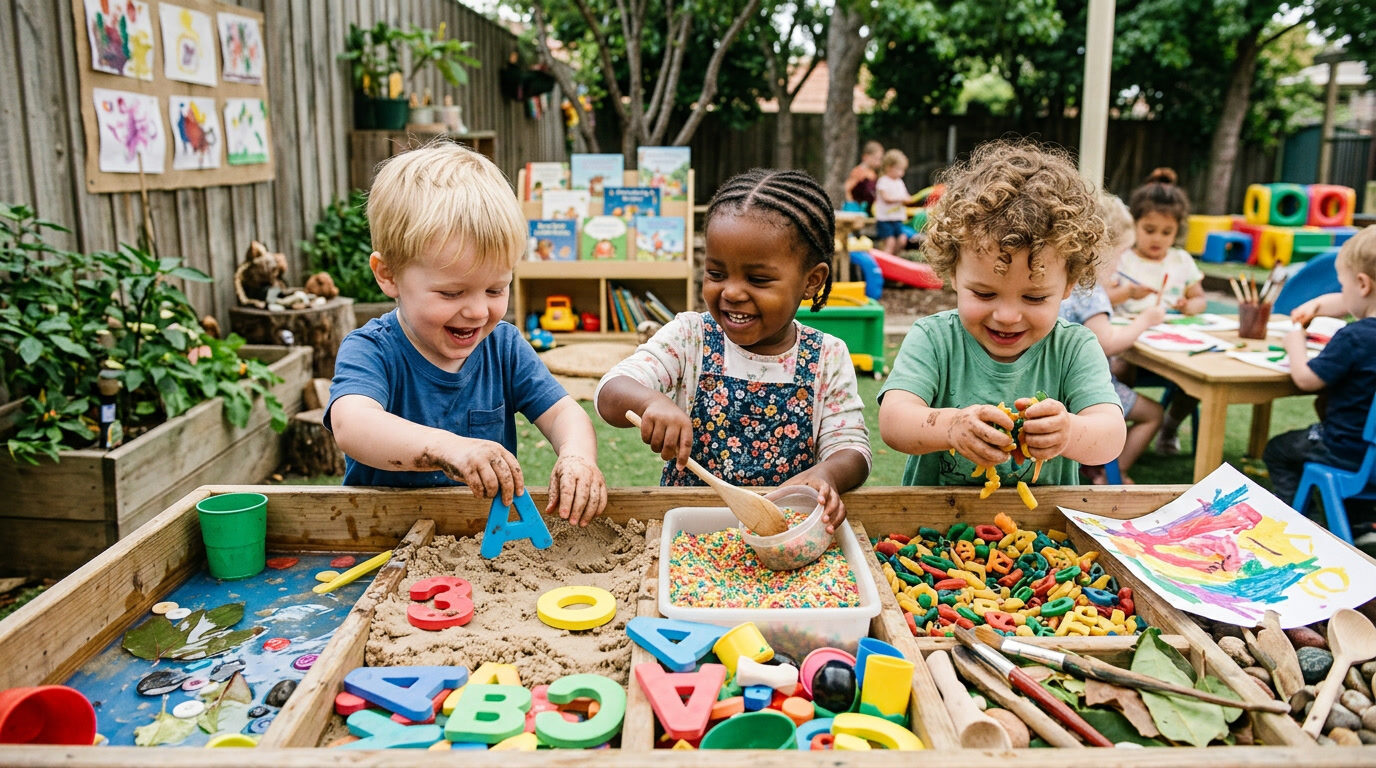
Sensory play lets toddlers touch, scoop, pour and hide things, so letters and numbers become objects they can handle. A simple bin of rice or sand with a few items is enough. Your job is to name what they find, not to quiz them.
Idea 1: A simple sensory bin
A sensory bin is just a shallow tub filled with something interesting to dig through. Toddlers learn through exploration, and a sensory bin lets them explore with their hands. The letters and numbers are hidden treasures, not homework.
Here is how I would set one up:
- Choose a shallow tub or baking tray and put a towel or old sheet underneath.
- Add a base such as dry oats, dry pasta, sand or scrunched paper.
- Hide a handful of items: large letters, a few foam or magnetic numbers, a toy animal or two, and some spoons and cups.
- Sit beside your toddler and let them dig for several minutes before you say anything.
- Narrate what they do. Add a letter or number only when they hold one up.
- Pack up when interest fades, even if that is after three minutes.
Safety matters here. Choose pieces that are clearly too big to swallow, stay beside your toddler the whole time, and avoid small items if your child still puts everything in their mouth. If you are unsure what suits your child, ask your doctor or health visitor what is safe at their stage.
What to say during sensory play
You do not need a script, but a few phrases make it easy. Try these:
If your toddler likes it, you can ask a question such as "Can you find the number 3?" once in a while. Offer it lightly and let them ignore it. If they give you a spoon instead, say "Thank you, that's a spoon," and carry on.
Themed bins keep things interesting. A dinosaur bin can hold plastic dinosaurs with a few numbers to count. An ocean bin can hold sea animals and the first letter of your child's name. Choose a theme your toddler already loves, so the learning rides on their enthusiasm.
Idea 2: Water, sand and mud
You do not even need a tub. Playing with water, sand or mud lets your toddler explore new textures and sensations. Every pour and splash comes with words like wet, dry, heavy, full, empty, more and gone, which are the building blocks of early maths.
Outdoors, a bowl of water and a few cups can fill a happy half hour. A patch of mud and a stick can become a place to draw lines, circles and eventually a letter shape. A toddler's "writing" at this age is wiggly lines, and that is exactly right.
Stay right beside your toddler around any water, even a shallow bowl. Keep your attention on them rather than your phone.
Keeping things fresh without starting over
The NHS gives a handy tip for toys in general:
Rotate your child’s toys every few days to keep them stimulated and trying new activities.
NHS
Apply the same idea to bins. Keep the game your toddler loves, such as scooping into cups, and swap a few props. Monday it is animals, Thursday it is cars and a few number tiles. The routine stays familiar, which matters because repeating activities is how toddlers master skills.
When messy play goes wrong
Some toddlers dislike messy textures at first. Do not force it. Offer a spoon or a pair of tongs, start with dry materials and let them watch you play. If distress around textures, sounds or clothing is strong and constant, mention it to your doctor or health visitor.
Can sorting, matching and puzzles teach early maths?
Yes. Sorting by colour, size or shape helps toddlers notice how things are the same and different, a skill that supports early maths. Puzzles and matching games add fine motor practice. Keep them simple, and let your toddler repeat them as often as they like.
Idea 3: Sorting everything in sight
Raising Children, a trusted Australian parenting site, suggests giving your toddler things to sort, like coloured blocks, shapes or pegs, or plastic cups and containers of different sizes. I like this idea because the best sorting materials are already in your kitchen and laundry basket.
Here are some easy sorting games:
Start with two groups that are very different, such as red and blue. Show your toddler with one or two items, then hand the job over.
- Set out two baskets and a small pile of mixed items.
- Pick up a red block and put it in the red basket, saying "Red one, red basket."
- Hand your toddler a block and wait.
- Describe what they do rather than judging it: "You put blue in the blue basket."
- Let them mix everything up and start again.
Why repeating the same game is a good sign
Picture a two year old who sorts blocks into a bowl, tips them out, and does it again. And again. And again. You may be bored by the fourth round, but your toddler is not wasting time. Raising Children notes that repeating activities is how toddlers master skills.
Each repeat helps your toddler work out what is likely to happen in a given situation. Resist the urge to move on to something "new". Add a tiny twist instead, such as a timer song or a third basket.
Idea 4: Matching games and puzzles
Matching is sorting's close cousin. Toddlers match lids to pots, shoes to feet and socks to socks. Each match helps your toddler see that two things belong together, an idea that can later support matching a letter to its sound or a number to a group of objects.
Puzzles add fine motor control and patience. Begin with chunky puzzles that have a few big pieces. If you want a letter and number version, wooden alphabet and number puzzles are one option, though check the age guidance on the listing, as a younger toddler will need your help or may do better a few months from now. Check pieces for size and watch your toddler while they play.
For colours and first words, a busy book can be a gentle tool, as long as you play with your child instead of handing it over.
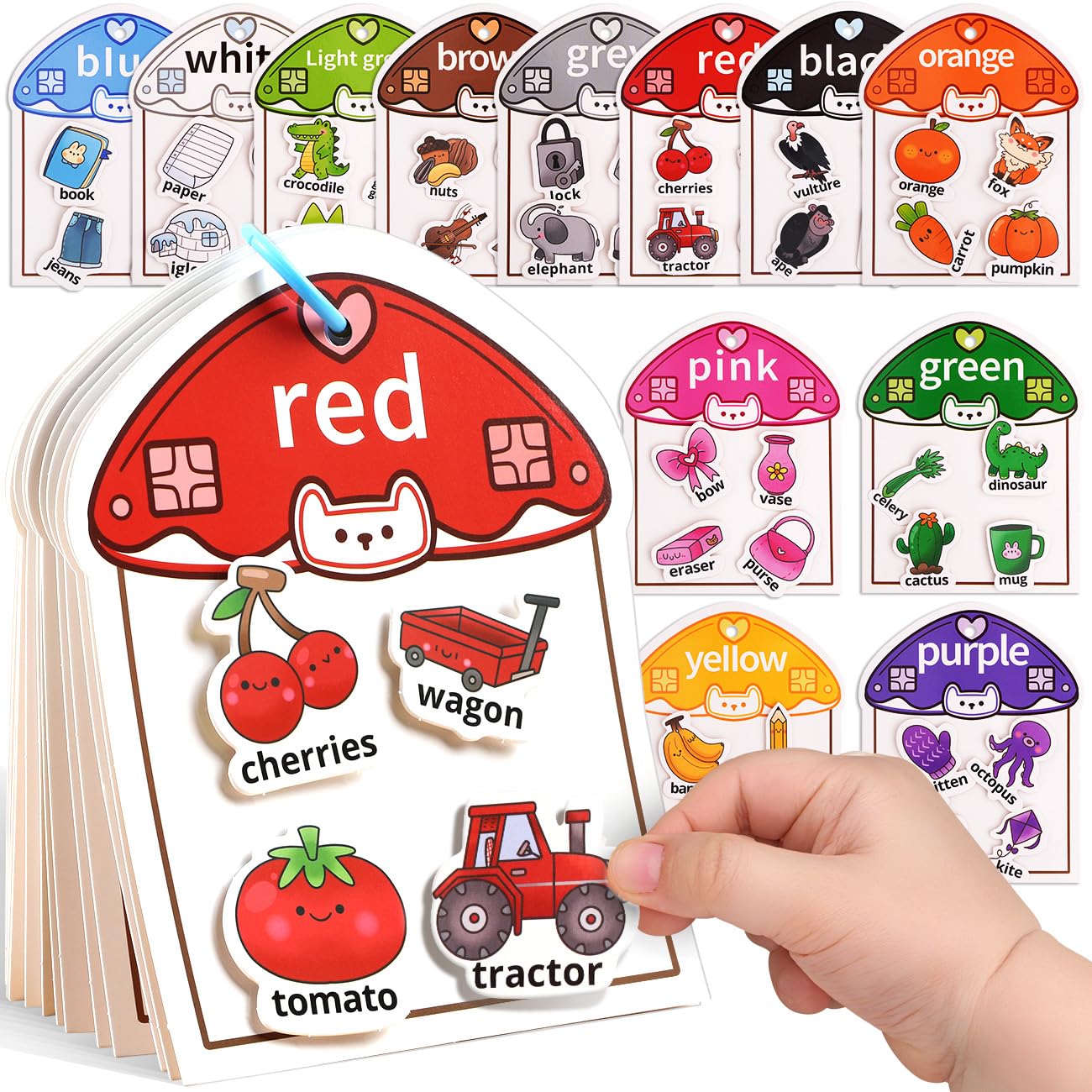
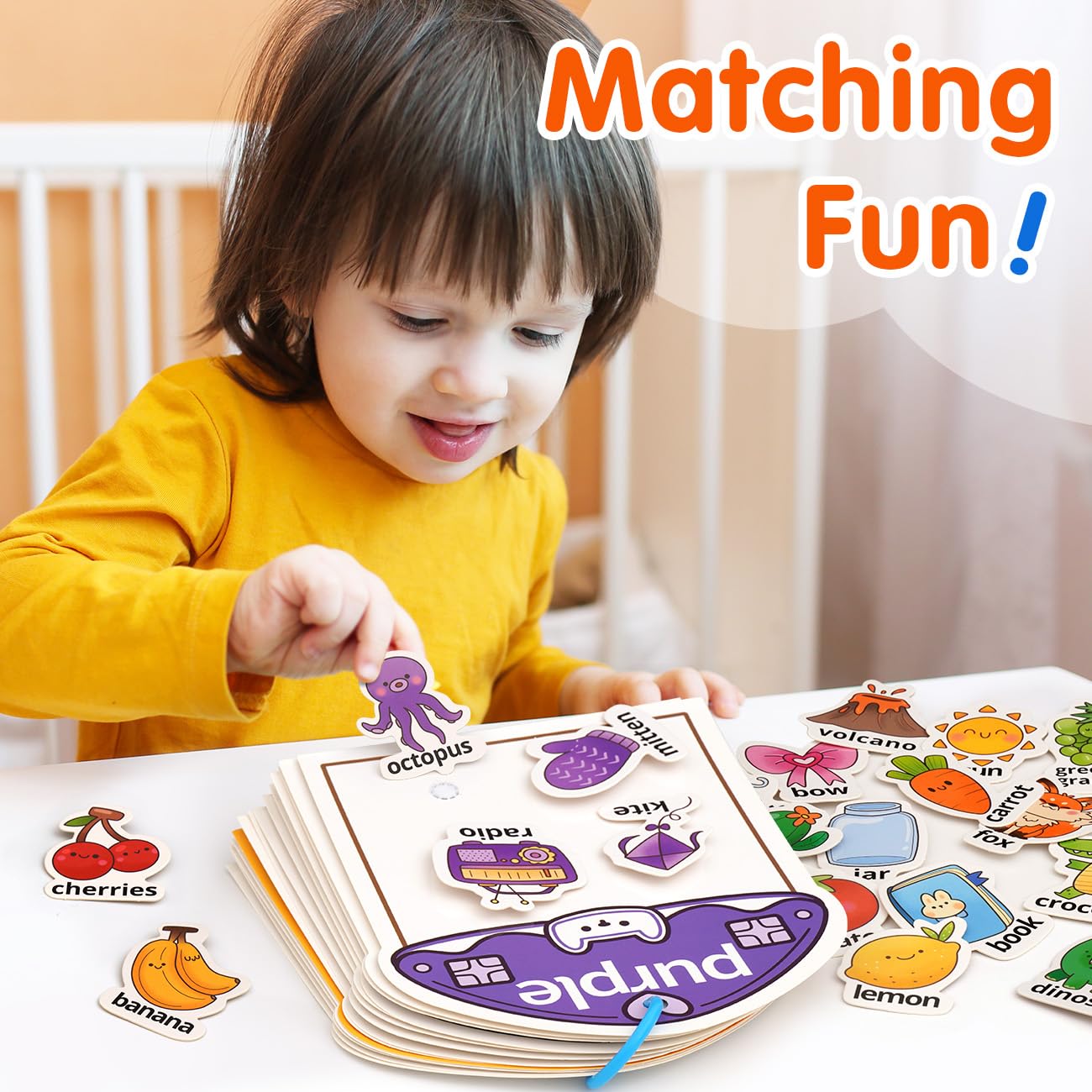
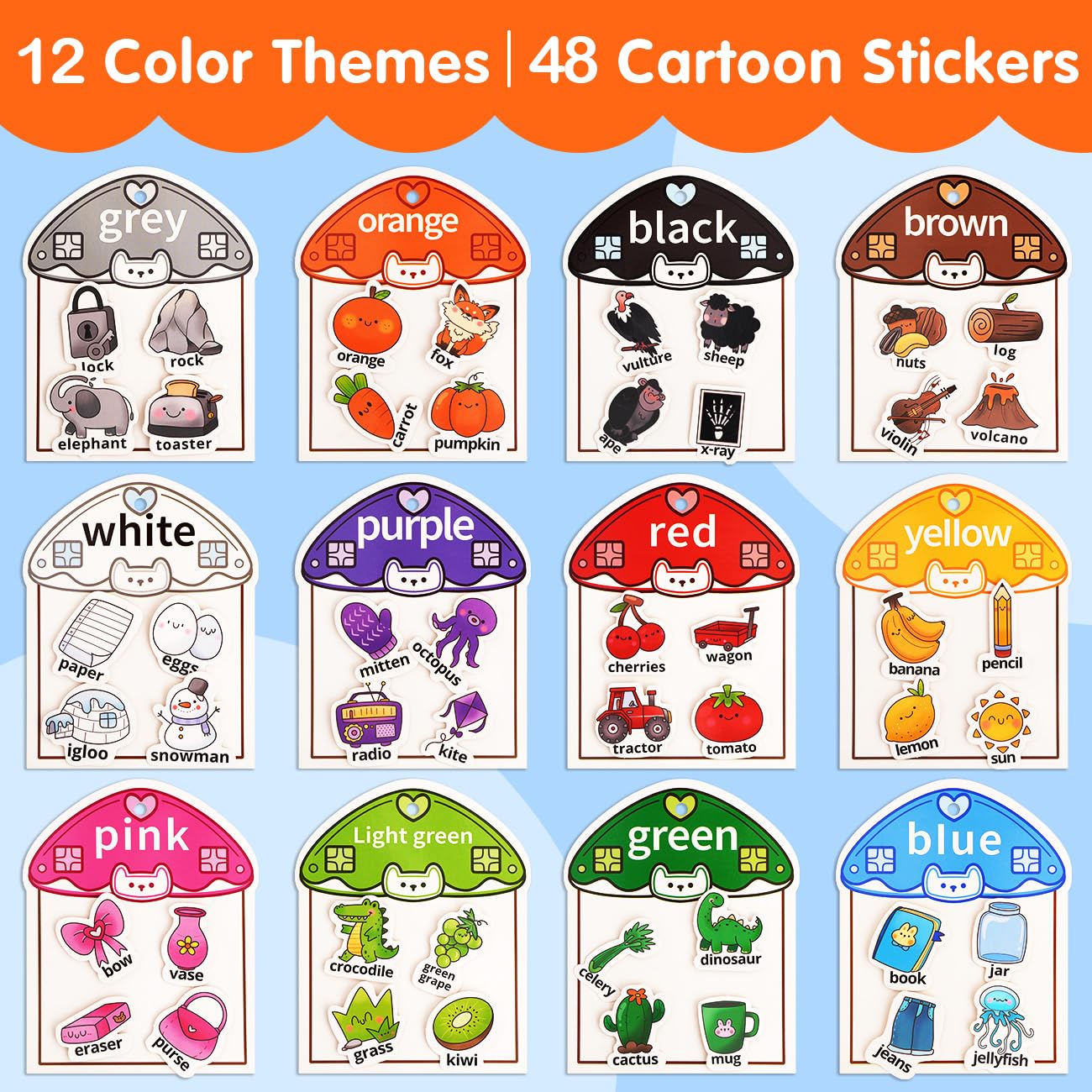
Montessori Busy Book Color Sorting Toys for Toddlers 2-4 Years
- Matching Color Busy Book: Your toddlers will adore mastering 12 colors with our interactive busy book…
- Build Essential Skills: Watch your child's mind grow! This engaging activity is far more than a sorting…
- Spark Joyful Connections & Teamwork: "Wow, you found the red tomato! Great job, sweetie!" This busy book is…
I would treat this as a conversation starter, not a curriculum. The listing describes matching colours with hook and loop pieces and word labels, which gives you plenty to say: "Red tomato! Where does the red tomato go?" Where does the red tomato go?" Sit with your toddler for the first few goes so the small pieces stay where they belong.
For slightly older toddlers who like counting, a wooden abacus gives them beads to slide one at a time while they count.
Sorting and matching mistakes
Introducing every number from 1 to 10 in one week; a few at a time is plenty.
A basket of household bits can give your toddler plenty to sort, like plastic cups and containers of different sizes, with no need for a big set.
If your toddler rarely plays with objects at all, shows no interest in toys or people, or seems to have lost skills they used to have, speak to your doctor or health visitor rather than waiting.
How do you turn storytime into letter and number learning?
Read often, point to pictures, and talk about what you see rather than drilling letters. Count the ducks, name the sounds, and pause so your toddler can fill in a word. Talking around the book builds the language that reading depends on.
Idea 5: Talk around the book
KidsHealth says reading to kids as often as possible is the best way to help them learn to read by themselves. That message is simple and encouraging: you do not need special books or lessons, only time together and a willing voice.
Here is a routine you can use with almost any picture book:
- Let your toddler hold the book and turn the pages, even if they skip half of them.
- Point and name: "Look, a duck. A yellow duck."
- Count what is on the page: "One, two, three ducks!"
- Connect it to real life: "A dog! Like Grandma's dog."
- Pause on a familiar line and let your toddler finish it. By 2 years, you can leave out words from your toddler's favourite stories and ask them to tell you what happens next.
- Add a letter sound only when it fits: "Duck starts with d, d, duck."
For the pause trick, try a rhyme you both know. "Humpty Dumpty sat on a..." then wait, smile and look at your toddler. If they say "wall" or just make a sound, you have a conversation.
Why words matter more than letters
Many toddlers can say 10 or more words by about 18 months. But every child moves at their own pace, and what comes before words is just as important: listening, pointing, copying and playing with sounds. Books give your toddler a store of words to try out later.
NAEYC makes the point that communication and language skills are what really foster early literacy. This is why pointing, naming and chatting matter more than flashing a letter at your child. If you are curious about those first sounds, you may enjoy why Mama and Dada are a toddler's first words.
Choosing books that teach without drilling
You do not have to read an alphabet book from A to Z. Pick the letter that starts your toddler's name, find it on three pages and move on.
If your toddler is past 18 months and you want a song to sit alongside your books, a singalong video can work when you watch it together and chat about it. I cover how to do that safely in the last section. Here is one example to watch with your toddler:
When books turn into battles
Some toddlers prefer to wander while you read. That is normal. Keep reading, keep your voice lively and let them drift in and out.
If you are worried about your toddler's talking, or you have a feeling they do not hear you well, ask your doctor or health visitor. I would rather you ask early than wait for a gap to grow.
Can everyday routines teach counting and letters?
Yes, and they are often the best lessons because they are real. Counting stairs, naming foods at lunch, sorting socks and spotting letters on signs all give toddlers meaning and repetition. Narrate what you do in short, simple sentences while you do it.
Idea 6: Turn the daily routine into a classroom
Toddlers repeat activities again and again, and repetition is how they master skills and learn what to expect. That means your morning, mealtimes and bath are already a curriculum. You just have to add words.
The trick is to narrate rather than test. Say what you are doing, count what you see, and give your toddler a chance to join in if they want to.
Kitchen and mealtime
Let your toddler help with safe jobs: tearing lettuce, putting spoons in a drawer, passing napkins to everyone. Counting napkins for the people at the table is a lovely, real life maths problem. Keep hot items, knives and anything breakable well out of reach.
Dressing, bath and tidy up
Dressing is a daily counting game: "One sock, two socks. One shoe, two shoes." Bath time adds pouring, floating and sinking. Tidy up time is sorting in disguise: "Cars in the red box, animals in the blue box."
Pretend you do not know where things go. "Where does the duck live?" gives your toddler the pleasure of knowing something you do not.
Outings and letters in the wild
Letters are everywhere once you look for them. The first letter of your toddler's name on a cereal box, a stop sign, a bus number, the number on your front door. Say it lightly: "Look, that's a big S, like Sam." Do not wait for an answer.
A small wall display at your toddler's eye level can give you something to point to. These learning posters are made for classrooms, and a full set is far more than any one toddler needs. A poster is not a teacher. It is a picture to stand in front of together and talk about.
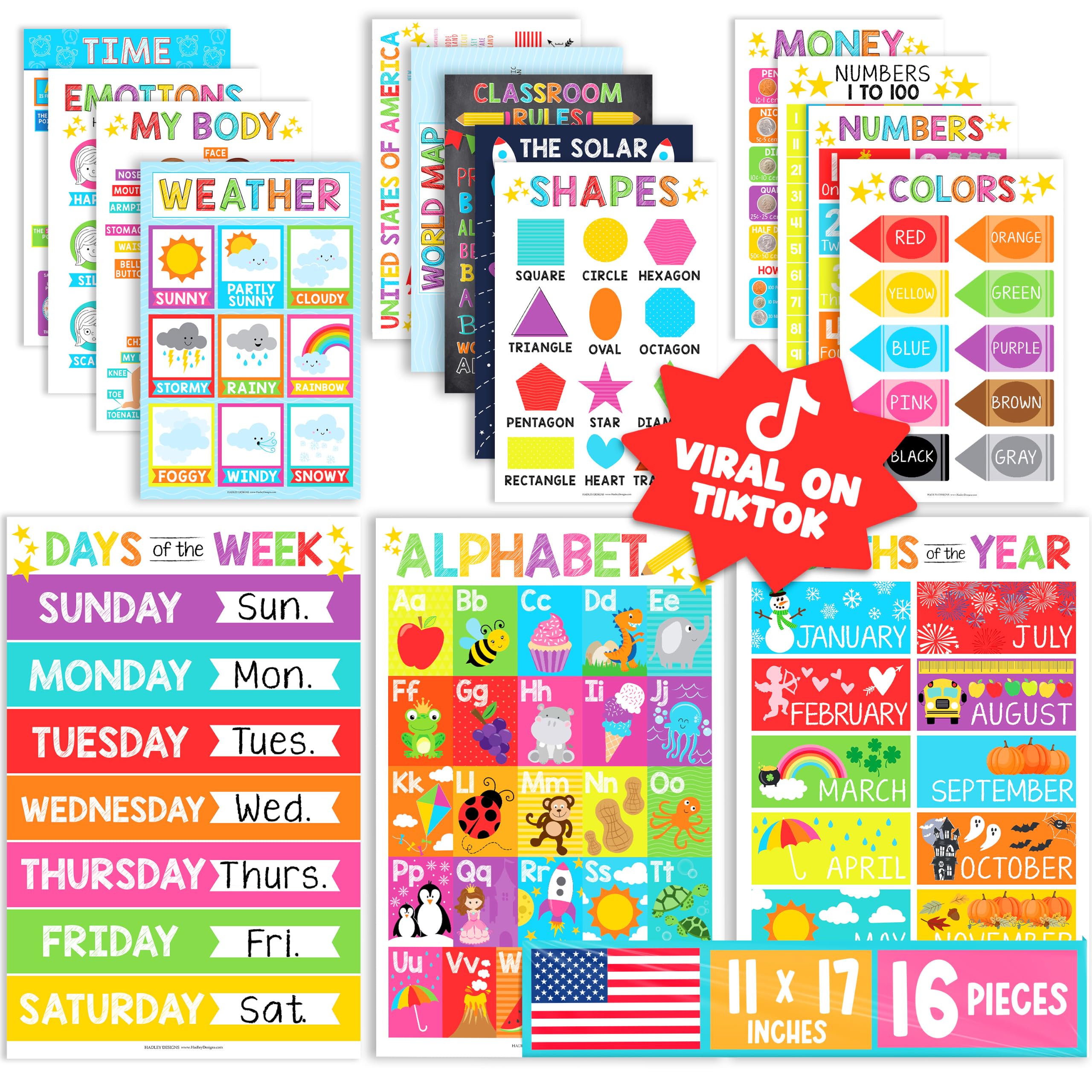
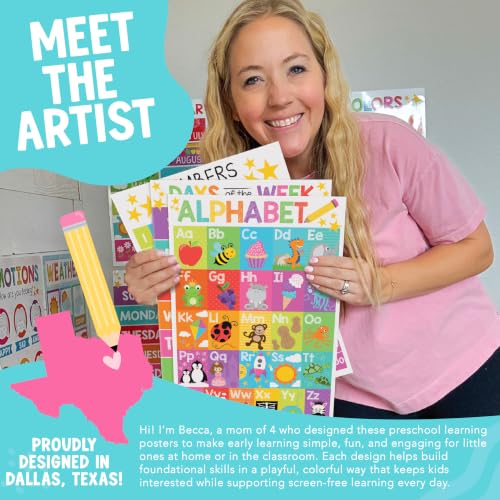

Hadley Designs Learning Posters for Toddlers 1-3 Preschool Classroom Decor
- BOOST PRESCHOOL LEARNING WITH LAMINATED EDUCATIONAL POSTERS: Hadley Designs 16 educational posters for…
- ERROR-FREE & COMPREHENSIVE EDUCATIONAL CONTENT: Designed in the USA by a mom of four and former pre-school…
- KINDERGARTEN AND PRESCHOOL CLASSROOM MUST HAVES: These learning posters for kids ages 3-5 are classroom…
If posters appeal to you, choose one or two and hang them low. The ones that cover everyday things like shapes, feelings and numbers are probably the most useful for toddlers. Rotate them if your toddler loses interest.
When toddlers refuse, melt down or ignore you
Toddlers say "no" to everything, including a perfectly lovely counting game. If your toddler resists, this is not a lesson plan failure. It is a toddler being a toddler. Skip it, try again tomorrow, or move to something they have chosen.
If a refusal turns into a tantrum, check whether the moment is just too rushed or whether your toddler is tired, hungry or overwhelmed. My guide to positive parenting and gentle discipline has calm responses that keep learning moments friendly.
Routine learning mistakes
If you are worried that your toddler does not respond to their name, rarely looks at you, or does not seem to enjoy these small shared moments at all, speak to your doctor or health visitor.
Do crafts, scavenger hunts and outdoor play help?
Yes. Open ended crafts build hand strength and confidence, while outdoor hunts and a small garden give toddlers real things to count and name. Let your toddler choose what to make, praise the effort, and expect a mess. Stay close, because scissors, paint and small seeds all need watching.
Idea 7: Crafts that follow your toddler's lead
Raising Children has a line I love, because it flips the usual craft idea on its head:
Let your toddler decide what to make.
Raising Children Network
It also says that celebrating effort will encourage your toddler to tackle new problems. So skip the perfect snowman on a tray and let your toddler make a scribble masterpiece.
Easy craft ideas:
What to say: "You made so many lines!" "Tell me about your picture." "You worked so hard on that." Avoid "What is it?" which can leave a toddler stuck.
Scissors and cutting
Cutting is a skill that usually arrives later in the toddler years or at preschool age. Do not rush it, but if your toddler is curious, a child safe pair is a good start. Crayola blunt tip safety scissors are designed for first cutters.


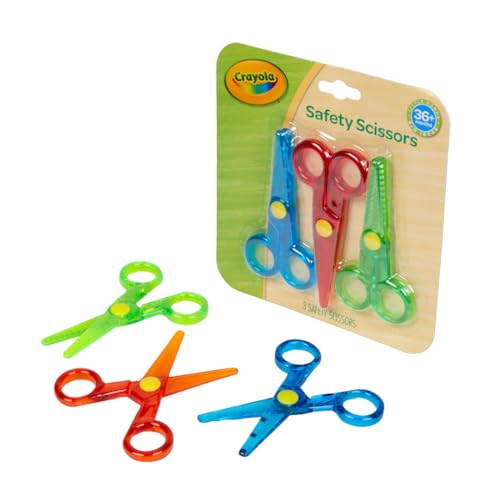

Crayola Toddler Safety Scissors 3pk, Blunt Tip Training Scissors
- MY FIRST SCISSORS: This set includes 3 Crayola Safety Scissors designed for “ouch-free” paper cutting…
- 3 CUTTING STYLES: Featuring straight, wavy, and zigzag blades, these scissors are perfect for a wide range of…
- SAFE FOR PRESCHOOLERS: With plastic blades and rounded tips, these scissors are ideal for classroom crafting,
Blunt does not mean harmless, so sit with your toddler every time. Start by snipping a playdough snake or a thin strip of paper. Many toddlers will just open and close the scissors at first, and that is a fine first step. If you want a structured book for later, a scissor skills activity book is aimed at preschool-age children, so keep it on the shelf until your child is ready.
Pretend play is a natural next step. A cardboard box becomes a bus, and a cut paper ticket becomes the fare. If you would like ideas, see how imaginative play builds problem solvers at every age.
Idea 8: Scavenger hunts and a tiny garden
Scavenger hunts turn a walk into a game. Keep them very simple for toddlers:
- Say "Let's find something red."
- Walk together and point out candidates.
- Collect them in a bag or bucket.
- Count what you found at the end: "One leaf, two sticks, three stones."
You can vary the hunt: "something soft," "something bumpy," "something that starts with the sound of your name." Indoors, the same game works with "find three socks" or "find something round."
A tiny garden adds another layer. A pot of cress or beans on the windowsill gives your toddler something to water, watch and name every day. Counting seeds, looking for the first shoot and measuring with a finger teach patience and number words. Repeating the same daily job is exactly the kind of repetition toddlers thrive on.
Check that any plants and seeds are safe for children, keep small seeds out of mouths and wash hands afterwards.
Craft and outdoor mistakes
If you are worried about how your toddler uses their hands or moves, ask your doctor or health visitor to take a look. Early advice is easier to act on than late advice.
Where do apps and videos fit in?
They can have a small place, but play with you does more. The AAP advises avoiding screens for babies under 18 months except video calls. After that, choose high quality programmes and watch together, then turn what you saw into real play.
What the guidance says
The AAP recommends that babies younger than 18 months avoid screens except for video calls with loved ones. ZERO TO THREE says it is fine to introduce young children aged 18 months to 2 years to high quality children's media, as long as you watch it with them and help them understand what they are seeing.
For ages 2 to 5, ZERO TO THREE suggests limiting screen use to one hour a day of high quality programmes designed for children. These are guides, not scorecards. A long, sick day on the sofa is not a failure.
How to choose and use a video or app
After the show, bring it back to real life. If a character counted apples, count apples from the fruit bowl. If a song had animal sounds, copy them together. This simple step moves learning from the screen into your toddler's hands.
Here is one example of a toddler programme with songs and first words. Judge it for yourself, and watch it together if your toddler is past 18 months:
An off screen option for quiet moments
Sometimes you need a calm, screen free activity, especially at the end of a long day. A themed busy book can work if you sit with your toddler for the first few tries.

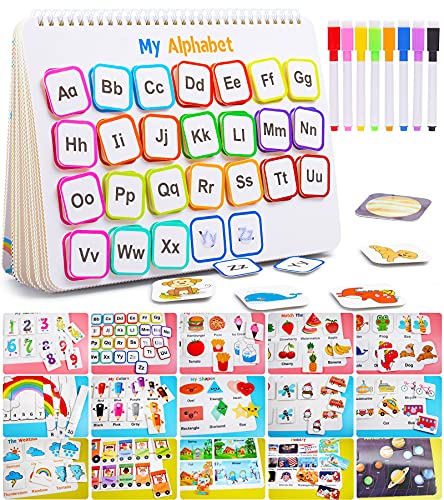


Montessori Preschool Learning Activities Busy Book - Workbook Activity Binder / Toys for Toddlers, Autism Learning Materials and Tracing Coloring Book
- LEARNING WHILE PLAYING: This is a book helping toddlers to learning while playing.Parents can participate in…
- 15 THEMES AND 14 DRAWING&WRITING PAGES: This Busy Book covers 15 themes, including numbers, alphabet, Food &…
- DIVERSE LEARNING EXPERIENCE: This preschool educational toy is multi-functional, allowing child to develop…
Check the age range on the listing for this busy book and workbook, because younger toddlers will need you beside them and some pages may be too advanced. Treat it like a picture book: point, name and chat, and skip the pages that do not interest your child.
When should you ask for advice?
Most toddlers learn in bursts, with plenty of quiet patches in between. Still, some signs are worth checking early:
Ask your doctor or health visitor what to look for at your child's age, and what a check involves. You are not being fussy. Noticing where your toddler may need support is part of the job.
Screen mistakes to avoid
Which tools are worth it? A quick comparison
None of the products below are required. They are options for parents who like a little structure. Use the age notes as a loose guide and check the age label on anything you buy. Anything with small pieces needs your supervision.
| Option | Best Age Range | Primary Benefits | Main Drawbacks | Recommended Product | Price Range |
|---|---|---|---|---|---|
| Colour sorting and matching | From about 2 years, with help | Colour words, matching, focus, fine motor practice | Small stickers and pieces need watching | Montessori Busy Book Color Sorting Toys | $8.95 |
| Wall pictures to talk about | From about 1 year | Shared talk, new words, familiar images | Does nothing unless you talk about it; set is classroom sized | Hadley Designs Learning Posters | $24.99 |
| Cutting practice book | Closer to 3 years | Hand control, patience, following lines | Too advanced for many younger toddlers; scissors need supervision | Scissor Skills Preschool Activity Book | $6.51 |
| Themed busy book and workbook | About 3 years, younger with you | Many themes: numbers, letters, shapes, animals | Listing says over 3; can feel like a worksheet | Montessori Preschool Learning Activities Busy Book | $22.99 |
| First scissors | When your child shows interest, with an adult | Snipping, tool control, confidence | Blunt is not harmless; needs close supervision | Crayola Toddler Safety Scissors | $4.97 |
| Wooden letter and number puzzles | Listing says ages 3 to 5; simpler puzzles for younger | Matching, fine motor skills, early letter shapes | Pieces may frustrate younger toddlers; lower rated than others | NASHRIO Wooden Puzzles | $9.99 |
If you only spend money on one thing, choose something your toddler can use in many ways, like cups, blocks and a few chunky puzzles. A basket of household items often beats a box of new toys.
One last thing before you put the cards away
Learning at this age does not look like a lesson. It looks like a toddler pouring water between two cups and a parent saying "full, empty, full." It looks like a sock sort that ends in a pile, a bin of oats on the floor, and a favourite book read for the fortieth time.
You are already doing the work that matters. Talking, pointing, counting, laughing and repeating are the real curriculum of the toddler years.
Key Takeaways
- Toddlers learn mainly through play and exploration, so the best learning activity is one your child chooses and you narrate.
- Flash cards emphasise memorising rather than the communication and language skills that foster early literacy.
- Repeating the same game is how toddlers master skills, so welcome the fortieth round of the same sort or story.
- Sensory bins, sorting, matching, interactive stories and daily routines are all forms of guided play, where your child leads and you support.
- Narrate rather than test: describe what your toddler does, count what you see and pause so they can join in.
- Screens are a small add on: avoid them under 18 months except video calls, and watch high quality programmes together after that.
- If you are worried about talking, hearing, movement or lost skills, ask your doctor or health visitor early rather than waiting.
Your toddler is already learning
Put the cards in a drawer, pick one idea from this guide and let your toddler lead. You are not behind, and you do not need a perfect plan.
Toddlers do not need lessons, they need you, a few simple things and time to repeat.
If this guide helped, save it for a rainy afternoon and share it with the grown up who is also holding a pack of alphabet cards and feeling guilty.
Sources & References
- Raising Children Network. "Toddler play: ideas, games and activities."
- Raising Children Network. "Play ideas for toddler cognitive development."
- NHS. "Play ideas for your toddler."
- NIH (National Library of Medicine). "The Theoretical and Methodological Opportunities Afforded by Guided Play With Young Children."
- American Academy of Pediatrics. "Watching CoComelon and Guidance on Early Childhood Development."
- NAEYC. "Toddlers and Reading: Describe but Don’t Drill."
- KidsHealth. "Toddler Reading Time."
- Cleveland Clinic. "When Do Babies Start Talking?"
- KidsHealth. "Media Use Guidelines: Babies & Toddlers."
- ZERO TO THREE. "Screen-Time Recommendations for Children Under Six."
Frequently Asked Questions
Should I teach my toddler letters and numbers at all?
How long should a learning activity last?
Is it ever OK to use flashcards?
What if my toddler will not sit still for books?
How much screen time is OK for a toddler?
How many words should my toddler say?
Should I rotate my toddler's toys?
Was this helpful?
Thanks — your feedback helps us pick what to write next.