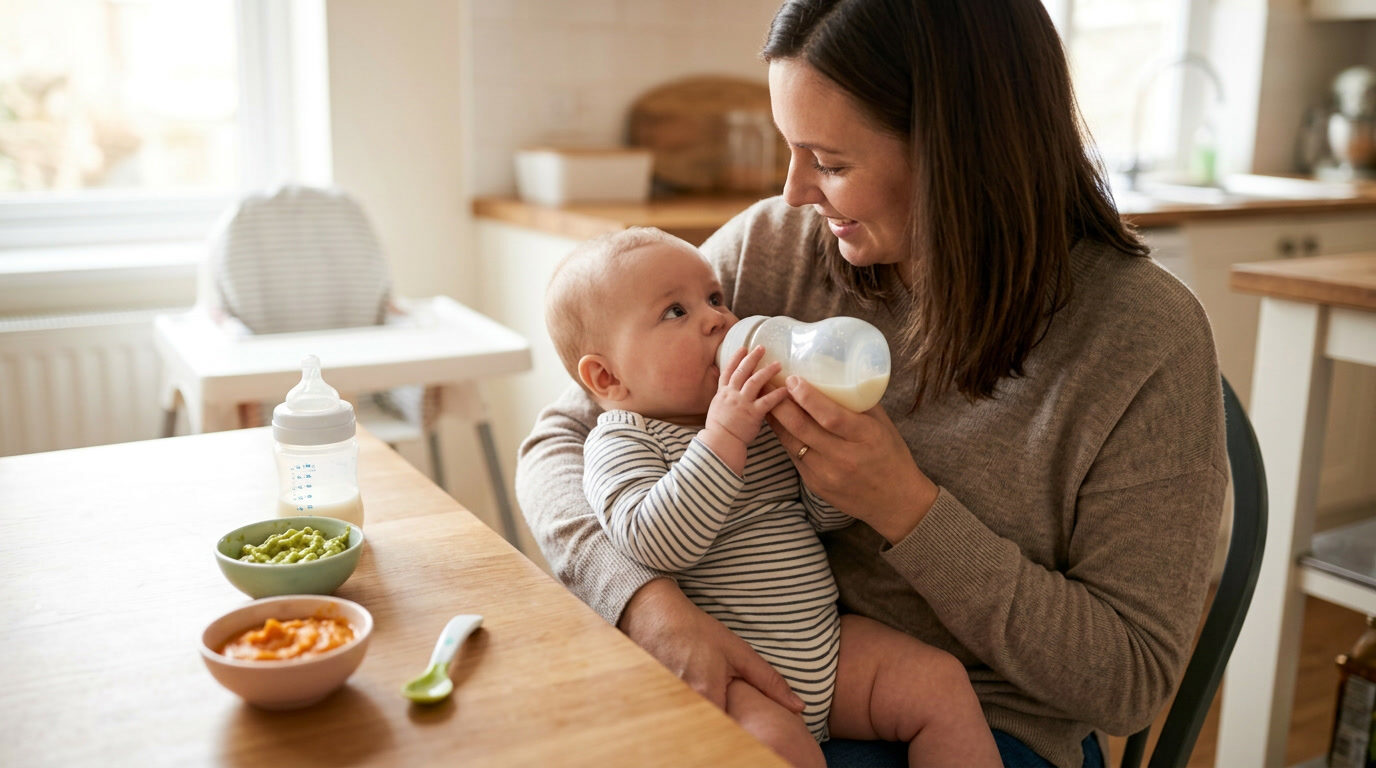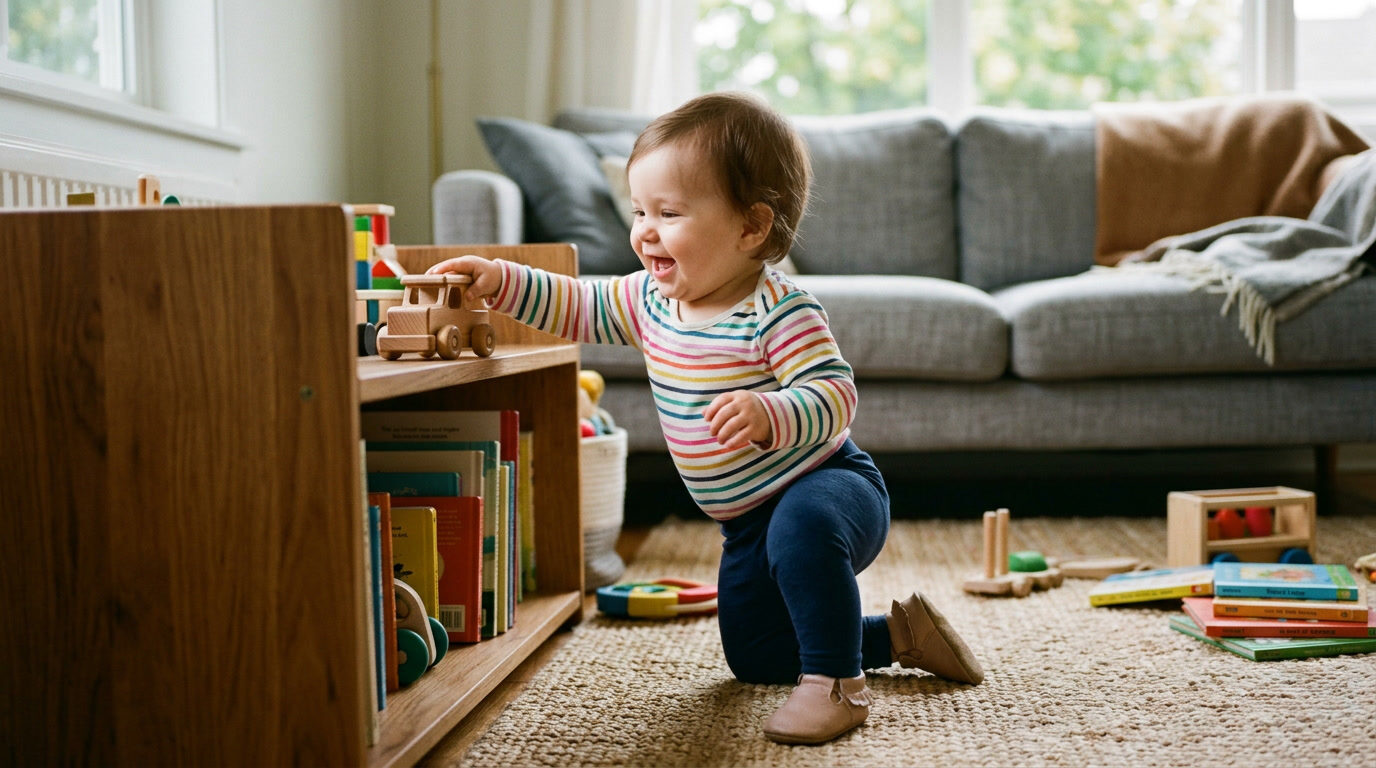
Starting Solids With Your Baby: When, What and How to Begin
Most babies are ready to start solids at about 6 months, when they can sit with a steady head, pick up food and swallow it. Start with small tastes once a day, offer one new food at a time, and keep breast milk or formula as the main drink.

In this article
TL;DR: Quick summary
Most babies are ready to start solids at about 6 months, when they can sit with a steady head, pick up food and swallow it. Start with small tastes once a day, offer one new food at a time, and keep breast milk or formula as the main drink.
What you'll get
About 31 minutes to read. Short on time? Read the bold lines and the Key Takeaways near the end.
It is 6pm, and your baby is watching every forkful travel from your plate to your mouth. A relative says it's time for "proper food". A friend swears solids fixed her baby's sleep. Meanwhile you have a half read leaflet, a cupboard of unopened jars and a nagging worry that you might be doing it wrong.
This article is for parents and carers who want a calm, clear plan for starting solids. I'll walk you through when to start, how to spot real readiness, what to offer first, how much, and how to handle allergy foods, refusals and cups. You'll also get exact words to use with relatives and childcare, plus the common mistakes I see families make.
You don't need to be perfect. Starting solids is a slow, messy learning process for both of you, and there is far more room for error than the internet suggests. Let's make it feel manageable.
When should I start solids with my baby?
Most guidelines say to start at around 6 months. Before then, breast milk or formula covers your baby's needs. Some babies show readiness a little earlier, but introducing foods before 4 months is not recommended, and the signs of readiness matter more than a date on the calendar.
In clinic, this is one of the questions I hear most, usually from a parent holding a baby who is staring at their dinner. The short version is that there is a window, and the middle of it is around 6 months.
What do the major guidelines say?
The NHS puts it plainly:
Introducing your baby to solid foods, sometimes called complementary feeding or weaning, should start when your baby is around 6 months old.
NHS
In the United States, the Dietary Guidelines for Americans and the American Academy of Pediatrics also point to about 6 months. The Canadian Paediatric Society agrees for babies at no or low risk of food allergy.
The CDC adds a floor: introducing foods before 4 months is not recommended. So the range you will hear is "about 6 months, and not before 4". Treat the word "about" as a real word. It means your baby's readiness counts for more than the exact day.
Why wait until about 6 months?
UNICEF says that before 6 months, breastmilk alone meets all of a baby's energy and nutrition needs. The American Academy of Pediatrics recommends only breast milk for approximately 6 months, then continued breastfeeding alongside the first foods. The same timing applies if you use formula.
Waiting is not about being strict. By about 6 months, most babies can sit, grab and swallow in a way that makes eating easier and safer. Think of it as your baby's body catching up with the menu.
What if my baby seems ready a little early?
Some babies look keen well before 6 months. The AAP notes that infants who have doubled their birth weight, typically around 4 months, and weigh about 13 pounds or more may be ready for solids. That is a clue, not a green light on its own.
For babies with a higher risk of food allergy, the Canadian Paediatric Society says to consider common allergenic solids at around 6 months, but not before 4 months, based on developmental readiness.
If your baby is not quite 6 months and is very interested in food, book a chat with your doctor or health visitor. Here is what you can say:
"My baby isn't 6 months yet, but she's watching us eat and sits well with support. Can we check whether she's ready, or should we wait?"
If your baby was born early, ask your doctor which age to count from. Don't guess.
How do I know my baby is ready for solids?
Look for three signs: your baby can stay sitting with a steady head, can coordinate eyes, hands and mouth to pick up food, and swallows food instead of spitting it out. Age is a guide, but these signs tell you whether your baby can actually handle eating.
Ready is a skill set, not a birthday. Here is what each sign looks like at your kitchen table.
The three signs, in plain words
Sign one: sitting with a steady head. Your baby can stay in a sitting position, supported in a high chair, and hold their head up without it wobbling. This is the one I'd weigh most, because eating while slumped or tipping sideways is harder and riskier. If head control still feels shaky, a little more tummy time practice is a good use of this week.
Sign two: eyes, hands and mouth working together. Your baby looks at a piece of food, reaches for it, picks it up and gets it to their mouth. Picture a baby who grabs your spoon, gets the handle in their mouth and looks up at you, very pleased with themselves. That coordination is exactly what feeding needs.
Sign three: swallowing instead of spitting out. Younger babies have a tongue thrust reflex that pushes food out of the mouth. KidsHealth says this reflex disappears between 4 and 6 months. If most of the first tastes end up on the bib, that is the reflex at work. It is not a sign your baby dislikes food.
Here is a quick checklist you can run through:
Signs that look like readiness but aren't
Parents often tell me they're sure their baby is ready because of one of these:
All of these are common at this age, and none of them proves your baby needs solids. Drooling and fist chewing are very often about teeth, and teething relief that actually works is a separate topic with its own tricks.
Interest in your food is a lovely sign of curiosity. It is not the same as being able to swallow it safely.
Do a rehearsal with no food
Before the first real meal, try a dry run. Sit your baby in the high chair, give them a clean spoon or a toy, and watch. Do they stay upright? Do they reach, grab and mouth the object on purpose?
If yes, you have your answer. If they slump, tip or can't get things to their mouth, try again in a week or so. There is no prize for starting early.
What to say when someone says "just try it"
Relatives mean well. A calm script helps. For example, with your mother-in-law:
"Thanks, we're waiting until she can sit steady and pick things up herself. Those are the signs the NHS tells us to look for, and she's nearly there."
Keep it short, friendly and repeatable. You don't have to win the argument; you only have to hold the line.
When to ask for help
If your baby is around 6 months and still can't hold their head steady, or seems to have real trouble swallowing, mention it to your doctor or health visitor. They can check whether something else is going on. Ask them to show you how to tell gagging from choking, and what to do if it happens.
Will starting solids help my baby sleep or settle?
No. Starting solids will not make your baby any more likely to sleep through the night, and it is not a cure for fussiness. Babies wake for many normal reasons. The right reason to start is readiness, not tiredness.
This is the myth I'd most like to retire, because it sends tired parents down the wrong road at the worst possible time.
Where does the idea come from?
The American Academy of Pediatrics notes that a substantial number of families introduce solids around 3 to 4 months, especially when the baby seems fussy. It also notes that family members and friends sometimes gave false evidence that solids helped calm fussy babies.
Picture a baby who has started waking again and again at night. Her grandmother says, "She's hungry, give her some cereal." It sounds so logical that most of us nod along.
The NHS is blunt about it:
Starting solid foods will not make your baby any more likely to sleep through the night.
NHS
What is really going on at night?
Night waking in the first year has many causes. Babies go through developmental leaps, learn new skills, get teeth and change their sleep cycles. None of that is fixed by a bowl of mashed carrot.
Many families find a baby sleep regression chart helps them see whether they are in a normal rough patch rather than facing a feeding problem. Knowing a phase has a shape, and an end, makes the 3am hours easier to bear.
If you rock or feed to sleep every single time, it is also worth knowing when rocking can make nights harder. That is a conversation about sleep habits, not about food.
What to say to relatives
You can be warm and still firm. Try these:
"We're going to wait until she's ready. The NHS says solids won't make her any more likely to sleep through the night, so we're working on bedtime instead."
"He's fussy at the moment, but the guidance says solids don't calm fussy babies. We'll keep an eye on it with the doctor."
If the conversation keeps looping, change the subject to something they can help with, like a lunch invitation or an hour of babysitting.
What actually helps when nights are rough
These are simple, low drama steps that don't depend on food:
When to get help
If fussiness comes with poor feeding, vomiting, a baby who seems unwell, or crying that you can't settle, see your doctor. Fussiness can have causes that need checking, and solids have not been shown to calm it. You know your baby best. If something feels off, trust that.
What should I feed first, and how much?
Start tiny. Guidance ranges from two to three spoonfuls of soft food twice a day (UNICEF) to 1 to 2 tablespoons once a day (a pediatrician quoted by Cleveland Clinic). Soft, plain foods such as porridge, mashed fruit or mashed vegetables work well. Milk stays the main food.
At this stage, a meal is mostly practice. Your baby is learning to open their mouth, move food around and swallow it. A spoonful or two is a good first day.
What does a first meal look like?
Here is a simple way to run it:
- Pick a calm moment when your baby is awake and happy, not frantic with hunger or ready to fall asleep.
- Sit your baby upright in the high chair, with you at eye level.
- Put a small amount of soft food on the tip of a spoon and let your baby open their mouth for it.
- Stop when your baby turns away, clamps their lips or loses interest.
- Finish with a milk feed as usual.
If your baby is very hungry, a small milk feed first can take the edge off. Then offer the food.
Cleveland Clinic quotes a pediatrician on how to begin:
Start with 1 to 2 tablespoons once a day, and make it fun
Cleveland Clinic
Notice the last three words. Nobody expects your baby to clear a bowl.
Do I need special gear?
No. A soft spoon and a small bowl will do the job. If you like a bowl that stays put on the high chair tray, a suction bowl can save you a lot of mopping. A budget friendly option is the PandaEar 9 piece silicone feeding set, which comes with a bib, spoons, a suction bowl and plate, and a cup.

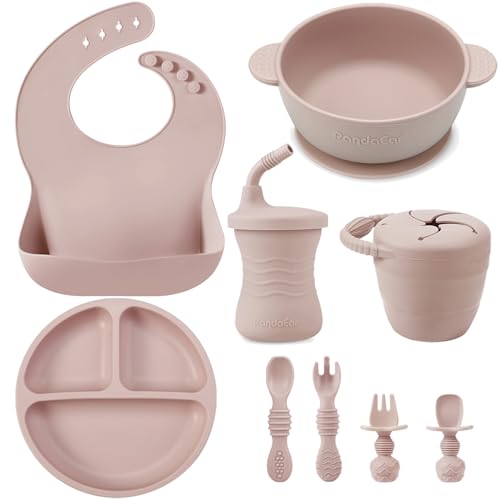

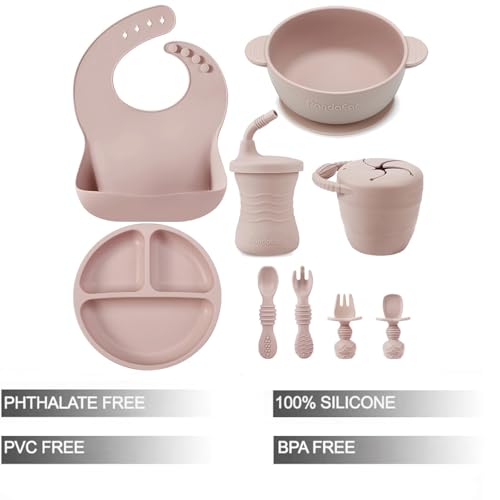

PandaEar 9 PCS Silicone Baby Feeding Set, Suction Plate & Utensils
- Safe & Certified Materials: PandaEar Silicone Baby Feeding Set, where safety meets innovation. Our commitment…
- Complete Self-Feeding Set of 9 Pieces: Elevate your baby's mealtime experience with our comprehensive 9-piece…
- High Quality & Easy to Clean: Quality and convenience merge seamlessly in our PandaEar Silicone Baby Feeding…
Treat any set as a convenience, not a requirement. The food and your calm attitude do far more than the tableware.
Which foods first?
The notes I'm using don't rank first foods, so here is what I say in clinic. Start with plain, soft, single ingredient foods, such as the porridge, mashed fruit or mashed vegetables UNICEF mentions. At about 6 months babies need the extra nutrition, such as iron and zinc, that solid foods provide, and your doctor or health visitor can tell you which foods suit your family.
Ask them, too, what to add or avoid in your baby's food at this age. Don't guess about salt, sugar or textures; ask.
How do I know when my baby has had enough?
Watch for cues. A baby who leans in, opens wide and reaches is still interested. A baby who turns their head, clamps their lips, pushes the spoon away or starts playing with the food is done.
Picture a baby who happily eats three spoonfuls, then bats the spoon away and grins. That is a perfectly good meal. Stop there and offer milk.
How do I increase amounts?
Slowly, and following your baby's lead. As appetite grows over the coming weeks, offer a little more at each meal, and add a second meal when your baby is handling the first well. There is no set timetable, so ask your doctor or health visitor what pace suits your baby.
Purees or baby led weaning, which should I choose?
Either can work. Both start at around 6 months, when your baby is ready, and both keep milk as the main drink. Spoon fed purees give you control over amounts; baby led weaning lets your baby feed themselves soft pieces. Many families mix the two.
I'm not going to tell you one is right. The best approach is the one you can do safely, calmly and consistently.
Spoon fed purees and mashes
With purees, you hold the spoon and your baby opens up. You can see what is going in, and it is easy to offer a taste of something new.
The upsides are control and less worry about big pieces. The downsides are that it can be slower, and your baby may want to grab the spoon, which is a good sign. Over time, move gradually from smooth to lumpier textures so your baby keeps learning to chew.
Picture a family who starts with smooth sweet potato from a spoon and, a few weeks later, moves to a mashed version with soft lumps. That slow ladder is a perfectly good plan.
Baby led weaning
With baby led weaning, you offer soft pieces of food your baby can hold, and they feed themselves. It lets your baby control the pace and explore textures, and it suits babies who want to grab everything.
The honest trade off is mess, and the need to be very clear on safety. Ask your doctor or health visitor which shapes and textures suit your baby's stage, and which foods to avoid. Ask them to show you how to tell gagging from choking, and what to do if it happens. A baby first aid class is worth an evening of your time.
If your baby is happy with finger foods, a divided plate with suction can make serving several small items easy. A good option is the SofiAl 11 piece baby led weaning set, which has a three section suction plate, a deep bowl, a soft tip spoon and fork, a bib and a training cup.


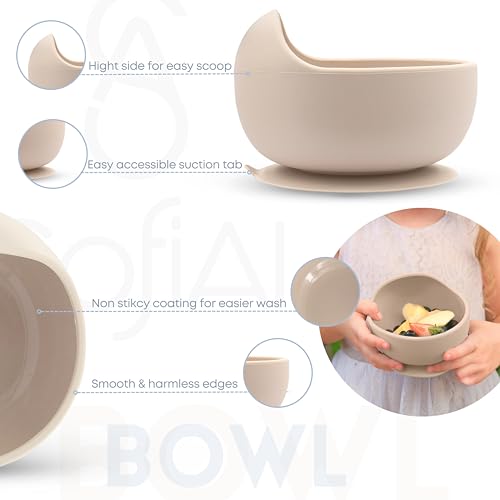

BPA-Free Non-Toxic Silicone Baby Feeding Set – Suction Plate, Bowl, Bib & Cup – 11-Piece Baby Led Weaning Set for Ages 6-18 Months – Eco Gift Bag (Royal Beige)
- BPA-FREE & NON-TOXIC – Made from 100% food-grade silicone that is FDA food contact safe and CPSC compliant…
- COMPLETE 11-PIECE BABY LED WEANING SET – Everything your baby needs to start self-feeding: suction divider…
- STRONG SUCTION BASE THAT STAYS PUT – The suction plate and bowl lock securely to flat surfaces, preventing…
The mixed approach
Most families I meet end up doing a bit of both. A spoon of mash at one meal, a soft finger food at another. If you need extra space to store and serve small portions, a bigger bundle like the 22 piece JELLDJK feeding set with freezer trays and a fruit feeder gives you plenty of pieces to rotate.
There is no prize for purity. If your baby does well with both, you are doing it right.
What to say when someone has strong opinions
People will insist on one method. Try:
"We're doing a bit of both and watching what works for her. The doctor is happy with that."
Short, kind and final.
Common mistakes
When to get help
If your baby coughs and gags at most meals, seems to struggle to swallow, or you are worried at all, talk to your doctor or health visitor. Don't push through. They may suggest a different texture or a check on feeding skills.
How do I introduce allergy foods and new foods safely?
Offer one new food at a time, in small amounts, and wait 3 to 5 days before the next one. Allergy foods such as peanuts, eggs, gluten and fish can be introduced from around 6 months. If your baby has a higher allergy risk, talk to your doctor first.
This is the part that makes parents most anxious, so let's make it concrete.
How does the one at a time rule work?
The CDC puts it simply:
Wait 3 to 5 days between each new food.
CDC
The reason is practical. If something upsets your baby, you will know which food it was. If you introduce three foods in one day, you won't.
Picture a week. You offer mashed pear for the first few days, and your baby is fine. You then add a different soft vegetable and watch again. A simple note on your phone with the date and food keeps everything clear.
The NHS says foods containing allergens, such as peanuts, hens' eggs, gluten and fish, can be introduced from around 6 months, one at a time and in small amounts. Offer them early in the day, when you can watch your baby, rather than just before bed.
What about allergy risk?
For babies at no or low risk of food allergy, the Canadian Paediatric Society recommends introducing complementary foods at about 6 months. For higher risk babies, it says to consider common allergenic solids around 6 months, but not before 4 months, based on developmental readiness.
If your baby has eczema, a known food allergy, or a close relative with allergies, ask your doctor before offering allergy foods. Ask also which reactions to watch for and what to do if one happens. Don't try to work this out online while your baby is in the high chair.
Ask them, too, how to serve peanut safely at your baby's stage. Don't guess at textures.
What if my baby refuses a food?
Refusal is normal, and it doesn't mean your baby is picky. The NHS says:
It may take 10 tries or more for your baby to get used to new foods, flavours and textures.
NHS
Picture a baby who pulls a dramatic face at broccoli. To you, it looks like "no". To your baby, it is a surprise. Offer it again in a few days, without pressure.
Here is what to say at the table:
"That's new, isn't it? No problem. We'll try again tomorrow."
Keep your voice light. Babies pick up on tension quickly.
Tips that make new foods easier
Freezing tiny portions of a new food in a tray means you can thaw one cube at a time without waste. The o'doe 15 piece baby weaning set includes a freezer tray, a fruit feeder, a suction plate and bowl, a bib and a sippy cup, so one box covers a lot.



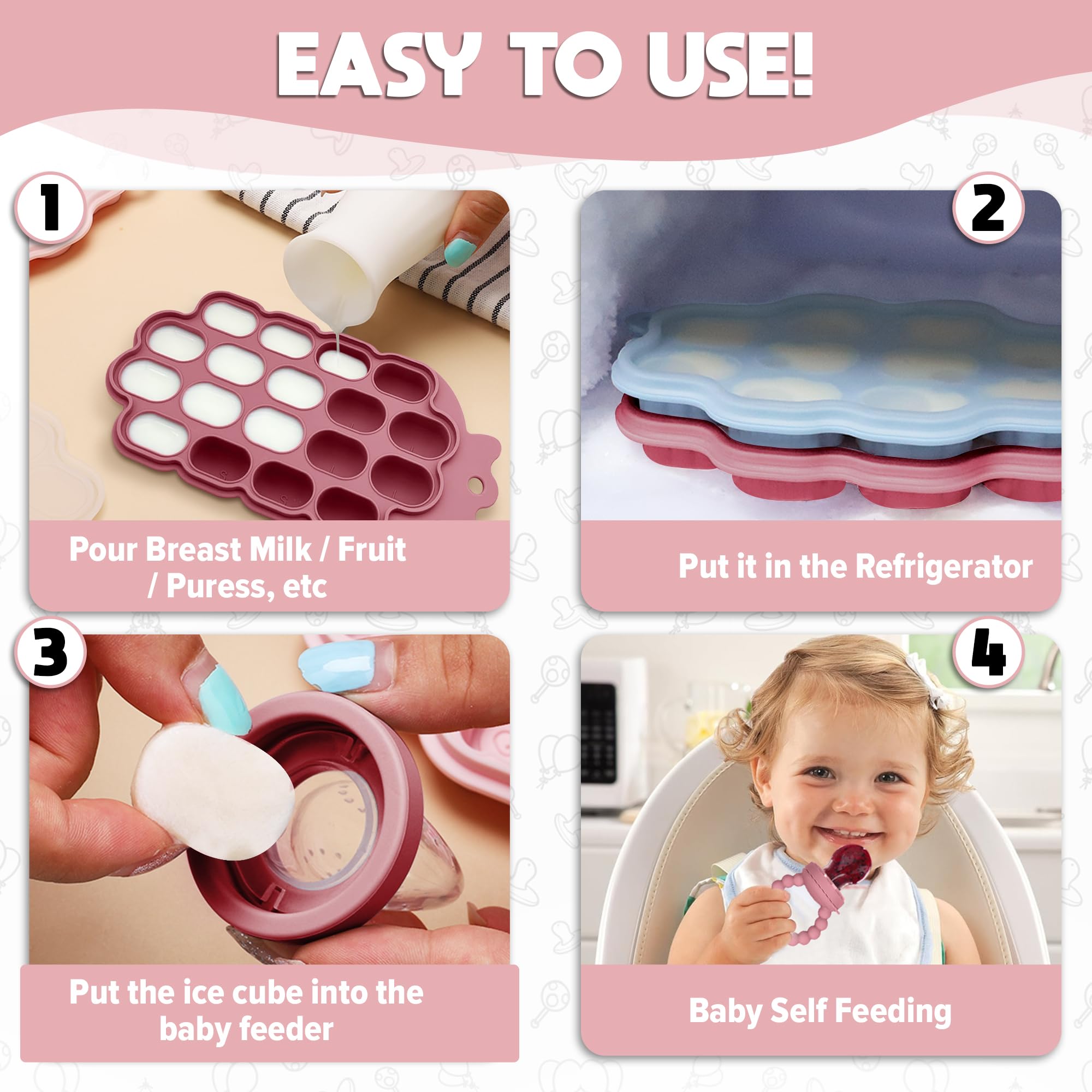
️Baby Weaning Set, 15 Pcs Silicone Baby Feeding Set
- 𝟏𝟓-𝐢𝐧-𝟏 𝐁𝐚𝐛𝐲 𝐖𝐞𝐚𝐧𝐢𝐧𝐠 𝐄𝐬𝐬𝐞𝐧𝐭𝐢𝐚𝐥𝐬 – 𝐅𝐮𝐥𝐥 𝐒𝐢𝐥𝐢𝐜𝐨𝐧𝐞 𝐅𝐞𝐞𝐝𝐢𝐧𝐠 𝐊𝐢𝐭: This complete baby silicone feeding set includes…
- 𝐒𝐚𝐟𝐞 & 𝐃𝐮𝐫𝐚𝐛𝐥𝐞 𝐁𝐚𝐛𝐲 𝐓𝐚𝐛𝐥𝐞𝐰𝐚𝐫𝐞 – 𝐏𝐫𝐞𝐦𝐢𝐮𝐦 𝐒𝐢𝐥𝐢𝐜𝐨𝐧𝐞 𝐐𝐮𝐚𝐥𝐢𝐭𝐲: Made from 100% food-grade silicone, our baby plate…
- 𝐒𝐭𝐫𝐨𝐧𝐠 𝐒𝐮𝐜𝐭𝐢𝐨𝐧 𝐁𝐨𝐰𝐥 & 𝐏𝐥𝐚𝐭𝐞 – 𝐒𝐭𝐚𝐲-𝐏𝐮𝐭 𝐅𝐞𝐞𝐝𝐢𝐧𝐠 𝐒𝐨𝐥𝐮𝐭𝐢𝐨𝐧: Our baby suction plate and bowl set features…
Check the instructions on any tray or feeder, and ask your doctor or health visitor what suits your baby's stage.
When to get help
If your baby has a reaction to a food, or you are worried at all, contact your doctor. If you have no clear guidance on which signs matter, ask your doctor or health visitor before you offer the first allergy food. If your baby refuses almost everything for a long stretch, or seems to be eating very little, mention it too.
How do milk, water and cups fit in once solids start?
Breast milk or formula stays the main drink for now. From around 6 months you can introduce a cup and offer sips of water with meals. Once solids begin, a small amount of water between feeds, up to 4 to 8 ounces a day, can be offered.
This is the part parents forget to plan for, and it saves a lot of confusion later.
Why does milk still come first?
Before 6 months, breastmilk alone meets all of a baby's energy and nutrition needs, according to UNICEF. When solids start, the AAP supports continued breastfeeding alongside the introductory foods.
At the very beginning, tastes are mostly practice. Your baby is learning how to eat, and milk is still doing most of the work. That is why you shouldn't cut back on milk feeds early.
If you worry that feeds are dropping off too quickly, ask your doctor or health visitor to check in.
How do I introduce a cup?
The NHS recommends introducing a cup from around 6 months and offering sips of water with meals. Don't expect much water to go down at first. Early cup use is mostly about learning to hold, tip and sip.
Picture a baby who bangs the cup on the tray, chews the rim and gets about a teaspoon in. That is a successful first day.
If you'd like a set that bundles cups and bowls, the 24 piece JELLDJK silicone feeding set has three training cups with straws, along with suction bowls and divided plates, adjustable bibs and spoons and forks. The same set also comes in a pink and blue colour option if you prefer.

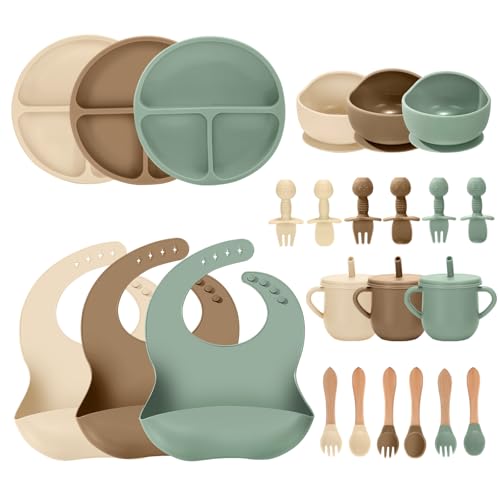
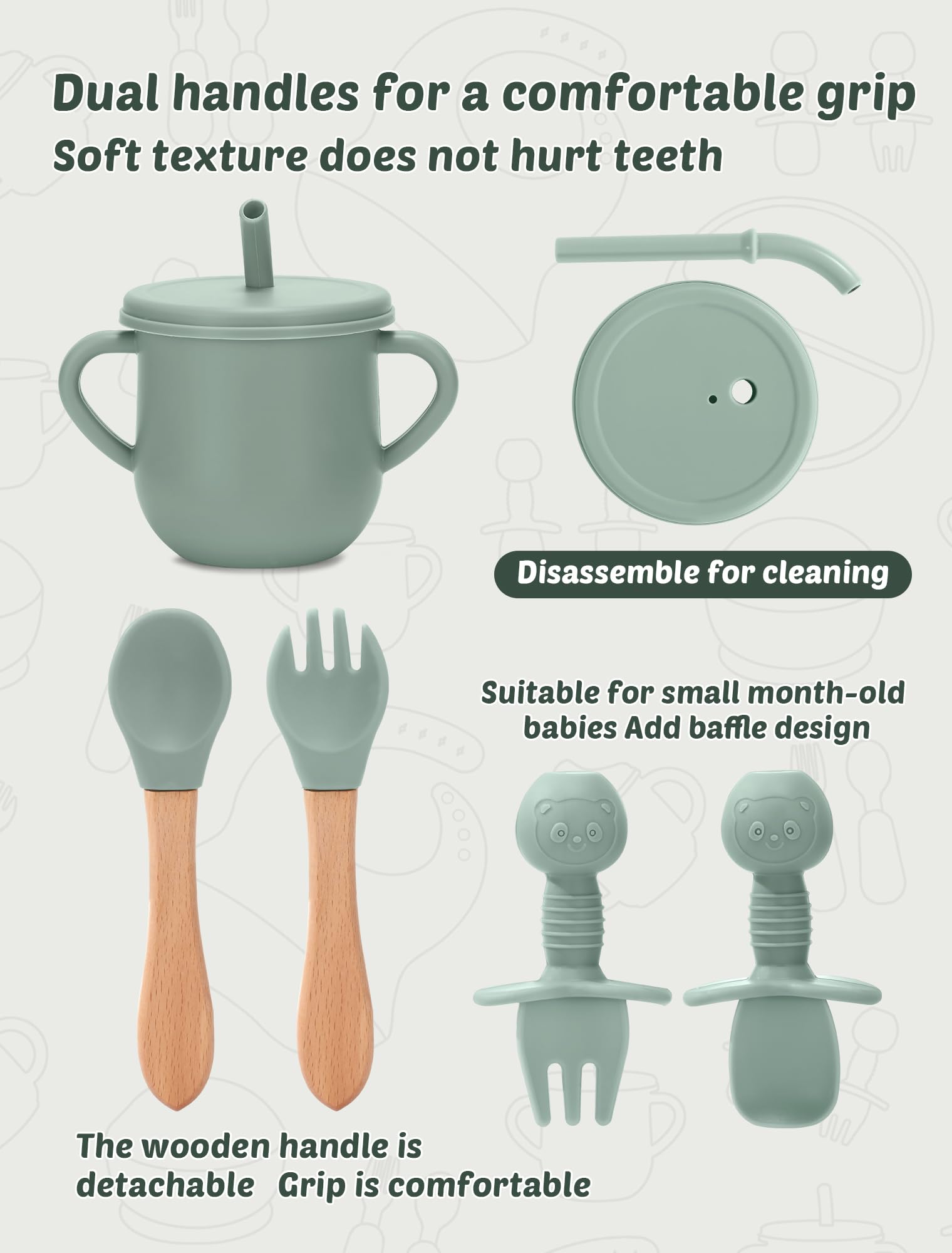
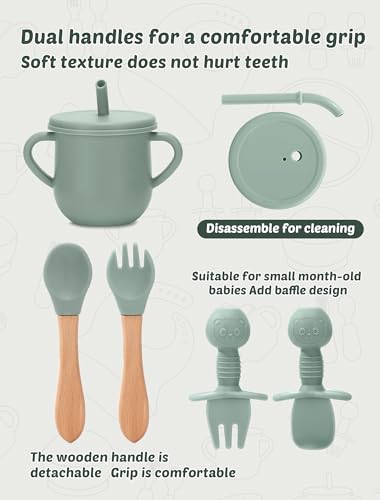
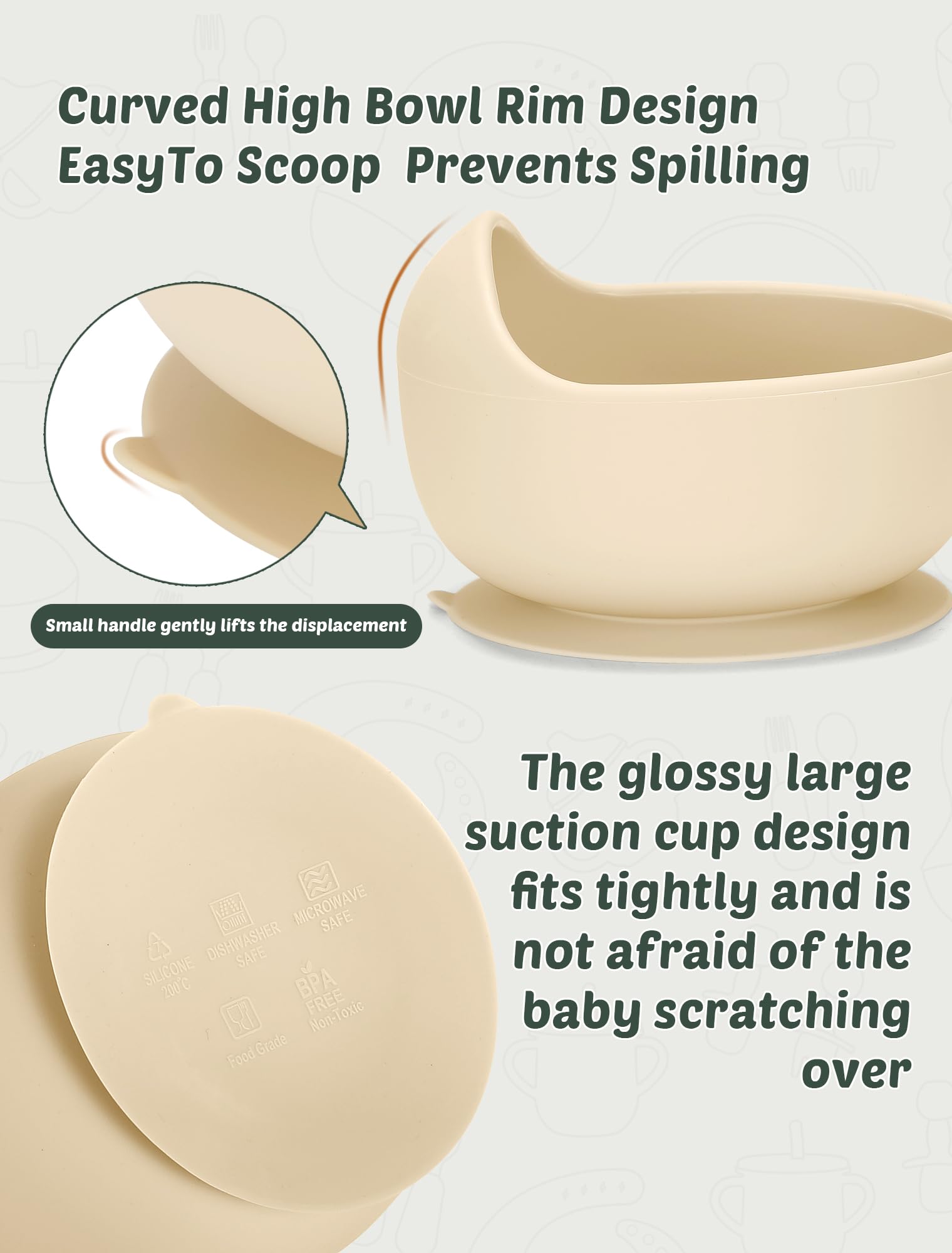
24 PCS Silicone Baby Feeding Set, Baby Led Weaning Supplies Includes Suction Bowls and Divided Plates, Adjustable Silicone Bib, Spoons&forks, Training cup with straw (Green+Brown+Beige)
- 24 pcs Silicone Baby Feeding Set : Our silicone baby feeding set includes 3 suction divided plate, 3…
- Safe & Certified Materials: These baby dishes are made from food-grade silicone, meeting the rigorous…
- Easy Cleaning: Our baby bowls and suction plates feature a powerful suction base to minimize spills. The…
You don't need to buy a set. Any cup your baby can safely hold and sip from will do.
How much water is right?
KidsHealth says that once your baby is eating solid foods, you can offer a small amount of water between feedings, up to 4 to 8 ounces a day. Water is for practice and thirst, not a replacement for milk.
If you're unsure how much your baby needs, ask your doctor or health visitor, particularly in hot weather or during illness.
What does a day look like?
Here is a gentle example:
- Your baby has a milk feed on waking.
- At lunch, you offer a small taste of one new or familiar food, and a few sips of water from a cup.
- A milk feed follows when your baby is hungry.
- In the evening, you offer the same, or skip the second meal if your baby isn't interested.
Nothing about this is a rigid schedule. It is a rhythm that grows, with milk feeds in between.
What to tell childcare or grandparents
Keep it simple:
"Milk is still her main drink. Please offer sips of water with meals, and follow her lead on food. If she refuses, that's fine."
Write it down if you can, so everyone follows the same plan.
When to get help
If you're worried your baby isn't drinking enough, is refusing milk altogether, or seems unwell, ask your doctor or health visitor. Don't wait. Feeding changes are a normal reason to book a check in.
How do the feeding options compare?
Here is a quick side by side look at the main ways families start solids, along with a product that fits each. Treat this as a menu of ideas, not a shopping list. Everything works best when your baby is ready and you are relaxed.
| Option | Best Age Range | Primary Benefits | Main Drawbacks | Recommended Product | Price Range |
|---|---|---|---|---|---|
| Smooth purees from a spoon | From about 6 months | You control amounts and can offer new tastes easily | Can be slower, and your baby needs to move on to lumpier textures over time | PandaEar 9 piece silicone feeding set | $17.95 |
| Mashed and lumpy foods | From about 6 months, as your baby gets used to eating | Builds chewing skills gradually | Takes patience and a bit more mess | o'doe 15 piece baby weaning set | $27.99 |
| Soft finger foods (baby led weaning) | From about 6 months, once your baby sits steady | Your baby sets the pace and explores textures | Messy, and needs close supervision and safety knowledge | SofiAl 11 piece baby led weaning set | $29.99 |
| A mix of spoon and finger foods | From about 6 months | Flexible, and suits most families | Needs a little planning | JELLDJK 24 piece set in pink, blue and beige | $39.99 |
| Batch cooking and freezing small portions | From about 6 months | Saves time and reduces waste when trying new foods | Needs freezer space and some prep | JELLDJK 22 piece set with freezer trays | $60.99 |
| Sips of water from a cup with meals | From around 6 months | Builds cup skills early | Very little water is actually drunk at first | JELLDJK 24 piece set with training cups | $39.99 |
The NHS recommends introducing a cup from around 6 months and the same timing applies to starting solids.
Cost matters, but a simple, affordable option can meet your baby's needs just as well as a pricier one. What matters is a safe, upright position, a patient adult and food your baby can manage.
Key Takeaways
- Start at about 6 months, and not before 4 months, using readiness signs rather than the calendar.
- Look for three signs: sitting with a steady head, coordinating eyes, hands and mouth, and swallowing rather than spitting out.
- Solids will not help your baby sleep through the night, so don't start them to fix sleep.
- Begin with a few spoonfuls of soft, plain food, and keep milk as the main drink.
- Offer one new food at a time and wait 3 to 5 days before the next.
- Introduce allergy foods from around 6 months, and talk to your doctor first if your baby has a higher allergy risk.
- Refusal is normal; keep offering without pressure, because it can take 10 tries or more.
Conclusion
Starting solids can feel like a big milestone, but really it is a slow, messy conversation between you and your baby. There will be pulled faces, food in hair and meals that last about four minutes. That is all part of it.
You don't need a perfect plan, only a calm one: wait for readiness, start small, add one food at a time and keep milk going. A baby who is learning to eat is already doing something hard.
If this helped, save it for the week you start, or share it with the person who feeds your baby alongside you. I'll be here when you're ready for the next stage.
Sources & References
- CDC. "When, What, and How to Introduce Solid Foods."
- NHS. "Your baby's first solid foods."
- Canadian Paediatric Society. "Timing of introduction of allergenic solids for infants at high risk."
- American Academy of Pediatrics. "When Can Babies Start Solid Foods? Readiness & Feeding Tips."
- KidsHealth. "When Can My Baby Start Eating Solid Foods?"
- KidsHealth. "Formula Feeding FAQs: Starting Solids and Milk."
- UNICEF. "Feeding your baby: When to start with solid foods."
- Cleveland Clinic. "When Can Babies Start Eating Baby Food?"
- American Academy of Pediatrics. "Infant Food and Feeding."
Frequently Asked Questions
Can I start solids at 4 months?
How much should my baby eat when starting solids?
Will solids help my baby sleep through the night?
How long should I wait between new foods?
When can my baby have peanut, egg and other allergy foods?
Is it normal for my baby to spit food out or gag?
Do I still need to give breast milk or formula once solids begin?
Was this helpful?
Thanks — your feedback helps us pick what to write next.