
Potty Training Tips for Girls: A Calm, Practical Guide for Parents
TL;DR: Quick summaryStart when your daughter shows signs she is ready, not when the calendar says so. The American Academy of Pediatrics suggests waiting until she is at least 18 months old, shows readiness signs, and you use a child oriented approach. Stay calm, skip the pressur

In this article
TL;DR: Quick summary
Start when your daughter shows signs she is ready, not when the calendar says so. The American Academy of Pediatrics suggests waiting until she is at least 18 months old, shows readiness signs, and you use a child oriented approach. Stay calm, skip the pressure, and expect a few accidents.
What you'll get
About 29 minutes to read. Short on time? Read the bold lines and the Key Takeaways near the end.
Picture this. A friend's daughter is using the toilet at 20 months, your cousin swears she did it all in a weekend, and your own girl is happily hiding behind the couch to fill a diaper before asking for a snack. You start to wonder whether you are behind.
You are not. Potty training gets a lot of confident advice, and much of it contradicts the next person's confident advice. That is exhausting when you just want to know what to do on Monday morning.
Here is what I tell parents in clinic. Your daughter's readiness is the thing to watch, not the calendar and not the neighbor's child. When you follow her lead, stay relaxed and keep your expectations realistic, this stage is usually far less dramatic than people make it sound.
Let's start with the question almost every parent asks first.
When is a girl ready to start potty training?
The American Academy of Pediatrics suggests starting once your daughter is at least 18 months old, shows signs of readiness, and you use a child oriented approach. In other words, her readiness matters more than her birthday. Watch her body and her interest, then follow her lead.
What do the numbers say about girls?
The average age of toilet training is 27 months. That is an average, so plenty of healthy children train earlier and plenty train later. Most children in the United States are bowel and bladder trained by 4 years of age.
Girls do tend to get there a little sooner as a group. One study found that girls showed toilet training skills at earlier ages than boys. The median age for showing an interest in using the potty was 24 months for girls and 26 months for boys, and for staying dry for 2 hours it was 26 months for girls and 29 months for boys.
Risko, quoted by Boston Children's Answers, puts it simply: girls are generally potty training around 2½ and boys around age 3.
Other sources tell a more cautious story. Raising Children, an Australian parenting site, says there are no big differences in when boys and girls start showing signs of readiness or how quickly they learn. So treat the girl and boy figures as a rough map, not a deadline. Your daughter is one child, not a median.
Signs she may be ready
Readiness is a mix of body, brain and mood. One of the clearest body signs is staying dry for at least 2 hours at a time during the day, or being dry after naps. That tells you her bladder can hold on for a while.
Over one week, watch for these:
You do not need every box ticked. Readiness can show up in one area and not in the others, because normal development is uneven. If she is dry for long stretches but could not care less about the potty, that is useful information too.
Bring it to your well child visits
Toilet training may come up at the 18 month, 2 year, 2½ year and 3 year well child visits. That makes those appointments a handy place to ask questions. Jot down what you have noticed (dry naps, grunting, curiosity) and bring the list with you.
What to say when she shows interest
You do not need a speech. Keep it light and matter of fact:
"I see you're curious about the potty. Do you want to sit on it with your clothes on?"
"Your diaper is wet. Next time, tell me and we can try the potty."
The mistake to avoid: comparing her
Comparing rarely helps and often adds pressure, and pressure is what tends to cause trouble. If your daughter is closer to two, our guide on potty training tips for 2 year olds goes deeper on that stage.
How do I start potty training my daughter, step by step?
Start by choosing a calm stretch of weeks, introducing the potty as an ordinary object, and practicing sitting with clothes on. Then move to short, regular tries at predictable times, like after waking and after meals. Let her set the pace, and expect a slow build rather than a weekend fix.
The plan in six steps
- Pick a calm stretch. Choose a few weeks with no big changes and fewer outings. You do not need to clear your whole calendar, but you do want a routine you can repeat.
- Make the potty a normal object. Put it in the bathroom, or in the living room if that feels friendlier. Let her touch it, carry it and sit her favorite doll on it.
- Practice sitting with clothes on. Keep it short and light. A story or a song while she sits is plenty.
- Try with clothes off at predictable times. Good moments are after waking, after meals and before bath. Offer a try, then let it go if nothing happens.
- Notice her cues. Freezing, squatting, grunting or a sudden quiet corner can all mean something is coming.
- Repeat, calmly, every day.
The American Academy of Pediatrics (AAP) recommends starting once a child is at least 18 months old, shows signs of readiness, and you use a child oriented approach.
Expect a slow build
Here is the part that surprises many families. It is ideal to practice daily for at least three months. That does not mean three months of accidents. It means a few months of steady, low key repetition while her skills catch up.
If you go in expecting a weekend fix, every wet pair of pants feels like failure. If you go in expecting a slow build, it feels like Tuesday.
What to say
Keep your words short, neutral and kind. Here are a few you can borrow:
Notice what is missing: no "good girl" or "bad girl", no sighs and no sharp tone. She is learning a body skill, not passing a test.
What a child oriented approach looks like
The AAP strongly recommends that parents avoid pushing their child into toilet training. Pushing can set off power struggles, and those can hurt the relationship between you and your child.
In daily life, child oriented means she sets the pace and you offer the chances. Picture a two and a half year old who says "no potty" after breakfast. You say, "Okay, no problem. We'll try again after your snack." You have not argued, bribed or lectured, and the door stays open.
Common mistake: starting in the middle of big change
A move, a new baby, a new daycare or a family upheaval all use up a toddler's coping energy. Potty training needs some of that energy too. If a big change is coming, wait until things settle, then begin.
If she resists, the real issue may be cooperation rather than the potty itself. Our guide to gentle parenting when your toddler won't listen has calm ways to get buy in without a fight.
What is the best potty for a girl?
The best potty is the one your daughter will actually sit on, comfortably and without fear. There are no big differences in strategies for toilet training girls and boys. So choose by fit, stability and how easy it is to clean, not by colour or gender.
Standalone potty chairs
A standalone potty sits on the floor, so her feet are planted and she never has to climb. That feels safer to many toddlers, and she can get to it quickly when she needs to go. Picture a two year old who freezes when she sees the big toilet; a floor potty can feel less intimidating because her feet are planted and she is close to the ground.
The Kindsgut Whale Potty Training Toilet in Pistachio is a friendly, playful choice. It has a backrest, a rubber grip on the base so it stays put, and a removable inner bowl that lifts out for quick cleaning.


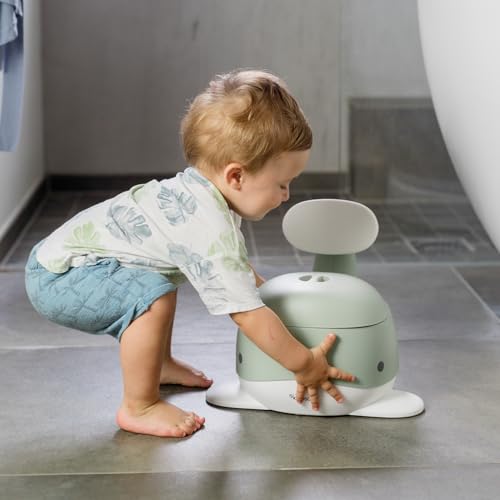

Kindsgut Whale Potty Training Toilet, Pistachio
- WHALE POTTY TRAINING TOILET FOR BOYS & GIRLS AGE 1+: This ergonomic toddler potty features a comfortable…
- NON-SLIP, EASY TO CLEAN & BUILT TO LAST: Rubber grip on the base keeps the potty chair securely in place…
- LOVED BY PARENTS AWARD 2026: Designed in Germany by a family brand from Berlin Kindsgut's whale potty is the…
The Snugzy 3 in 1 foldable potty with step stool suits families who want one item that does several jobs. It works as a floor potty, sits over the adult toilet with a step, and folds away. It also comes with a removable urinal, which only matters if there is a boy in the house.
Seats that sit on the regular toilet
A seat and step option skips the "now we move from the potty to the toilet" stage, and there is no bowl to empty. The trade off is that she has to climb up, so a wide, non slip step matters a great deal.
The COOSEYA 2 in 1 seat has a waterproof cushioned mat and a non slip step stool. The green 2 in 1 seat with steps adds an extended splash guard and a foldable ladder, which helps with storage. If she wants extra support climbing on and off, the 2 in 1 seat with upgraded safety armrests gives her something solid to hold.
For a child who loves characters, the Disney Princess "Loving Life" soft potty seat has a soft cushion and easy grip handles. Sometimes a familiar face is all the motivation she needs to sit down.
A quick buying checklist
Before you commit, let her test it. Have her sit on it fully clothed, then let her name it or decorate it with a few stickers. Something like, "This is your special seat. You can decide what to call it."
The mistake to avoid
The potty is only a tool. The routine, your calm words and your patience do the real work. One comfortable option that she trusts will beat a bathroom full of gadgets.
How do I teach my daughter to wipe and wash her hands?
Teach her to wipe from front to back every time, because that keeps germs from her bowel away from her urethra. Show her how to spread her legs apart while she wipes. Then add a simple handwashing routine. Expect to help for a good while.
Why front to back matters
Girls are particularly susceptible to urinary tract infections (UTIs), which are infections of the bladder or the tube that carries pee out. Their urethras are very short, and germs from the bowel can easily pass along that route to the bladder.
You don't need to scare her with any of this. Just make "front to back" the way things are done, like buckling a car seat.
How to teach the technique
Girls should spread their legs apart when wiping. That gives her room to reach and see what she is doing. It is hard to do in a squirming toddler body, so practice outside the bathroom first.
- Sit with a doll or soft toy and a dry tissue, in a calm moment with no pressure.
- Show the doll's "front" and "back," using plain words like "pee spot" and "bottom."
- Let her wipe the doll from front to back with her legs apart, and say the phrase together.
- Swap roles. Let her show you how she does it, and praise the effort.
A short phrase helps a lot. Try "Front to back, that's the track," or just "Front to back, every time." Say it each time she wipes until she says it for you.
Helping without shaming her
Early on, she will probably need you to help or double check. That is normal, not a failure. Poo in particular is hard for small children to wipe well.
Try this order:
- Wipe together, with your hand over hers.
- Next, she tries first and you finish.
- Later, she wipes alone and you simply check, "Want me to have a quick look?"
Say it lightly: "Let's make sure you're all clean. I'll do the last bit." Keep your face relaxed and skip comments about smell or mess.
Handwashing, the other half of the job
Make sure both boys and girls learn to wash their hands well after using the toilet. Give her four steps she can say out loud:
- Soap
- Scrub
- Rinse
- Dry
Have her scrub for as long as it takes to sing a short song. A sturdy step stool at the sink makes this possible without you holding her up. Some of the potty seats we looked at in the last section, such as this 2 in 1 seat with a built in step stool, may also be usable as a stool for handwashing, and a wide, steady step also helps her climb on and sit more securely. Keep the soap pump and a small towel where she can reach them.
Watch for discomfort
If she complains of pain, burning or stinging when she pees, or starts having wetting problems even though she was doing well, those can be signs of a bladder infection. Don't wait it out. We cover when to call in the doctor section near the end of this article.
What should I do about potty training accidents and refusal?
Treat accidents as normal practice, stay calm, and clean up together without fuss. Avoid forcing her onto the toilet or punishing her. If she refuses outright, pause training for about 1 to 3 months, then try again. A break is a reset, not a failure.
What to say when an accident happens
Picture a two year old who has been playing happily, then freezes and looks down at a wet puddle on the kitchen floor. Her face crumples because she can tell something has happened. This is the moment your tone matters most.
Keep your voice flat and friendly. Try this:
"Oops, your pants are wet. Let's get cleaned up and try next time."
That is the whole script. No sighing, no "again?", no lecture. If she wants to help, hand her a cloth to wipe the floor or let her drop the wet clothes in the laundry basket. Keep it simple and tiny, because the goal is a sense of "I can fix this," not a chore.
Accidents are part of learning, even for girls who seemed fully trained last week. Her body is still figuring out the signal, and she is often too busy playing to listen to it.
What to avoid
The old tactics can feel logical when you are tired of washing sheets. They backfire. Boston Children's Hospital lists these as once common tactics to avoid:
The American Academy of Pediatrics (AAP) strongly recommends that parents avoid pushing a child into toilet training. Pressure tends to turn a learning job into a power struggle, and power struggles hurt the relationship you actually care about.
Sarcasm and sighing count as pressure too. Toddlers read your face faster than they understand your words.
If she refuses outright
Some girls simply say "no" to the potty, cry when you suggest it, or hold their pee until the diaper goes back on. When that happens, stop the training for about 1 to 3 months and then try again.
Say it out loud so she hears no drama: "Okay, we'll skip the potty for now. Maybe we'll try again later." Then put the potty away or leave it in the bathroom without comment.
Think of the break as a reset. Her readiness may be a few weeks off, or something else in her life (a new sibling, a move, a new daycare room) may be taking all her energy. Coming back later is not necessarily starting over, because her readiness may have moved on while you took a break.
Troubleshooting ideas that stay simple
Before you change anything big, run through this short list:
If every bathroom visit ends in a standoff, you may be dealing with a bigger toddler battle than a potty one. Our guide on why toddler tantrums can last all day explains what sits underneath those fights and what helps.
Look after your own calm too
Your child borrows her calm from yours. If you feel your jaw tightening over a third wet outfit before lunch, step back before you speak. Take one slow breath, count to five, and say your script on purpose.
It helps to see what this looks like in a real home. Here is how one mom regulates herself during toddler tantrums, and many of her tricks work just as well at the bathroom door.
How long does potty training take, and what about nights and outings?
Expect months, not days. Daily practice for at least three months is ideal, the average age of toilet training is 27 months, and most children in the United States are bowel and bladder trained by 4 years of age. Nights usually follow later, and that is normal.
A realistic timeline
Picture a girl who stays dry all day on Tuesday, then has three accidents on Wednesday. Many parents read that as failure. It is simply how learning looks: two steps forward, one step back, then forward again.
Think of it as three rough stages. First comes practice, with lots of reminders and lots of accidents. Next comes the middle stretch, where she notices the signal herself but still needs you to prompt her. Last comes real independence, when she walks off to the bathroom without a word from you.
Each stage can take weeks. If you are still cleaning up puddles weeks in, you are not behind.
Daytime and nighttime are separate milestones
Staying dry while awake and staying dry while asleep are two different skills. During the day she can feel the signal and choose to act. At night her body has to hold urine for hours without her help, and that part matures on its own schedule.
So a girl can be a star in the daytime and still wake up wet. That is not a training failure, and it is not her fault. If your child is age 5 or older and does not stay dry at night, it is worth discussing with your child's healthcare provider.
Here is what to say after a wet morning: "Your body is still learning to stay dry at night. That's okay. Let's get cleaned up." Keep your voice flat and kind, and move on with the day.
Daycare, grandparents and outings
A girl learns fastest when every adult does the same thing. Mixed messages slow things down, even when everyone means well.
For travel, a foldable seat is easy to toss in a bag. The lalalark foldable potty seat unfolds in seconds with no tools. The Snugzy 3 in 1 potty seat also folds and works as a floor potty. For a lighter option, the Disney Princess soft potty seat sits on most regular toilets.
Mistakes to avoid
Take backup away one piece at a time. Move to underwear for daytime first, keep night protection as long as she needs it, and drop the extra clothes from your bag only after several weeks of reliable dry days.
When should I talk to a doctor about potty training?
Talk to your doctor if your daughter is not using the toilet by 4 years old, or if she is older than 3 and isn't toilet trained during the daytime. For night wetting, raise it with her provider if she is 5 or older and does not stay dry at night.
The thresholds in plain words
Most children are bowel and bladder trained by 4 years of age, so a girl who is still training at 2 and a half or 3 is well within the normal range. These checkpoints are not deadlines you have to race toward. They are the points where a quick conversation is worth having.
Night dryness often comes later than daytime dryness, and that is normal. Please don't wait until the 5 year mark if the wet beds are upsetting her or you. Ask at any visit.
Other reasons to check in
Thresholds are about age. Some reasons to call have nothing to do with age at all.
Wetting problems even though she is already potty trained are a reason to check in with a healthcare provider. So is a sudden change in a girl who had been doing well.
Girls are particularly susceptible to urinary tract infections (UTIs), because their urethras are very short and germs from the bowel can easily pass along this route to the bladder. The urethra is the small tube that carries urine out of the body. So if she seems uncomfortable when she pees, or starts having new accidents after weeks of dry days, call her clinician.
I can't diagnose anything from a description, and neither can you at home. That is the whole point of the call. A clinician can look at the full picture and decide what, if anything, needs doing.
What to bring to the visit
You will get far more from an appointment if you arrive prepared. Picture a mum who walks in and says, "She's been difficult with the potty." The doctor has little to work with. Now picture her saying, "We started 6 weeks ago, she's dry most mornings, and accidents happen after lunch." That is something a doctor can use.
Bring a short note on your phone or on paper:
Well child visits are a natural time to ask. Toilet training may come up at the 18 month, 2 year, 2 and a half year and 3 year visits, so you never need to feel you are bothering anyone. If you are not sure whether something is worth mentioning, mention it.
Common mistakes
You are doing fine
Zoom out for a moment. Most girls get there, usually with a few accidents and a lot of patience from the adults around them. If you remember five things from this article, make them these:
- Wait for signs of readiness rather than the calendar.
- Keep your tone calm, and treat accidents as information, not misbehaviour.
- Teach wiping from front to back and good handwashing every time.
- Choose a potty or seat that fits her comfortably and feels safe.
- Ask for help when the thresholds above are met, or sooner if something worries you.
You know your daughter better than anyone. Trust that, and let a professional fill in the rest.
Which potty or seat suits your daughter?
There is no single best choice, only the one that fits your bathroom, your budget and her comfort. Here is how the six products in this guide compare side by side.
| Option | Best Age Range | Primary Benefits | Main Drawbacks | Recommended Product | Price Range |
|---|---|---|---|---|---|
| Floor potty with backrest and removable bowl | Young toddlers just starting out | Feels safe and low to the ground, non slip base, bowl lifts out for quick cleaning | Takes up floor space, and you will need to move to the big toilet later | Kindsgut Whale Potty | $44.99 |
| Toilet seat with armrests and a wide step stool | Toddlers who want the "big toilet" | Armrests help her climb and sit, doubles as a hand washing stool | Bulky to store, and some children dislike the armrests at first | SKYROKU armrest potty seat | $37.99 |
| Foldable seat with steps and splash guard | Toddlers, and families who travel or have little space | Quick setup with no tools, soft seat ring, folds away | Fewer reviews so far, and the seat needs to match your toilet shape | lalalark foldable potty seat | $35.95 |
| Three way seat with adjustable height | Toddlers growing through different stages | Five height levels, can also be used on the floor, suits squat toilets | Lower average rating, and more parts to set up and clean | Snugzy three way potty seat | $36.99 |
| Toilet seat with cushion and adjustable step stool | Toddlers who are nervous about heights | Wide step, six height positions, waterproof soft cushion | Needs adjusting as she grows, and the stool adds bulk | COOSEYA potty seat with step stool | $25.64 |
| Soft padded seat with grip handles | Toddlers who are already comfortable on the toilet | Lowest price, easy to carry, fits most regular and elongated toilets | No step stool, so she will need a separate stool to climb up | Disney Princess soft potty seat | $15.99 |
Expert Insights
Many parents hear that girls potty train earlier. This line from a Boston Children's clinician matches what many families notice, though it is an average and not a rule.
Generally, girls are potty training around 2 1/2 and boys around age 3,
Risko, Boston Children's Answers
Keep that in perspective. Another source notes there are no big differences in when boys and girls start showing signs of readiness or how quickly they learn. Your daughter's signs matter more than any average.
Key Takeaways
- Wait for signs of readiness, such as staying dry for stretches and showing interest, rather than following the calendar. Starting at 18 months or later with a child oriented approach is the guidance from the AAP.
- Girls may show skills slightly earlier on average, but every child is different, so compare her with herself and not with a sibling or a friend.
- Keep your tone calm and treat accidents as information, never as misbehaviour. Punishment and forced sitting do not help.
- Teach wiping from front to back, with legs apart, and handwashing after every visit to the toilet.
- Choose a potty or seat that fits her well and feels safe, whether that is a floor potty like the Kindsgut Whale Potty or a seat with a step stool such as the COOSEYA seat.
- If she refuses, take a break for about 1 to 3 months and try again later.
- Ask your doctor for help if she is not trained in the daytime after age 3, not using the toilet by 4, or not dry at night by 5. Also ask if wetting problems appear after she was trained.
One last thing before you go
Somewhere in the middle of potty training, you will probably feel like you are the only parent whose child is taking forever. You are not. Every household has its own puddles, its own victory dances and its own bad days.
Your daughter is learning a brand new skill, and she is learning it from you. A calm parent and a patient pace will usually serve you better than a rushed schedule.
So take a breath, keep the praise easy and the pants spare, and trust her to get there in her own time. If you want to share this guide with another parent who is in the thick of it, send it along.
Sources & References
- American Academy of Pediatrics. "Toilet Training."
- hopkinsmedicine.org. "Toilet Training."
- American Academy of Pediatrics. "The Right Age to Potty Train - HealthyChildren.org."
- American Academy of Pediatrics. "Sequential Acquisition of Toilet-Training Skills: A Descriptive Study of Gender and Age Differences in Normal Children."
- answers.childrenshospital.org. "The dos and don'ts of potty training - Boston Children's Answers."
- raisingchildren.net.au. "Toilet training: when & how to do it."
- American Academy of Pediatrics. "The Right Age to Potty Train - HealthyChildren.org."
- American Academy of Pediatrics. "The Right Age to Potty Train - HealthyChildren.org."
- mayoclinic.org. "Potty training: How to get the job done - Mayo Clinic."
- American Academy of Pediatrics. "Toilet Training Methods, Clinical Interventions, and Recommendations."
- CDC. "Urinary Tract Infection Basics."
- American Academy of Pediatrics. "Potty Training: 12 Tips to Keep the Process Positive - HealthyChildren.org."
- American Academy of Pediatrics. "5 Ways to Help Prevent Urinary Tract Infections (UTIs) in ."
- American Academy of Pediatrics. "The Right Age to Potty Train - HealthyChildren.org."
- kidshealth.org. "Urinary Tract Infections (UTIs) in Kids."
- answers.childrenshospital.org. "The dos and don'ts of potty training - Boston Children's Answers."
- caringforkids.cps.ca. "Toilet learning - Caring for kids - Canadian Paediatric Society."
- hopkinsmedicine.org. "Toilet Training."
- caringforkids.cps.ca. "Toilet learning - Caring for kids - Canadian Paediatric Society."
- mayoclinic.org. "Potty training: How to get the job done - Mayo Clinic."
Frequently Asked Questions
At what age should I start potty training my daughter?
Are girls easier to potty train than boys?
How do I teach my daughter to wipe properly?
Should I use a floor potty or a toilet seat for a girl?
What if my daughter refuses to use the potty?
How long does potty training take?
When should I talk to a doctor about potty training?
Was this helpful?
Thanks — your feedback helps us pick what to write next.


