
Working Mom Balance: What Is Normal and What Actually Helps
TL;DR: Quick summaryWorking mom balance feels hard because the system is hard: long hours, costly childcare, unpredictable kid needs and an unequal mental load. It is not a personal failing. Parents who work part time struggle almost as much as those who work full time. The fix i
In this article
TL;DR: Quick summary
Working mom balance feels hard because the system is hard: long hours, costly childcare, unpredictable kid needs and an unequal mental load. It is not a personal failing. Parents who work part time struggle almost as much as those who work full time. The fix is a shared load, clear priorities and a simple plan.
What you'll get
About 30 minutes to read. Short on time? Read the bold lines and the Key Takeaways near the end.
It is 8:40 p.m. The lunchboxes are packed, the laundry is half folded, and you are answering one last email while a permission slip sits unsigned on the counter. You tell yourself tomorrow will be calmer. It rarely is.
If that sounds familiar, you are in very good company, and you are not doing it wrong. Working mom balance is hard for roughly half of working parents. Most of the pressure comes from how work, childcare and home life are set up, not from how much you love your kids or how organized you are.
In this guide I will talk to you the way I talk to parents in clinic: plainly and without judgment. We will look at what the research says is normal, how to share the load, how to use leave and flexible working rights, and how to plan a week that holds together. We will also cover how to look after yourself without adding another chore to your list.
Take what helps. Skip what does not. Nothing here needs to be done perfectly.
Why is working mom balance so hard?
It is hard because the difficulty is built into the system: costly childcare, kid needs that do not follow a calendar, and a mental load that lands unevenly. It is not a personal failing. Similar shares of parents who work part time (51%) and full time (54%) say balancing work and family is difficult.
You are not the only one struggling
Cutting your hours does not make the problem disappear. Parents who work part time (42%) and full time (46%) both say they felt they could not give 100% at work in the past year because they were juggling work and family.
An earlier Pew survey found a similar pattern. About half of working mothers said they had needed to reduce their work hours (54%) or had felt they could not give 100% at work (51%).
What a weekday really looks like
Picture a weekday for a mom with a six year old and a toddler. This is an example, not a case from clinic. Notice how many small jobs are about remembering and deciding, not doing.
- 6:00 a.m. You answer two work messages before the house wakes up. You also remember Friday is a dress up day at school.
- 7:15 a.m. Breakfast, shoes, a missing water bottle. The permission slip is due today, so you sign it at the counter.
- 12:30 p.m. On your lunch break you book the dentist, because you are the one who knows which dentist.
- 5:30 p.m. Someone asks, "What's for dinner?" You decide, shop and cook.
- 7:30 p.m. Bath, books, bed, and one more glass of water.
- 9:00 p.m. You check tomorrow's calendar, order a birthday present for Saturday's party and add milk to the list.
None of these tasks takes long. Together they fill every gap in your day, and nobody sees most of them. That is the mental load: the planning, remembering and deciding that sits behind the visible work.
Why it matters beyond feeling tired
Research has linked work and family life that do not fit together with parental depression, poor physical health, poorer health habits and worse sleep quality. That is an association, not proof that work causes these problems.
I share it for one reason. It means fixing the system is worth your time, and it is not selfish. Small changes to how your household runs are health changes too.
The common mistake: one standard for everything
Most of us try to do every task at the same high standard. That works for a week, then it collapses.
Try "good enough" priorities instead. Each day, pick the few things that truly must happen: kids fed, safe and connected, one key work task, and one thing that keeps you going. Everything else can be done later, done simply or handed to someone else. This is also at the heart of the real cause of parental burnout, where the load, not your effort, is the problem.
When to get extra help
If low mood, constant worry or poor sleep is not easing, tell your doctor or health visitor. Ask what support is available to you. Asking is a sign you are taking care of the whole family.
Is mom guilt normal, and does working hurt my kids?
Yes, guilt is very common, and it reflects social pressure as much as reality. Roughly half of working parents say being employed makes it harder to be a good parent. That is a feeling worth taking seriously, but a feeling is not the same as a measure of what your child needs.
Where the guilt comes from
Only 16% of adults say the ideal situation for a young child is a mother who works full time. So many women go to work carrying a belief that society expects them to be somewhere else.
That belief is loud at drop off and quiet when the bills arrive. You can hold both truths: your job matters, and you miss your child. Neither cancels the other.
Guilt versus evidence
Guilt tells you that you care. It does not tell you that something is going wrong.
What the evidence does point to is stress. In one study, healthy preschoolers whose parents reported parenting stress during infancy had 2 times higher odds of mental health problems at age 3. Please read that as a case for support, not blame. Work-family strain is linked to poorer wellbeing, so easing the load is worth more of your effort than trying to be a more perfect mother.
Three needs that make balance feel better
A study of working mothers with children aged 1 to 36 months looked at balance through the lens of three basic psychological needs: autonomy, competence and relatedness. In plain words, that means feeling in control of your choices, capable at what you do, and connected to the people who matter.
Here is how to meet each one:
Picture a mother who gets home at 6 pm, scrolls her phone while cooking, and feels awful by bedtime. She does not need more hours. She needs ten minutes where nothing else competes.
A 10 minute connection ritual
Pick one anchor point in the day and make it the same every time. This could be the drop off, the walk home or bedtime.
- Put your phone out of reach and get down to your child's level.
- Ask one open question, such as "What was the funniest thing today?"
- Share one thing from your own day, in simple words.
- Finish with the same goodbye or goodnight phrase every day.
Children love sameness. A short, reliable moment often lands better than a long, distracted afternoon.
What to say when someone judges you
Comments from relatives, other parents or strangers can sting. You do not owe anyone a defence, so keep a calm line ready:
"We've thought hard about this, and it works for our family. Thanks for caring."
Then change the subject. If the person keeps pushing, a gentle "I'd rather not discuss it" is enough.
Common mistakes
For more on easing that feeling, see mom guilt when going back to work. It also helps to understand why self care alone won't fix burnout, because the issue is often the load, not your habits.
When to talk to a professional
Guilt that never lifts, a low mood most days, loss of interest in things you enjoy or trouble sleeping deserves attention. Incompatibility between work and family life has been linked with parental depression and worse sleep quality. Speak to your doctor or health visitor, and say it plainly: "I've been feeling low and guilty for weeks, and I need help."
How do we split housework and childcare fairly?
Fair does not mean a perfect fifty fifty split. It means each of you owns whole jobs, from planning to doing to following up, instead of one parent managing everything while the other "helps". Ownership is what lifts the unseen load off one person's mind.
What is mental load, in plain terms?
Mental load is the thinking work behind the chores. It is noticing the shoes are too small, remembering the school form is due Friday, and deciding what's for dinner. When one parent holds all of that, the other can do plenty of tasks and the first parent still feels like the manager.
How to share the work, step by step
- List everything. Write down every recurring household and child task, including the invisible ones: school emails, birthday gifts, doctor appointments, laundry, bins, packed lunches.
- Sort into three groups. Daily (meals, bedtime, school run), weekly (shopping, laundry, cleaning) and occasional (dentist, uniform, holiday plans).
- Give each task one owner. The owner plans it, does it and follows up. No "just remind me".
- Agree what "good enough" looks like. Dinner on the table matters more than the exact menu.
- Review every two weeks. Ten minutes, with one question each: "What felt heavy this fortnight?"
Here is an example of how it might look. Picture one parent owning all school communication (emails, forms, reading logs, parents' evening) while the other owns meals and groceries. Each can stop checking on the other.
You could open the conversation with: "I'd like us to each own whole jobs. Which of these would you rather take completely?"
Why ownership works
One study of working mothers with children aged 1 to 36 months looked at work and family balance through self determination theory. It highlighted the psychological needs for autonomy, competence and relatedness. In everyday terms, people stick with tasks they control and feel capable of doing. That fits the idea that handing over a whole job, and letting it be done differently, may work better than handing out scattered favours.
Give the plan a shared home
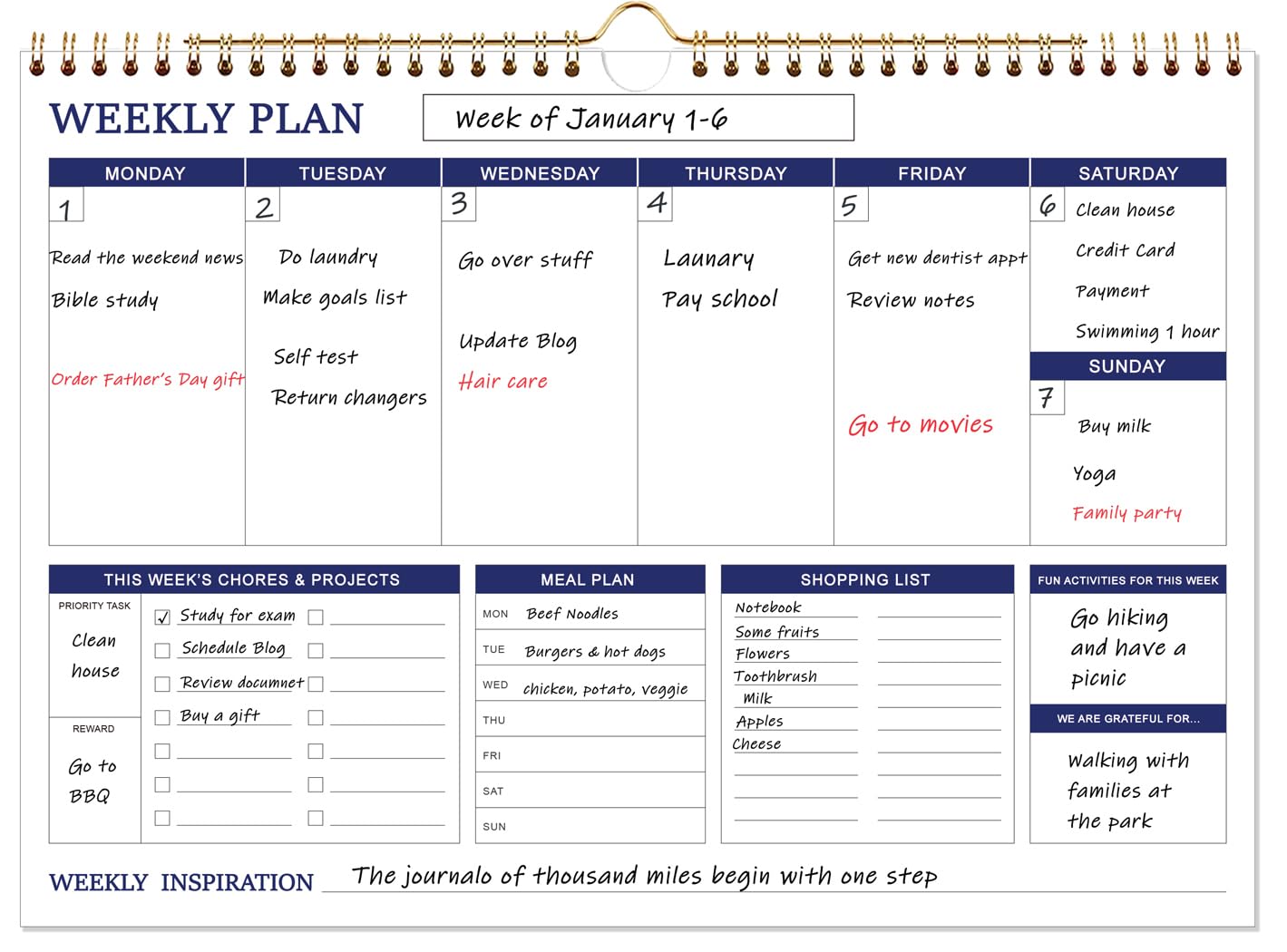
A plan only the planner can see is still a mental load. The Meal Tracker section of the Large Weekly Planner gives you a shared place to write who is cooking and what is planned.
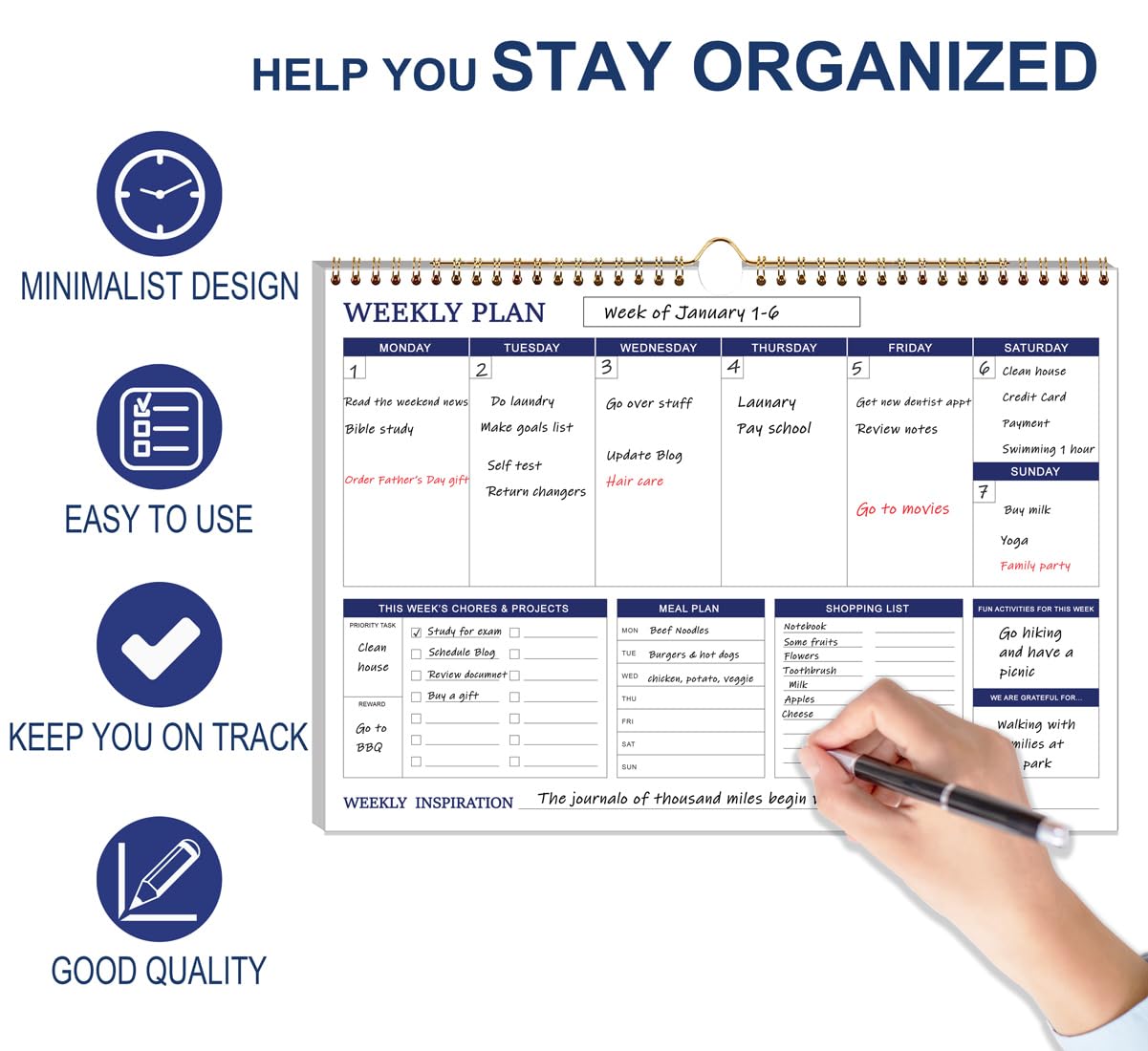

Large Weekly Planner - 17" x 12" Spiral Weekly Calendar, 52 Weekly Goals Schedule Planner for Planning and Organizing Family Activities, Meal Tracker, Undated
- WEEKLY PAGE - This large family planner features a spacious and clear layout. Each week contains two pages…
- PRACTICAL SECTIONS - This large weekly planner is devided into 4 sections, including a section for each day…
- PREMIUM QUALITY - Golden strong twin-wire binding makes it easy for turning pages and enables this daily…
If you are parenting solo
Ownership still helps; you just need more hands.
Say it directly: "Could you take Thursday pickups? It would take a huge weight off me." If your family shape is changing, our pieces on the rise of the stay at home dad and how fatherhood has changed may help you talk about roles with your partner.
Common mistakes
If resentment stays high after a few reviews, consider talking to a counsellor or your doctor.
What's the best family schedule system for a busy household?
The best system is one visible, shared place that everyone can read in 10 seconds. Think of it as one source of truth: a single board or planner that holds every pickup, deadline and dinner plan, so nobody has to ask you what is happening on Thursday.
Why one shared system beats several private ones
When your calendar lives in your phone, your partner's lives in theirs, and the school letter lives in a bag, you become the human switchboard. That is the mental load in action. A visible board moves the information out of your head and into the room.
Keep the 15 minute Sunday reset simple. Sit down together with a drink and do these in order:
- Copy the week's fixed events onto the board: school, clubs, appointments, work deadlines.
- Write who is doing each pickup and drop off.
- Choose dinners for the week and add one shopping list.
- Pick your top 3 priorities for the week, one list per adult.
- Wipe off last week's leftovers.
Match the tool to the job
Different spaces and different people need different tools. Here is how I would sort them.
The parent who manages weekly goals and meals will like the Large Weekly Planner, a large spiral book that is undated, so a missed week does not leave you with wasted pages. It is also a good home for your top 3 priorities.
For a hallway or kitchen command center, go big. The Magnetic Large Weekly Calendar Whiteboard is large and can be read from across the room. A smaller wall option is the weekly calendar whiteboard for the wall, which is double sided, so the blank side can hold a to do list.


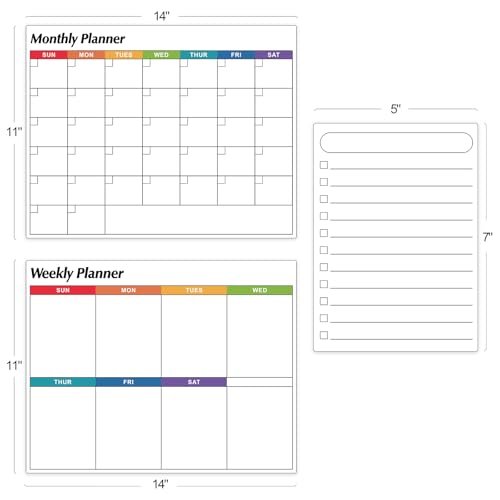

Dry Erase Magnetic Calendar for Refrigerator, 3 Pack- Monthly & Weekly & Daily Planner Magnet Whiteboard for Fridge Wall Door - Shopping, Meal/Menu, To Do List, Family Schedule Planning Board, 14"x11"
- 𝐏𝐑𝐎𝐃𝐔𝐂𝐓 𝐈𝐍𝐂𝐋𝐔𝐃𝐄𝐒 - 1 magnetic monthly calendar planner board (14x11 inches) + 1 magnetic weekly planner board…
- 𝐅𝐔𝐋𝐋-𝐌𝐀𝐆𝐍𝐄𝐓 𝐁𝐀𝐂𝐊 𝐃𝐄𝐒𝐈𝐆𝐍 - Ensure strong and stable attachment to any metal surface with each board's thick…
- 𝐄𝐀𝐒𝐘 𝐓𝐎 𝐂𝐋𝐄𝐀𝐍 - The surface of these white boards is made of advanced PET laminating technology, smooth and…
If the fridge is where your family actually gathers, the Dry Erase Magnetic Calendar 3 pack gives you monthly, weekly and daily views in one set. The Hivillexun 3 pack covers the same views and comes with markers and an eraser, which helps because markers go missing. Both also give you room for shopping and to do lists.
If you want something that looks good in a living space, the U Brands Rustic Weekly Dry Erase Board has a white wood frame and sits happily on a wall without looking like an office.
Digital tools can help too, and AI parenting technology has its place for reminders. But a board on the wall gets everyone involved, including the people who never open the family app.
An example layout
Picture a board with a row for each day. Give every family member a color: blue for you, green for your partner, orange for your 7 year old, purple for your 10 year old. Then add three fixed extras:
Get your kids involved
Children aged 5 to 12 can do more than you think. A 5 or 6 year old can tick off a simple morning routine with a magnet or a sticker. A child of 9 to 12 can write their own clubs, playdates and homework deadlines in their color.
Try saying: "This is your color. If it's not on the board, I won't know about it, and I can't promise to get you there."
Common mistakes
If you still miss things after a month of trying, the problem may be too many commitments, not the system. That is a good moment to ask what can come off the list.
What parental leave and flexible working rights do I have?
Your rights depend on your country, your employer and how long you have worked there. The examples below come from different systems (Northern Ireland, Great Britain, Canada, the US and Australia), so treat them as a guide. Check your own jurisdiction and your HR policy before you plan.
Examples of leave from different systems
In Northern Ireland, each parent can take 18 weeks of parental leave for each child, up to the child's 18th birthday. To qualify, you must be an employee with at least one year's continuous service where you work.
Shared parental leave works differently. In the UK system, it must be taken within one year of the birth, or of the date the child was placed with the family. A mother must take at least 2 weeks of maternity leave straight after birth (4 weeks in a factory or workshop). So the most shared parental leave available can never be more than 50 weeks.
Canada's federal rules offer another model. One employee may be eligible for up to 63 weeks, taken within the 78 week period after the child's birth or arrival. If two parents both take leave, their combined total cannot be more than 71 weeks.
In the US, covered federal employees get up to 12 weeks of Paid Parental Leave for a birth or adoption on or after October 1, 2020. Private employers vary a lot, so ask HR what applies to you.
Can I ask for flexible working?
In some places you have the right to request it, not the right to receive it. In Australia, for example, you can ask if you have worked for your employer for at least 12 months and meet certain criteria, such as having a child who is school age or younger.
Picture a mom whose school pickup is at 3:15. She could ask to start at 7:30 and finish at 3:00, with two afternoons a week made up from home after bedtime. That is a specific, workable request.
How to make the request
- Check your policy and your eligibility first, including how long you have been employed.
- Propose exact hours and days, not "something more flexible".
- Explain how your work will be covered, such as who handles urgent calls and when you will be reachable.
- Offer a trial period, such as three months, with a review date.
- Put it in writing and keep a copy.
Here is a script you can adapt:
"I'd like to request a change to my working pattern, starting 1 March. I'd work 7:30 to 3:00 Monday to Friday and make up the hours from home on Tuesday and Thursday evenings. I've listed how my deadlines and meetings will be covered. Could we try it for three months and then review it together?"
Common mistakes
Put every leave date and deadline on your wall calendar so it is visible to both parents.
When to get help
If your request is refused, delayed without explanation, or you feel pressured to drop it, talk to HR first and ask for the reason in writing. A union rep or a local employment advice service can explain your options and next steps. Do this early, because complaint windows can be short.
How can I manage childcare costs and money worries?
You are not alone if the numbers feel tight. Across income levels, parents say cost is the biggest hurdle in finding childcare. Feeling stretched is common, not a personal failure. Look at your real numbers first, then pick the fix that suits your family.
Money stress is not shared equally
Single moms, who tend to have lower family incomes, are much more likely than married or cohabiting moms to say they would be extremely or very worried about losing pay (50% vs. 32%). If that is you, your worry is not drama. It is a fair response to having one income and no back up.
If you are raising children on your own, these priorities help most:
- Protect your income first. Ask about paid sick days, leave and flexible working before you consider any cut in hours.
- Build a small buffer. Even a little set aside each month softens the blow of a sick child or a missed shift.
- Line up a back up carer. One trusted friend, neighbor or relative who can step in beats scrambling at 7 a.m.
- Ask for help with benefits. Check what support you may qualify for in your area. Many parents never ask.
Should you cut hours, change jobs, or keep going?
About half of working mothers say they have needed to reduce their work hours (54%). That is a very common path, but it is a big decision. Use a simple framework before you choose.
- Work out your net gain. Take your pay after tax, then subtract childcare, commuting and work costs. Look at what is left over, not the headline salary.
- Think about career effects. Ask how a cut in hours or a job change could affect promotion, pension and your pay a few years from now.
- Test what is sustainable. Ask honestly whether the whole family can keep this pace for the next year, including your sleep.
Picture a mom whose childcare bill swallows most of her second paycheck. On paper, quitting looks sensible. But when she checks, a four day week with one childcare day swapped with a friend keeps her skills current and her costs lower.
Ways to bring the cost down
You may not need to change your job at all. Try one or two of these first:
Food is the other big lever. Use the meal section of a planner such as the Large Weekly Planner with a meal tracker to plan dinners before you shop. Then keep a running shopping list on the fridge whiteboard, like the magnetic fridge calendar set, so everyone adds items as they run out. You may buy less on impulse and waste less food.
Dry Erase Magnetic Calendar for Refrigerator, 3 Pack- Monthly & Weekly & Daily Planner Magnet Whiteboard for Fridge Wall Door - Shopping, Meal/Menu, To Do List, Family Schedule Planning Board, 14"x11"
- 𝐏𝐑𝐎𝐃𝐔𝐂𝐓 𝐈𝐍𝐂𝐋𝐔𝐃𝐄𝐒 - 1 magnetic monthly calendar planner board (14x11 inches) + 1 magnetic weekly planner board…
- 𝐅𝐔𝐋𝐋-𝐌𝐀𝐆𝐍𝐄𝐓 𝐁𝐀𝐂𝐊 𝐃𝐄𝐒𝐈𝐆𝐍 - Ensure strong and stable attachment to any metal surface with each board's thick…
- 𝐄𝐀𝐒𝐘 𝐓𝐎 𝐂𝐋𝐄𝐀𝐍 - The surface of these white boards is made of advanced PET laminating technology, smooth and…
Finish with a monthly money check in. Sit down for 20 minutes with your partner, or on your own, with a cup of tea. Look at what came in, what went out and what is coming next month. Write the plan on the calendar so it does not live only in your head.
Common mistakes
When to get help
If money worries are keeping you awake, affecting your appetite or making you feel unwell, please talk to someone. A financial counselor or your workplace benefits office can go through your options with you. Your doctor or health visitor can also help if worry is starting to affect your health.
How do I switch off from work and look after myself?
Build a clear line between work and home, and use small rituals to mark the crossing. You will never get a perfect split, but even a rough boundary can help you recover and give your children more of your real attention.
Children notice when your body is at the table but your mind is in your inbox. A boundary gives them a parent who is fully there for a short stretch, and that usually beats a long evening of half attention.
Three rituals that mark the end of work
1. A shutdown routine. Take five minutes before you close the laptop or leave the building. Write down anything still on your mind, then choose tomorrow's top three tasks. Say out loud, "Done for today." It sounds silly, but it tells your brain the list is safe.
Many parents like to keep this on paper where the family can see it. A rustic dry erase board with a white wooden frame works well for an end of day checklist and tomorrow's top three. A magnetic fridge whiteboard set does the same job in the kitchen.
2. A phone free first 20 minutes after pick up. Picture a parent who arrives at the school gate still answering messages. Her seven year old talks, and she says "mm hm" without hearing a word. Now picture the same parent putting the phone in her bag until after a snack and a cuddle. The children get her first, and the messages wait twenty minutes.
3. A work mode signal at home. If you work from home, give your kids something they can see, such as a red card on the door or a lamp that means "Mum is working." Explain how long it lasts and what they can do meanwhile. A workspace that signals work mode helps your brain switch too.
Why this matters for your health
This is more than a nice habit. Research has linked work and family life pulling against each other with parental depression, poor physical health, poor health behaviours and worse sleep quality.
There is also a link to your children. In one study, healthy preschool aged children whose parents reported parenting stress during infancy had 2 times higher odds of mental health problems at age 3. That does not mean your stress will harm your child. It means support is worth seeking early, not after you hit a wall.
Self care that actually works
Start with the basics. Protect your sleep where you can, and ask for help in specific words: "Can you do bath and bedtime on Tuesdays and Thursdays?" works better than "I need more help."
Research on working mothers of children aged 1 to 36 months used a framework called self determination theory. It focuses on three needs: autonomy, competence and relatedness. In everyday terms, that means:
Bubble baths are lovely, but they do not rebuild these needs. If you want to go deeper, read why self care will not fix parental burnout and what 42 countries reveal about burnout.
Common mistakes
When to get help
Please reach out if low mood, anxiety or exhaustion lasts for weeks, or if you feel unable to cope. Start with your GP or family doctor. You can also try a therapist, your employee assistance program, or a postpartum support line. Asking is a sign you are taking care of your family.
Start this week
Which planning tool fits your family best?
A shared plan only works if everyone can see it. Here is how the six options compare, so you can pick the one that matches your kitchen, your kids' ages and your budget.
| Option | Best Age Range | Primary Benefits | Main Drawbacks | Recommended Product | Price Range |
|---|---|---|---|---|---|
| Large spiral weekly planner | Families with school age kids, and parents who like writing things down | Two pages per week, room for meals, shopping and each family member | Lives on a shelf or wall hook, so younger kids rarely check it | Tuun Fuplan Large Weekly Planner | $16.99 |
| Wall whiteboard with weekly grid | Any age, best for kids who read | Double sided, easy to rewrite when plans change, doubles as a to do list | Needs wall space and a marker that does not walk off | ABERLLS Weekly Calendar Whiteboard | $19.99 |
| Fridge magnet set (month, week and day) | Toddlers to tweens, since the fridge is where everyone goes | Cheap, three boards in one, markers and eraser included | Small writing space, so busy weeks get crowded | VITEVER Magnetic Calendar 3 Pack | $9.98 |
| Framed rustic wall board | Parents who want something that looks tidy in a shared space | Blank format you can shape, one marker with built in eraser | Only one board, so no separate month or day view | U Brands Rustic Weekly Dry Erase Board | $17.12 |
| Fridge magnet set with extra markers | Larger families, where each person can have a marker colour | Thick magnet, eight markers, wipes clean | Needs a flat metal surface, and the fridge can get cluttered | Hivillexun Magnetic Dry Erase Calendar Set | $18.99 |
| Large hourly wall board (36 by 24 inches) | Families with different after school activities and shift patterns | Hourly lines for 8 AM to 8 PM, big enough to read across the room | Costs the most, takes real wall space, and has very few reviews so far | Lincia Large Weekly Calendar Whiteboard | $50.47 |
If you are not sure, start with the cheapest option and see whether your family actually looks at it for two weeks. You can always upgrade later.
Expert insights
Plenty of parents tell me the hardest part of balance is not the schedule at all. It is the moment the laptop closes and work still follows you home. Pediatrician J. Michael Wertman, MD, says that separating work life from home life is important.
That is why a shutdown ritual matters as much as a good planner. A small, repeatable end to the workday tells your brain, and your kids, that you have arrived.
Key Takeaways
- Balance feels hard for most working parents, not just you. About half of both full time and part time working parents say it is difficult.
- Fair is not always 50 50, but it should be visible. Write the whole load down and share it on purpose, not by default.
- A planner or board that the whole family can see saves you from being the only person who remembers everything. Try a magnetic fridge set if you want a cheap place to start.
- Check your leave and flexible working rights early, because many depend on how long you have been with your employer.
- Childcare cost is the hurdle most parents name, so plan for it early and ask for help when it gets tight.
- Parenting stress in infancy is linked with higher odds of mental health problems at age 3, so looking after yourself is part of looking after your child.
- End the workday with a small ritual, and ask for support from your doctor or a counselor if you feel unable to cope.
One last thing before you go
You are not failing because the week feels like too much. You are doing a big job with a lot of moving parts, and many working parents feel it.
Pick one change from this guide, just one, and try it for a week. Maybe it is a board on the fridge, a short talk with your partner, or a shutdown ritual at the door.
Balance is not a perfect day; it is a family that shares the load and sees you trying.
Send this to a friend who needs to hear that today.
Sources & References
- pewresearch.org. "FOR RELEASE JUNE 16, 2026 For Working Parents, the Boundary Between Work."
- pewresearch.org. "FOR RELEASE JUNE 16, 2026 For Working Parents, the Boundary Between Work."
- pewresearch.org. "Despite challenges at home and work, most working moms and dads say being employed is what’s best for them."
- NIH (National Library of Medicine). "Mothers balancing work and family: the associations with emotional well-being, sleep–wake problems and the role of basic needs - PMC."
- pewresearch.org. "Despite challenges at home and work, most working moms and dads say being employed is what’s best for them."
- pewresearch.org. "Modern Parenthood."
- NIH (National Library of Medicine). "Parenting stress during infancy is a risk factor for mental health problems in 3-year-old children."
- NIH (National Library of Medicine). "Mothers balancing work and family: the associations with emotional well-being, sleep–wake problems and the role of basic needs - PMC."
- nidirect.gov.uk. "Parental leave."
- nidirect.gov.uk. "Parental leave."
- gov.uk. "Shared parental leave and pay: employers’ technical guide to shared parental leave and pay (HTML version) - GOV.UK."
- gov.uk. "Shared parental leave and pay: employers’ technical guide to shared parental leave and pay (HTML version) - GOV.UK."
- gov.uk. "Shared parental leave and pay: employers’ technical guide to shared parental leave and pay (HTML version) - GOV.UK."
- canada.ca. "Parental leave."
- canada.ca. "Parental leave."
- NIH. "2300-630-5 - Family Leave Policies And Programs."
- raisingchildren.net.au. "Work-life balance: tips for your family."
- pewresearch.org. "FOR RELEASE JUNE 16, 2026 For Working Parents, the Boundary Between Work."
- pewresearch.org. "How workplace benefits and flexibility shape parents’ ability to balance work and family."
- health.clevelandclinic.org. "Ready to Snap? Tips for Stressed-Out Parents."
Frequently Asked Questions
How much parental leave can I take in the UK?
Is it normal to find balancing work and family really hard?
Does being a working mom harm my child?
Can I ask my employer for flexible working?
What is the biggest childcare problem for most families?
How do I stop work from taking over my evenings?
Was this helpful?
Thanks — your feedback helps us pick what to write next.