Mom Guilt Going Back to Work: Why It Happens and How to Ease It
Mom guilt after returning to work is a normal, common response rooted in cultural expectations and brain chemistry, not a sign you're failing your child, and most of it fades with practical routines, honest self talk, and support.

In this article
Picture this: it's 7:45am, your toddler is sobbing at the door of daycare, your badge is already scanned into your work app, and you're sitting in your car in the parking lot wondering if you're doing permanent damage to your kid's sense of security. If this scene feels familiar, you are far from alone. According to the Pew Research Center's 2015 report on modern parenthood, roughly 60% of working mothers say juggling work and family responsibilities is difficult, and a large share admit to regular feelings of guilt about it. This guilt shows up whether you're heading back after two weeks or two years, whether you love your job or need the paycheck, and whether your child is 4 months or 9 years old.
As a paediatrician who has sat across from hundreds of parents in this exact moment, I want to walk you through what the research actually says, why this guilt feels so physical and urgent, and what genuinely helps.
What you'll understand after reading:
1. Why Mom Guilt Going Back to Work Feels So Intense
Mom guilt spikes around returning to work because it collides several stressors at once: hormonal shifts, sleep deprivation, cultural scripts about "good mothers," and the loss of full time proximity to your baby or child. This isn't a character flaw. It's a predictable psychological response with a name in the research: "maternal guilt" or "working mother guilt," and it has been studied since at least the 1980s.
The Cultural Script Problem
Much of this guilt traces back to what sociologist Sharon Hays called "intensive mothering," an ideology that holds that good mothers should be endlessly available, endlessly patient, and personally responsible for every aspect of a child's development. That standard was never realistic, but it is loud, especially on social media, where curated images of stay at home routines can make any working parent feel like they are falling short by comparison.
The Biology Behind the Guilt
There's also a physiological piece. Oxytocin and cortisol both rise during the newborn and toddler years, heightening your sensitivity to separation and your child's distress cues. That heightened sensitivity was protective for our species, it kept caregivers close to vulnerable infants, but in a modern context where most mothers must or want to return to paid work, it can feel like your own body is arguing against a decision you've already made for good reasons.
2. What the Research Actually Says About Working Mothers and Child Outcomes
The research consistently shows that children of working mothers do not fare worse overall, and on several measures they do as well or better than children of mothers who stay home full time. This is one of the most reassuring, and most under discussed, findings in developmental psychology.
A large scale study led by Kathleen McGinn at Harvard Business School, drawing on data from 24 countries, found that daughters of employed mothers were more likely to be employed themselves, held more supervisory roles, and earned higher wages in adulthood. Sons of employed mothers spent more time on caregiving and household work as adults. The researchers found no negative associations with emotional wellbeing.
— Kathleen McGinn, Harvard Business School, 2018Employed mothers are providing similar benefits to daughters and sons: an increased likelihood of employment, of supervisory responsibility, and of a more equitable division of household chores in the next generation.
What Actually Predicts Wellbeing in Kids
The research is far more focused on quality of interaction and stability of routines than on the raw number of hours a mother spends at home. Key predictors of child wellbeing include:
This doesn't mean the transition is easy, only that the guilt many mothers feel is not backed by the outcome data the way our instincts suggest it should be. If you're navigating this alongside a partner who has also had to rethink their role at home, it can help to look at how family structures are shifting more broadly; for instance, the growing number of stay at home dads shows that "who works" and "who's a good parent" have never been the same question.
3. Practical Strategies to Reduce Mom Guilt Day to Day
The fastest way to reduce mom guilt is to build small, repeatable rituals of connection rather than trying to manufacture more total hours together. Guilt often tells you the problem is quantity of time; in practice, the fix is usually quality and predictability.
Morning and Evening Rituals
A short, consistent goodbye ritual (a specific phrase, a hug sequence, a wave from the window) gives young children a sense of predictability that reduces separation distress over time, according to guidance from the American Academy of Pediatrics on childcare transitions. The same applies at pickup: a five minute window of full, undistracted attention (phone away) does more for reconnection than an hour of distracted togetherness later that evening.
Reduce Decision Fatigue at Home
Guilt often compounds when you're mentally exhausted from juggling a hundred small logistics. Simplifying the mental load frees up emotional bandwidth for the moments that actually matter.
The [Working Mom Guilt-Free Daily Planner](/PRODUCT_LINK:4|Working Mom Guilt-Free Daily Planner) is built around exactly this idea: instead of an endless to do list, it asks you to name your top three tasks each day, which naturally forces the "good enough" mindset that reduces guilt spirals.
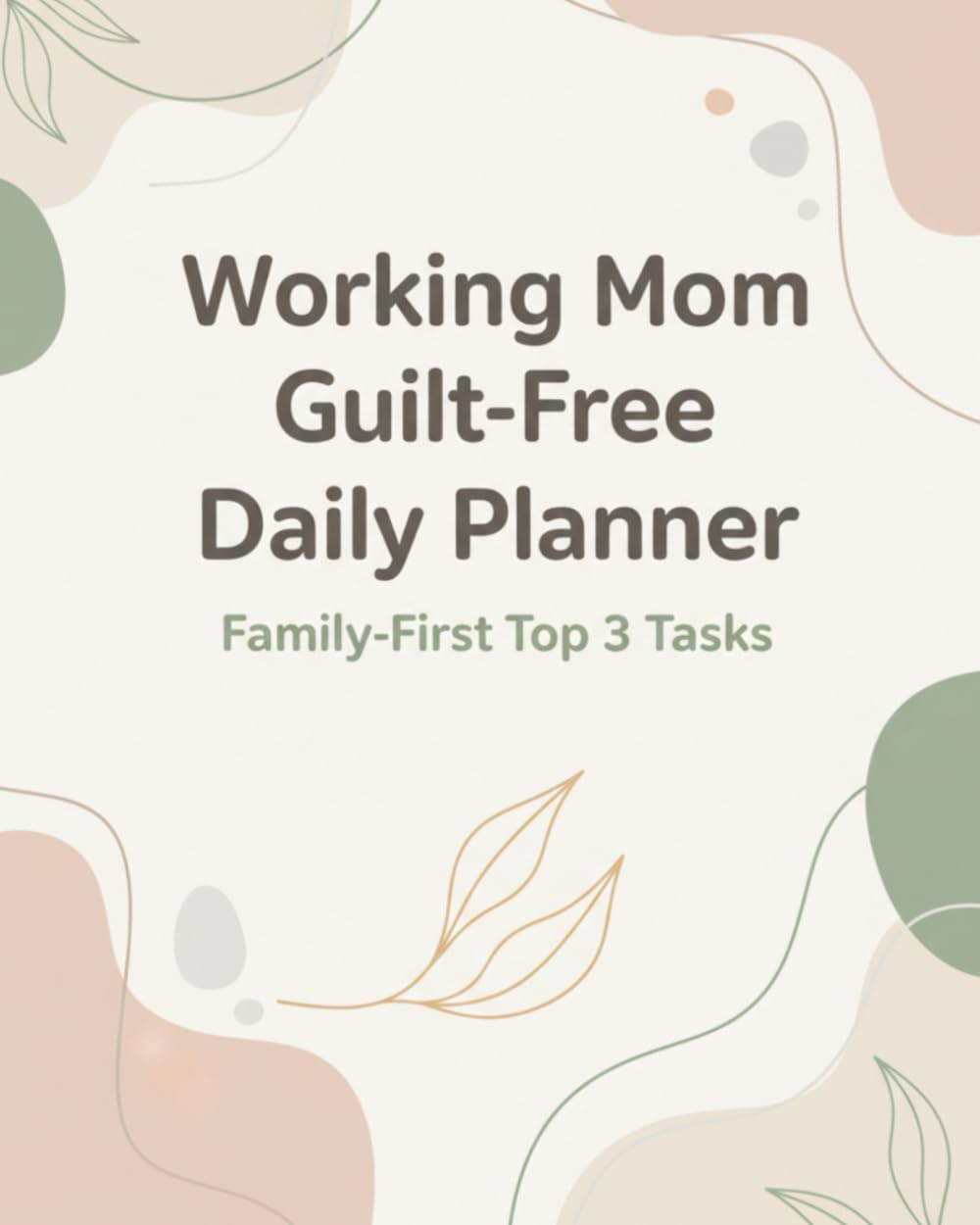
Working Mom Guilt-Free Daily Planner: Family-First Top 3 Tasks to Balance Work, Home, and Life Without Burnout
- Time Management
- Image Unavailable Image not available forColor:
- Focus on Top 3 Work Tasks — not endless to-do lists
Reframe the Internal Narrative
Cognitive behavioural approaches to guilt focus on catching the automatic thought ("I'm failing my child") and testing it against actual evidence ("my child is fed, safe, loved, and thriving at daycare; I am tired, not failing"). This isn't about suppressing feelings, it's about not letting a feeling masquerade as a fact.
4. How to Talk to Your Child About Going Back to Work
The most effective approach is simple, honest, and matched to your child's developmental stage rather than overexplained or apologetic. Children pick up on parental anxiety more than on the words themselves, so a calm, matter of fact tone does more good than a long justification.
By Age
Infants (0 to 12 months): Babies won't understand your words, but they read your tone and body language. A calm, unhurried goodbye (rather than sneaking out to avoid tears) helps them learn that separations are safe and predictable.
Toddlers (1 to 3 years): Keep it short: "Mommy is going to work now. Nana is going to play with you. I will be back after your nap." Repetition of the same script every day builds trust faster than novelty.
Preschool and early school age (4 to 7 years): Kids this age can handle a little more explanation. "My work helps our family, and I love spending time with you when I get home. What should we do together tonight?" gives them something concrete to look forward to.
School age (8 to 12 years): Older kids can participate in problem solving around logistics (who picks them up, what's for dinner) which gives them a sense of agency rather than just being informed of a decision.
— Dr. Becky Kennedy, clinical psychologist, "Good Inside," 2022Children do not need their parents to be constantly present. They need to trust that their parents are consistent, responsive, and will return.
5. The Role of Your Partner and Co Parenting in Easing Guilt
Guilt drops significantly when household and childcare labor is genuinely shared rather than "helped with." Research on dual income households consistently shows that mothers report lower guilt and stress when partners take on an equal share of the invisible mental load, not just the visible tasks.
What "Sharing the Load" Actually Looks Like
A lot of couples believe they are splitting things 50/50 when the actual division of labor, especially the planning and anticipating (remembering the dentist appointment, noticing the shoes don't fit anymore), still falls disproportionately on mothers. This invisible labor is a major, underrecognized driver of guilt and burnout.
If your household includes a father or partner who has taken on a larger share of caregiving, whether by choice or circumstance, understanding how fatherhood roles have shifted can help both partners recalibrate expectations without defaulting to old scripts about who "should" feel guilty.
6. When Mom Guilt Signals Something More: Recognizing Burnout or Depression
Occasional guilt about returning to work is normal; guilt that is constant, all consuming, or paired with other symptoms may indicate maternal burnout or postpartum depression and warrants professional support. It's important not to dismiss these as "just guilt" when they persist.
Red Flags to Watch For
According to the CDC, roughly 1 in 8 women experience symptoms of postpartum depression, and returning to work can be a trigger point where symptoms that were manageable become harder to hide or manage, especially if maternity leave was short. If you notice several of these signs, talk to your OB, your child's pediatrician, or a therapist. Screening tools like the Edinburgh Postnatal Depression Scale are quick, free, and something your provider can walk through with you in a normal visit.
— American College of Obstetricians and Gynecologists, 2023Postpartum depression does not always appear in the first weeks after birth. It can surface or intensify months later, often around major transitions like returning to work.
For parents managing a demanding return to work alongside remote or hybrid arrangements, having clear boundaries between work and home can also ease some of the guilt tied to feeling "half present" everywhere. Setting up a workspace that signals focus helps your brain (and your kids) understand when you're working and when you're available, which reduces the low grade guilt of feeling perpetually interrupted or distracted.

The Art of Good Enough: The Working Mom’s Guilt-Free Guide to Thriving While Being Perfectly Imperfect
- Health, Fitness & Dieting
- Beauty, Grooming, & Style
- Image Unavailable Image not available forColor:
Comparing Approaches to Managing Mom Guilt
| Approach | Best For | Primary Benefit | Main Drawback | Recommended Product | Price Range |
|---|---|---|---|---|---|
| Daily journaling and reflection | Parents who process feelings through writing | Builds a factual record that counters guilt spirals | Requires consistent daily habit | End Mom Guilt in Midlife: 30-Day Guide | Varies |
| Faith based reframing | Parents who draw strength from spiritual practice | Offers community and a values framework beyond productivity | Not a fit for every belief system | You Don't Have to Carry It All | ~$23 |
| Structured daily planning | Parents overwhelmed by logistics and mental load | Reduces decision fatigue, frees emotional bandwidth | Requires upfront setup time | Working Mom Guilt-Free Daily Planner | Varies |
| Weekly priority mapping | Parents juggling multiple roles and deadlines | Clarifies what actually matters each week | Less useful for day to day emotional processing | The Balanced Working Mom Planner & Journal | Varies |
| "Good enough" mindset coaching | Perfectionist parents prone to self criticism | Lowers unrealistic self imposed standards | Can feel counterintuitive at first | The Art of Good Enough | ~$15 |
| Faith based decision making guidance | Christian parents seeking scripture grounded confidence | Frames parenting choices within gospel freedom | Faith specific framing | Gospel Mom | ~$13 |
Expert Insights on Mom Guilt and Working Motherhood
Mom guilt going back to work is one of those experiences that feels intensely personal in the moment and is, at the same time, shared by nearly every working parent who has ever dropped their child off with a lump in their throat. You are not failing your child by working. You are modeling resilience, capability, and the reality that love does not require constant physical presence to be secure and steady. If there's one sentence worth carrying with you through the hard mornings, it's this: guilt is not proof of harm, it's proof of how much you care. Save this article, share it with another parent in your life who needs it today, and be gentle with yourself this week.
Sources & References
- Pew Research Center. "Raising Kids and Running a Household: How Working Parents Share the Load." 2015. pewresearch.org
- McGinn, Kathleen L., et al. "Learning from Mum: Cross National Evidence Linking Maternal Employment and Adult Children's Outcomes." Work, Employment and Society, Harvard Business School, 2018.
- Hays, Sharon. "The Cultural Contradictions of Motherhood." Yale University Press, 1996.
- American Academy of Pediatrics. "Starting Solid Foods and Childcare Transitions: Guidance for Parents." healthychildren.org
- Centers for Disease Control and Prevention. "Depression Among Women." cdc.gov/reproductivehealth
- American College of Obstetricians and Gynecologists. "Postpartum Depression." acog.org, 2023.
- Kennedy, Becky. "Good Inside: A Guide to Becoming the Parent You Want to Be." Harper Wave, 2022.
- Rodsky, Eve. "Fair Play: A Game Changing Solution for When You Have Too Much to Do." Putnam, 2019.
Frequently Asked Questions
Is mom guilt going back to work normal, or does it mean something is wrong?
How long does mom guilt about returning to work usually last?
Does daycare or full time childcare harm my child's development?
What can I do in the first week back at work to ease the transition?
Should I talk to my child about my feelings of guilt?
How can my partner help reduce my guilt about going back to work?
When should I seek professional help for guilt related to work and parenting?
Was this helpful?
Thanks — your feedback helps us pick what to write next.