Preschool Social Skills Groups Near Me: A Parent's Full Guide
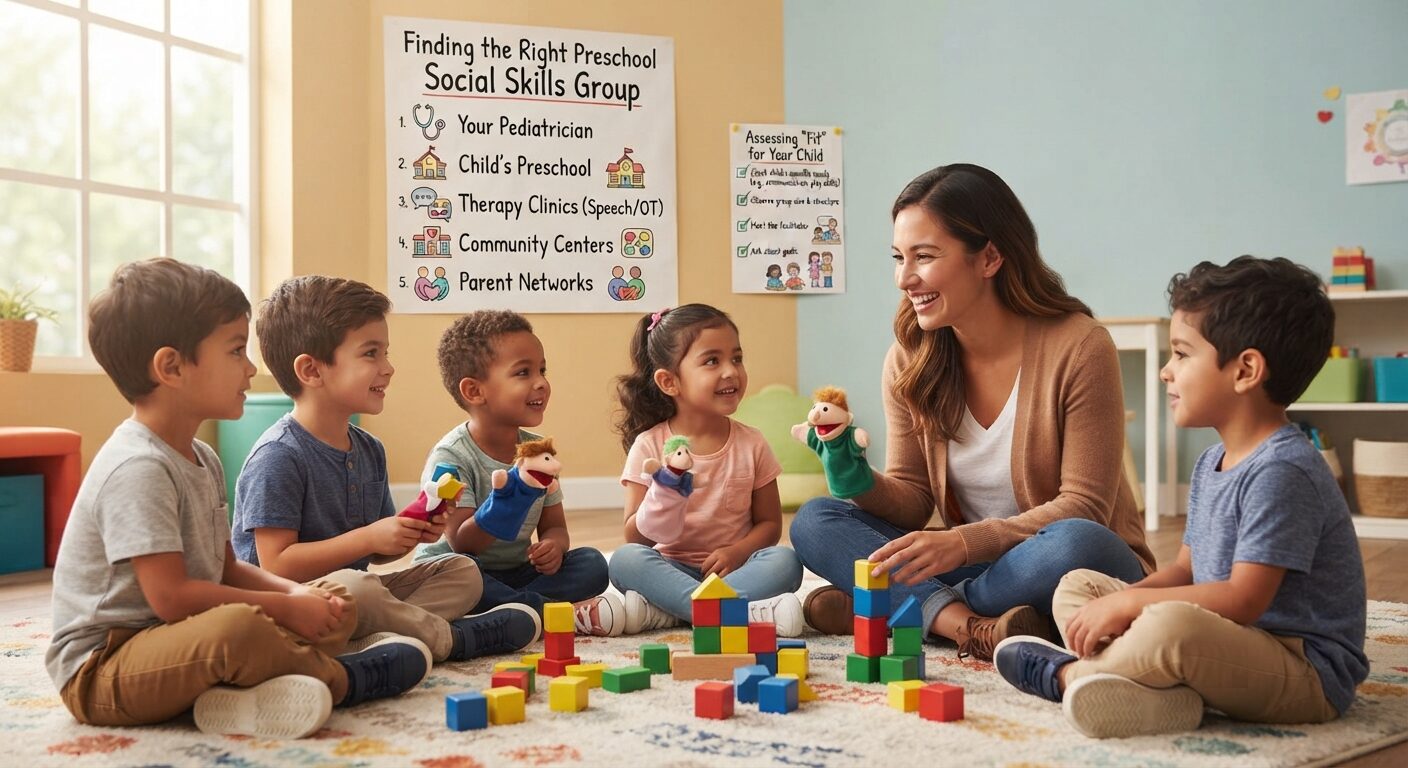
Preschool social skills groups near you can be found through your pediatrician, your child's preschool, local speech and occupational therapy clinics, community centers, and parent networks, and the right fit depends on your child's specific needs, not just proximity.
In this article
Picture a Tuesday pickup line. One mom is describing how her four year old still hovers at the edge of the sandbox, watching other kids play but never joining in. Another parent nods; her son melts down every time a friend wants to change the rules of a game. This is an incredibly common scene, and it is why so many parents start typing "preschool social skills groups near me" into a search bar at 11pm.
Here is something worth knowing before you search further: according to the CDC's National Survey of Children's Health, roughly 1 in 6 children ages 3 to 17 in the United States has a developmental or behavioral condition, and social communication difficulties are among the most frequently reported concerns by parents of preschoolers. Finding the right kind of support, and knowing what actually helps, makes an enormous difference.
What you'll understand by the end of this article:
1. What Preschool Social Skills Groups Actually Do
Preschool social skills groups exist to give children structured, repeated practice with the exact interactions that trip them up, in a setting small and predictable enough that a facilitator can coach in real time. This is different from a regular preschool classroom, where a teacher managing 15 to 20 children simply cannot pause every interaction to model a better response.
Who Runs Them
Groups are typically led by one of the following:What a Typical Session Looks Like
Most groups run 45 minutes to an hour, meet weekly, and include 3 to 6 children matched roughly by age and skill level. A session usually opens with a greeting ritual, moves into a themed activity (turn taking games, cooperative building, a story with discussion prompts), and closes with a reflection circle where the facilitator names what went well.This structured, repeated practice mirrors something bigger that researchers have found again and again: young children learn social and emotional skills far more effectively through guided play than through direct instruction, a point explored in depth in why play is how preschoolers actually learn. A good social skills group is essentially play with intention behind it.
2. Where to Actually Find Groups Near You
The fastest and most reliable path to finding a group is through your pediatrician's office, because pediatricians maintain referral relationships with local therapists and know which groups have a track record.
Five Real Places to Start Looking
1. Your pediatrician or family doctor. Ask specifically for a referral to a speech language pathologist or child psychologist who runs social groups, not just an evaluation. 2. Your child's preschool or daycare director. Many preschools host after hours groups or know which local providers are trusted. 3. Speech and occupational therapy clinics. Search "pediatric speech therapy" plus your city; most clinics list group offerings on their websites and many now offer virtual options for rural families. 4. Children's hospitals and university affiliated clinics. These often run sliding scale groups and are less expensive than private practice. 5. Local parent Facebook groups and community centers. Parents talk. A quick post asking "has anyone used a social skills group in [town]?" usually surfaces two or three names within a day.
Word of mouth referrals from other parents remain one of the most trusted ways families find quality early intervention services, often more trusted than provider directories alone.
— American Speech-Language-Hearing Association (2022)
Questions to Ask Before You Commit
3. Signs Your Child Might Actually Benefit From a Group
Your child might benefit from a structured social skills group if they consistently struggle with the same one or two social tasks across multiple settings, not just occasionally at home or only on a bad day.
What to Watch For
Every child has an off day. What matters clinically is a pattern that shows up across settings (home, school, playdates) and persists over months, not weeks.This is closely tied to broader developmental readiness. A preschool readiness assessment often includes a social communication component precisely because these skills predict how smoothly a child transitions into a classroom setting later on.
If you notice two or more of the signs above persisting for three months or longer across different settings, that is a reasonable point to bring it up with your pediatrician, not because something is necessarily wrong, but because early practice tends to be more effective than late practice.


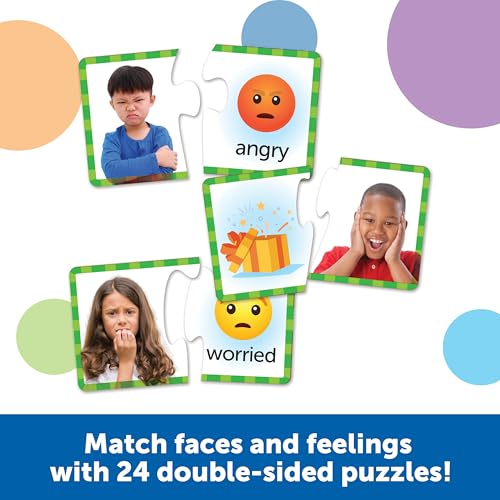

Learning Resources Feelings & Emotions Puzzle Cards
- BUILD SOCIAL-EMOTIONAL SKILLS - Kids ages 3+ strengthen emotional awareness by matching feelings to real-life
- PROMOTE CRITICAL THINKING - Unique puzzle shapes ensure only one correct match, helping children develop probl
- ENGAGE WITH COLORFUL ILLUSTRATIONS - Bright, kid-friendly images keep preschoolers focused and excited to lear
4. What Actually Happens Inside a Well Run Group
A well run group uses structured activities, like matching feelings cards or turn based storytelling, to give children low pressure repetition of the exact skills they find hardest, with immediate coaching from an adult when things go sideways.
Common Activities You'll See
Emotion recognition work. Facilitators often use physical materials like feelings cards to help children name what they and others are feeling before they can regulate around it. The [Learning Resources Feelings & Emotions Puzzle Cards](/PRODUCT_CARD:1) style activity, where kids match an expression to a scenario, shows up constantly in these sessions because the puzzle piece format only allows one correct answer, which builds confidence without frustration.
Turn taking games. Board games, simple card games, and cooperative building tasks are staples because they force natural turn taking without it feeling like a lesson.
Guided conversation practice. Facilitators use conversation cards with prompts like who, what, where, why, and how to help children practice describing situations and predicting how someone might feel. The [SpriteGru Scene Conversation Cards](/PRODUCT_CARD:3) format, showing everyday scenes on one side and open ended questions on the back, mirrors this exactly.
What a Strong Facilitator Does Differently
Structured peer interaction, when paired with adult coaching in the moment, produces measurably stronger gains in social communication than unstructured free play alone.
— Journal of Autism and Developmental Disorders (2019)
5. Building These Skills at Home Between Sessions
You can meaningfully reinforce group progress at home by turning the same skills, emotion naming, turn taking, and reading social cues, into five minute activities woven into your existing routine rather than treating them as extra homework.
Simple, Repeatable Home Activities
Name the feeling, then the fix. During a meltdown or a happy moment alike, narrate the emotion out loud calmly. Tools like the [Learning Resources All About Me Feelings Activity Set](/PRODUCT_CARD:6), with its 36 figurines representing six core emotions, give kids a hands on way to sort and label feelings outside the heat of the moment, which builds the vocabulary they need when emotions actually run high.
Practice sequencing everyday events. Understanding cause and effect, and the order things happen in, underlies a lot of social prediction (knowing what usually comes next in a conversation or a game). The [Hebayy 4-Scene Sequencing Cards](/PRODUCT_CARD:2) work well here since they walk kids through everyday scenarios in a logical order using illustrated cards.
Role play tricky moments before they happen. If you know a playdate or birthday party is coming up, spend five minutes acting out a scenario ("What do you say if someone won't share the toy?"). This rehearsal lowers anxiety and gives kids a script to fall back on.
A Note on Screens
It is tempting to lean on tablet apps that promise social skill building, but nothing replaces face to face practice with a real person reacting in real time. If screens are part of your routine, keep them limited and paired with conversation, since research consistently shows that even a phone visible during play changes how connected children feel to the adult across from them, a dynamic worth understanding if you're weighing how much your own phone use during play affects your bond.6. When to Loop In Your Pediatrician (and What Happens Next)
You should loop in your pediatrician if social difficulties persist across settings for three or more months, if your child seems distressed by their own struggles to connect, or if a preschool teacher independently raises the same concern you have.
The Typical Path From Concern to Support
1. Pediatrician conversation. Bring specific examples, not just "he's shy." Note frequency, settings, and how your child reacts when things don't go well socially. 2. Screening or referral. Your pediatrician may use a brief screening tool in office or refer you directly to a speech language pathologist, developmental pediatrician, or psychologist for a fuller evaluation. 3. Evaluation. This usually involves observation, parent interview, and sometimes standardized testing. It typically takes one to three sessions. 4. Group or individual therapy recommendation. Based on findings, you'll get a specific recommendation, group therapy, individual therapy, or a combination.
New technology is also starting to play a supporting role here. Some clinics now use AI powered screening tools alongside traditional evaluation, and early research out of the UAE has explored whether AI can reliably detect speech delays in young children, which may eventually make early screening faster and more accessible, though it is not a replacement for a trained clinician's judgment.
These same social foundations carry weight well beyond preschool. Strong early social skills are consistently linked to smoother kindergarten transitions and better academic outcomes years down the road, which is part of why researchers describe kindergarten readiness as a predictor that echoes for years.
| Option | Best For | Group Size | Typical Cost | Recommended Product | Price Range |
|---|---|---|---|---|---|
| Speech therapy led group | Pragmatic language, conversation delays | 3 to 5 kids | $50 to $150 per session | Who What Why Conversation Cards | $16.99 |
| Occupational therapy led group | Sensory regulation feeding into social difficulty | 3 to 6 kids | $60 to $160 per session | PP OPOUNT Funny Faces Games | $19.99 |
| Preschool run social club | Mild shyness, general practice, low cost | 4 to 8 kids | Free to $30 per session | Hebayy Sequencing Cards | $8.99 |
| Community center group | Broad social practice, sliding scale options | 5 to 10 kids | $10 to $50 per session | SpriteGru Scene Conversation Cards | $11.99 |
| Home based practice with a coach | Building skills between sessions, supplementing therapy | 1 on 1 | $30 to $80 per hour | Learning Resources All About Me Feelings Set | $14.99 |
| Self guided at home program | Mild concerns, budget conscious families | 1 on 1 | $10 to $20 total materials | Learning Resources Feelings & Emotions Puzzle Cards | $11.99 |
Building Friendship Skills Beyond the Group
Groups are only one part of the picture. Real friendships form through repeated, low stakes opportunities to practice sharing, cooperating, and resolving small conflicts. If you're looking for more everyday, structured ways to build this alongside formal group work, six practical activities that build real friendships offer a solid complement to whatever group your child attends.
Watching your child struggle to connect with peers is genuinely hard, and searching for help at 11pm is a sign of good parenting, not failure. The right group, paired with a little consistent practice at home, can turn a hesitant child into one who walks up to the sandbag with confidence. Save this guide, share it with another parent in your pickup line, and take the first step this week: one phone call to your pediatrician or your child's preschool director.
Sources & References
- Centers for Disease Control and Prevention. "Data and Statistics on Children's Mental Health." 2023. https://www.cdc.gov/childrensmentalhealth/data.html
- American Speech-Language-Hearing Association. "Social Communication in Children." 2022. https://www.asha.org/practice-portal/clinical-topics/social-communication/
- Journal of Autism and Developmental Disorders. "Peer Mediated Interventions for Social Skills in Young Children." 2019.
- Marcus Autism Center, Emory University. "Early Intervention Outcomes Research." https://www.marcus.org
- UCLA Semel Institute for Neuroscience and Human Behavior. Research on early social communication assessment.
Frequently Asked Questions
How much do preschool social skills groups typically cost?
What age should a child start a social skills group?
Is my child too shy for a group, or does shyness improve on its own?
Do these groups actually work, or is it mostly supervised playtime?
Can I run a mini social skills group at home with a few neighborhood kids?
What's the difference between a speech therapy group and an occupational therapy group for social skills?
How long before we see improvement from a social skills group?
Was this helpful?
Thanks — your feedback helps us pick what to write next.