Preschool Social Skills Curriculum: What to Teach and How
A preschool social skills curriculum is a planned set of lessons and practice on feelings, cooperation and sharing space and toys. It matters because kindergarten expects more, and children with this groundwork are better prepared. You can copy the core ideas at home with short,

In this article
TL;DR: Quick summary
A preschool social skills curriculum is a planned set of lessons and practice on feelings, cooperation and sharing space and toys. It matters because kindergarten expects more, and children with this groundwork are better prepared. You can copy the core ideas at home with short, daily, low pressure practice.
What you'll get
About 32 minutes to read. Short on time? Read the bold lines and the Key Takeaways near the end.
Picture a Tuesday afternoon. Your four year old comes home with a story: someone took the red truck, there was shouting, and a teacher "made everyone sit down." You wonder if this is normal, and whether school is teaching anything about it.
Short answer: yes, it is normal, and good preschools teach this on purpose. Getting along with other children is largely a skill that can be taught, not only a personality trait. Like any skill, it gets taught, modelled and practised.
I talk with parents about this all the time. They worry about grabbing, biting, tears at drop off, or a child who hovers at the edge of the playground. Most of them ask the same thing: what should we actually be doing?
This article explains what a preschool social skills curriculum is, what to expect at each age, and how classroom programs work. Then it shows you how to borrow the best parts at home. You do not need special training or a lot of equipment.
What is a preschool social skills curriculum and why does it matter?
A preschool social skills curriculum is a planned sequence of lessons and practice that teaches children to name feelings, cooperate, and share space and toys. Teachers often deliver it to the whole classroom, so every child gets the same words and the same chances to practise.
What it looks like in a real classroom
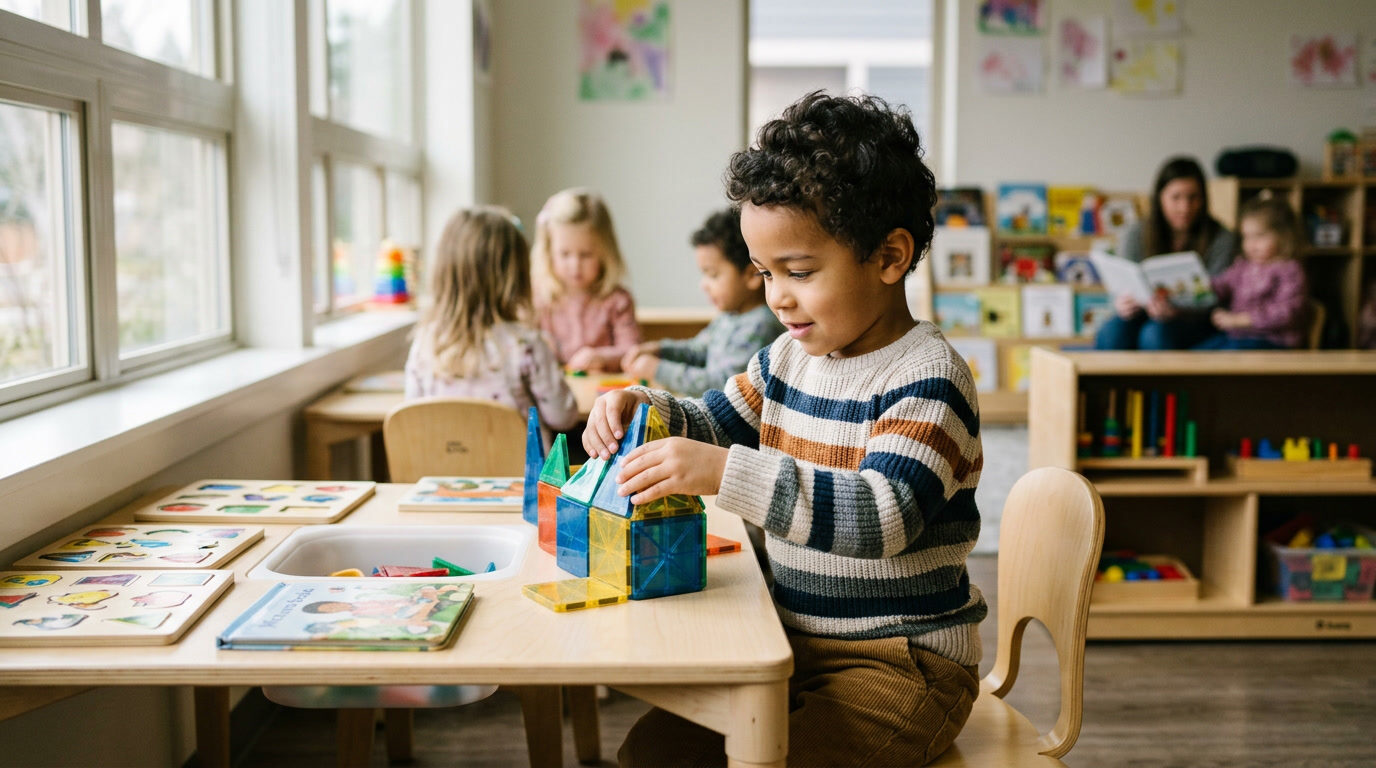
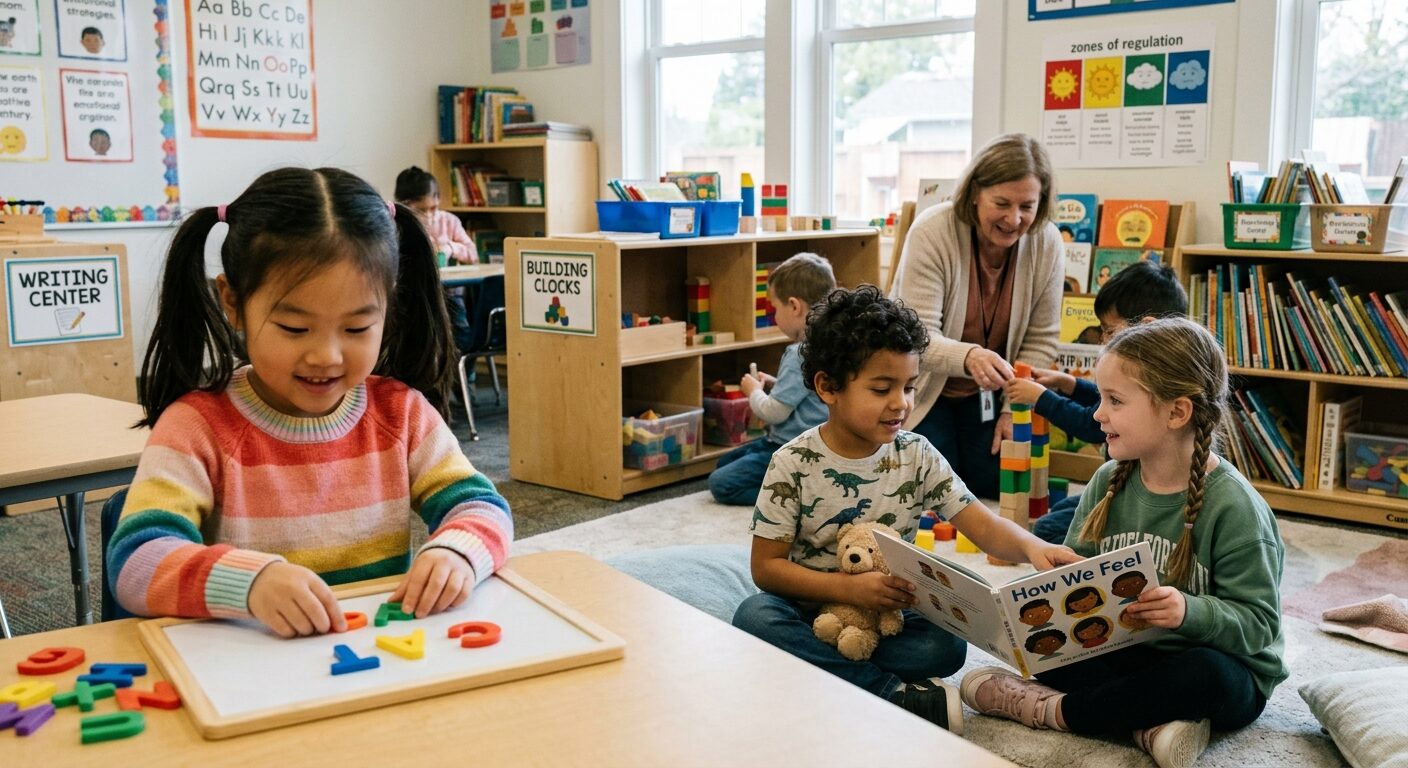
Forget worksheets. For three to five year olds, a curriculum usually means short group times, stories, puppets, songs and games, followed by practice during ordinary play.
The starting point is simple. Lessons begin with basic ideas such as identifying emotions, cooperating with others, and sharing space and toys. Harder skills, like solving a disagreement, come later and build on those first steps.
The key word is planned. A teacher who happens to say "use your words" is helping. A teacher who teaches the feelings words in circle time on Monday, then prompts them at the snack table on Tuesday, is running a curriculum.
Why it matters before kindergarten
Kindergarten brings higher expectations and a more formal curriculum than preschool. Children who have worked on social and emotional skills beforehand are better prepared for that jump.
Think about what a kindergarten day asks of a child. Wait for a turn. Sit in a group. Handle a "no." Ask for help without a meltdown. Those are social skills first and academic skills second.
For more on what schools look for, see our guide to what a preschool readiness assessment really checks.
Two children at the same snack table
Picture two children in the block corner. Both want the last long block.
The first child says, "I'm frustrated! Can I have a turn after you?" and then goes to look at the book shelf while waiting. The second child grabs the block, the other child cries, and an adult steps in.
Neither child is "bad." The first has been given the words and has had practice using them. The second has the same big feeling but no tool yet. A curriculum is how we hand children the tool.
Common mistakes
Manners matter, but they are only one small piece. A child can say "please" perfectly and still not know what to do when they feel left out. The big feelings behind these moments are normal; our article on why preschool brains are wired for big feelings explains why.
What you can do now
You do not need a classroom to use these ideas. Pick one feeling word a day, say it out loud when it fits, and give your child one small chance to practise with you before they have to do it with a friend.
What social skills should a 3, 4 and 5 year old have?
Most three year olds play near a friend rather than with one, and sharing and taking turns are hard. By four, cooperative play may begin and turn taking starts to make sense. Skills build gradually, so look for progress, not perfection.
The age snapshot
Picture a three year old at a sandpit. She sits beside another child, each digging a separate hole, barely talking. That is typical play at this age, and it counts as social practice.
At four, the same child may start building one sandcastle with a friend. Sharing can still end in tears, but she is beginning to understand what taking turns means.
What the later preschool picture looks like
The American Academy of Pediatrics lists several social milestones for the three to four year range. Children cooperate with other children and share, play "Mom" or "Dad", become more inventive in fantasy play, and negotiate solutions to conflicts.
By the time your child nears five, you will usually see these skills becoming steadier. The pretend games get longer and the stories get stranger. You may hear a child say, "You can be the baby first, then I'll be the baby."
Please do not treat any list as a deadline. Children develop more advanced social play skills, such as sharing and turn taking, over time as they near age 3 and beyond. A child who still grabs a toy at three and a half is not behind. She is practising.
Count skills, not friends
Parents often ask whether their child has "enough" friends. A better question is how your child behaves when she is with other children.
The number of friends a child has is not as important as whether the child uses appropriate social skills when interacting with peers.
NAEYC (2010)
So one close friend and a child who asks, waits and says "my turn next?" is doing well. A child with a busy party calendar who shoves and snatches may need more coaching.
Common mistakes at this stage:
Low pressure ways to practise at home
You do not need a formal curriculum to build these skills. Short, playful moments work best, and they should never feel like a test.
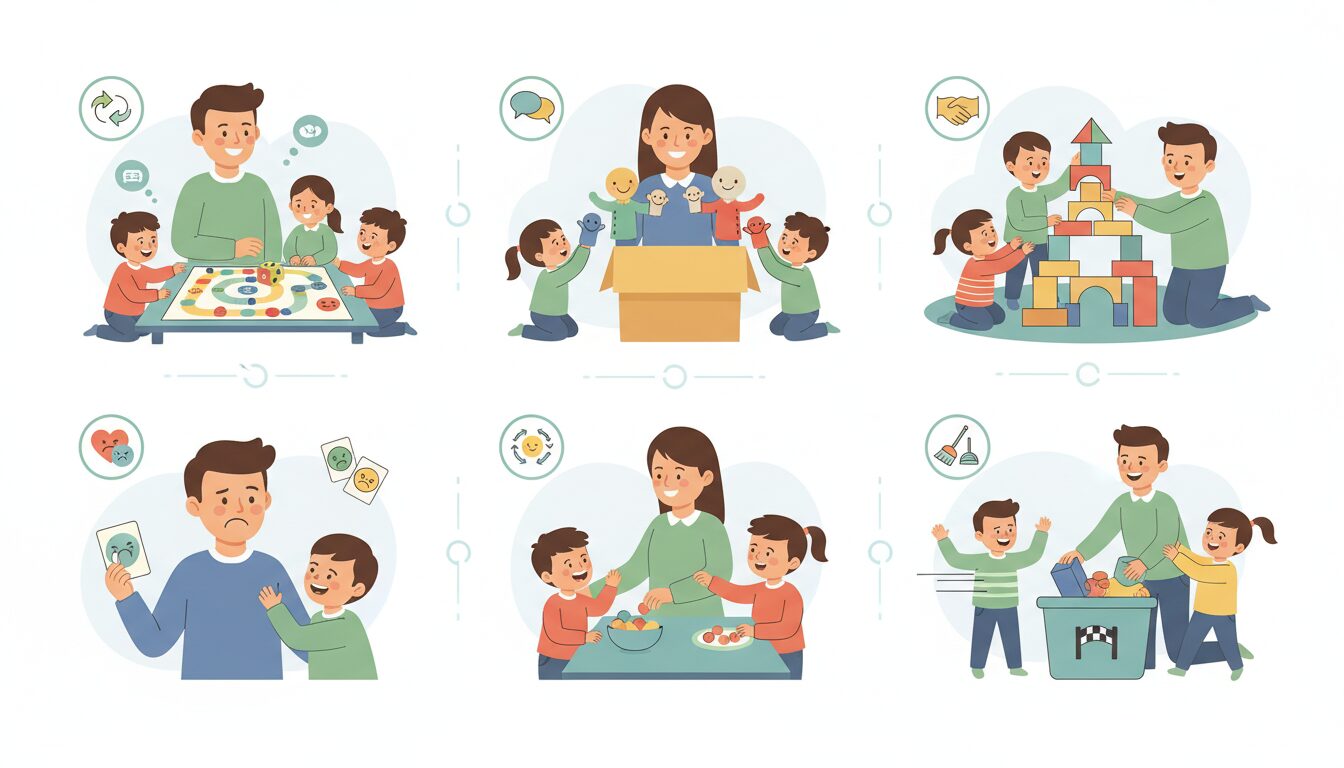
- Play a simple board or card game and say, "My turn, now your turn," out loud each round.
- Build something together with blocks and narrate it: "You put one on, I put one on."
- Play pretend shop or house and swap roles halfway through.
- Try a matching game such as the Learning Resources Feelings and Emotions Puzzle Cards, which can suit preschool children, and chat about each face as you go.
For more ideas, our list of activities for 3 year olds gives you plenty of play to choose from. If you like knowing why these games help, this guide to cognitive development for young minds explains how thinking and social skills grow together.
How do classroom programs like Strong Start and ICPS teach social skills?
Yes, structured programs exist, and they follow a clear plan rather than leaving social skills to chance. Teachers run short, regular lessons on feelings, sharing and solving problems, then give children time to practise. You can borrow the same rhythm at home in a few minutes a day.
What these programs look like
Strong Start Pre-K is tailored for preschool children, roughly ages 3 to 5. Strong Kids is the wider family of programs, designed for children from prekindergarten through 12th grade. So the same idea grows with your child, and the lessons get more advanced as they get older.
Formats differ, so be careful about assuming one program tells you how all of them work. One program runs 10 sessions over 5 weeks, with 2 extra booster sessions spread over 6 to 7 weeks after the main lessons end. The boosters give children a chance to revisit the skills after the main lessons end.
Another program is presented to every student 2 to 3 times a week in 20 minute circle time sessions, followed by 20 minutes of practice activities. Circle time is when the group sits together to talk and learn. The practice that follows is where children try the skill with real toys and real classmates.
Where ICPS fits in
ICPS is a program that teaches children to think through everyday conflicts. It has three versions for different developmental levels: 59 activities for preschool age children, 83 for kindergarten age children, and 77 for early primary grades.
That split tells you something useful. A 3 year old and a 7 year old need very different lessons, so a good program does not hand every child the same material.
What to ask your child's school
You do not need to be an expert to ask good questions. The What Works Clearinghouse practice guide gives one simple principle to listen for.
Start at a point in the sequence that is appropriate for the ages and developmental needs of the children in the classroom.
US Department of Education, What Works Clearinghouse (2022)
In plain words, the program should begin where your child actually is. Here are questions you can take to a teacher or director:
- Which program or curriculum do you use for social and emotional skills?
- Where in the sequence does it start for my child's age?
- How do you adjust if my child is not ready for that starting point?
- What will I see my child practising, and how can I echo it at home?
Echoing circle time at home
You can copy the pattern without buying a thing. Think of it as a short "talk, then try" routine, once a day.
Start with a few minutes of circle time on the sofa or rug. Pick one idea, such as "waiting for a turn," and talk about it with a picture book or a set of cards. Something like the Who What Why conversation cards can give you a scenario to chat about, though any story works.
Then move straight into practice. Play a quick game where you both wait, swap and say "my turn, your turn." Keep it light, and stop while your child is still enjoying it.
Here is an example of what you might say. "Look, the bunny wants the swing too. How do you think the bunny feels waiting? What could we say?" Then let your child answer, even if the answer is silly.
Common mistakes
If your child is already in a program, ask how they are doing and echo the same words at home rather than starting something separate. If there is no program at all, short daily practice is still worth doing, but it works best alongside time with other children.
How do I teach my preschooler to name and understand feelings at home?
Use a simple three step routine: notice what your child's body is doing, name the feeling out loud, then choose a next step together. Keep it short, daily and playful. Naming feelings comes first, and it builds the base for sharing and turn taking.
Why feelings come first
Programs for young children tend to start with basic ideas like identifying emotions, then move on to cooperating and sharing space and toys. That order makes sense at home too. A child who cannot tell "mad" from "disappointed" may find it harder to wait for a turn without a meltdown.
The three step routine: notice, name, choose
- Notice. Look at the body and face. Clenched fists, a wobbly chin and a loud voice are all clues.
- Name. Offer a word, and give two options if your child is unsure.
- Choose. Pick one small next step, such as a hug, a drink of water, or stomping like a dinosaur.
Picture a three year old whose block tower falls over. You might say, "Your body looks tight. Are you mad or disappointed?" If your child says "mad," you can follow with, "Mad makes sense. Do you want to stomp, squeeze a pillow, or build it again with me?"
Model your own feelings
Children learn the words by hearing you use them. Try saying, "I'm feeling frustrated because we're late. I'm going to take a big breath." You don't need to be perfect. A quick, honest sentence is enough.
Tools that match the job
A simple feelings chart on the fridge works well for a daily check in. Ask at breakfast, "Which face is closest to how you feel today?" The Emotion and Feeling Busy Book for Kids also includes emotion charts and blank face templates. It suits quiet time, waiting rooms and car trips.
For matching faces to words, these puzzle cards are a gentle place to start:


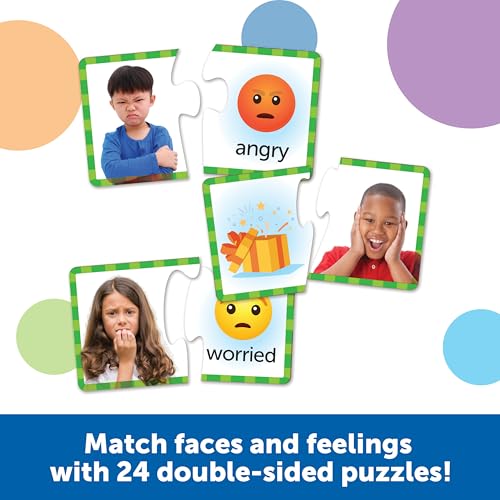

Learning Resources Feelings & Emotions Puzzle Cards
- BUILD SOCIAL-EMOTIONAL SKILLS - Kids ages 3+ strengthen emotional awareness by matching feelings to real-life…
- PROMOTE CRITICAL THINKING - Unique puzzle shapes ensure only one correct match, helping children develop…
- ENGAGE WITH COLORFUL ILLUSTRATIONS - Bright, kid-friendly images keep preschoolers focused and excited to…
For playful practice, the ThinkPsych Go Fish Faces and Feelings card game has children act out an emotion to ask for a card, so no reading is needed. Once your child can name feelings reliably, the Emotion Flipbook for Kids pairs emotions with coping skills. Use it when your child is ready to choose a strategy, not before.
Common mistakes
A child in the middle of a meltdown can't think or learn. Stay close, keep your voice low, and say very little. Teach the words later, when everyone is calm.
Some children feel everything very strongly and need extra time to settle. If that sounds like your child, signs of a highly sensitive child can help you adjust your pace. If your child seems unable to calm down at all, or the big reactions are getting in the way of daily life, talk with your paediatrician.
How can I teach sharing, turn-taking and conflict resolution?
Start small and expect slow progress. Sharing and turn taking are genuinely hard at age 3 and get easier with age and practice. Teach one skill at a time, in short moments, with a grown up close by to coach.
What is realistic at each age
At age 3, most children play near a friend rather than with them, and taking turns or sharing is difficult. By age 4, many begin cooperative play and start to understand turn taking, though sharing is still tricky. These skills keep developing as children get older.
So if your three year old screams when a cousin touches their truck, that is not a character flaw. It is a brain that is still learning.
Why practice with other children matters
Children get better at sharing, turn taking and resolving conflict the more they interact with peers. You cannot teach all of it at the kitchen table.
Keep the group small. A playdate with one or two children is easier to manage than a noisy party. Put away the one toy your child cannot bear to share before guests arrive, and say so: "These are the toys we share today. That one is resting in my room."
Cooperative building also works well. Building with Magna-Tiles gives two children one shared goal, such as a tall tower, and plenty of natural chances to say "My turn now" or "Can you hold this?"
Practise the talking part with conversation cards
Social skills grow mostly through practice with other children. The Who What Why Conversation Cards show a picture of a situation with a question about it. They are handy for practising back and forth talk, listening and problem solving questions at the table or in the car.


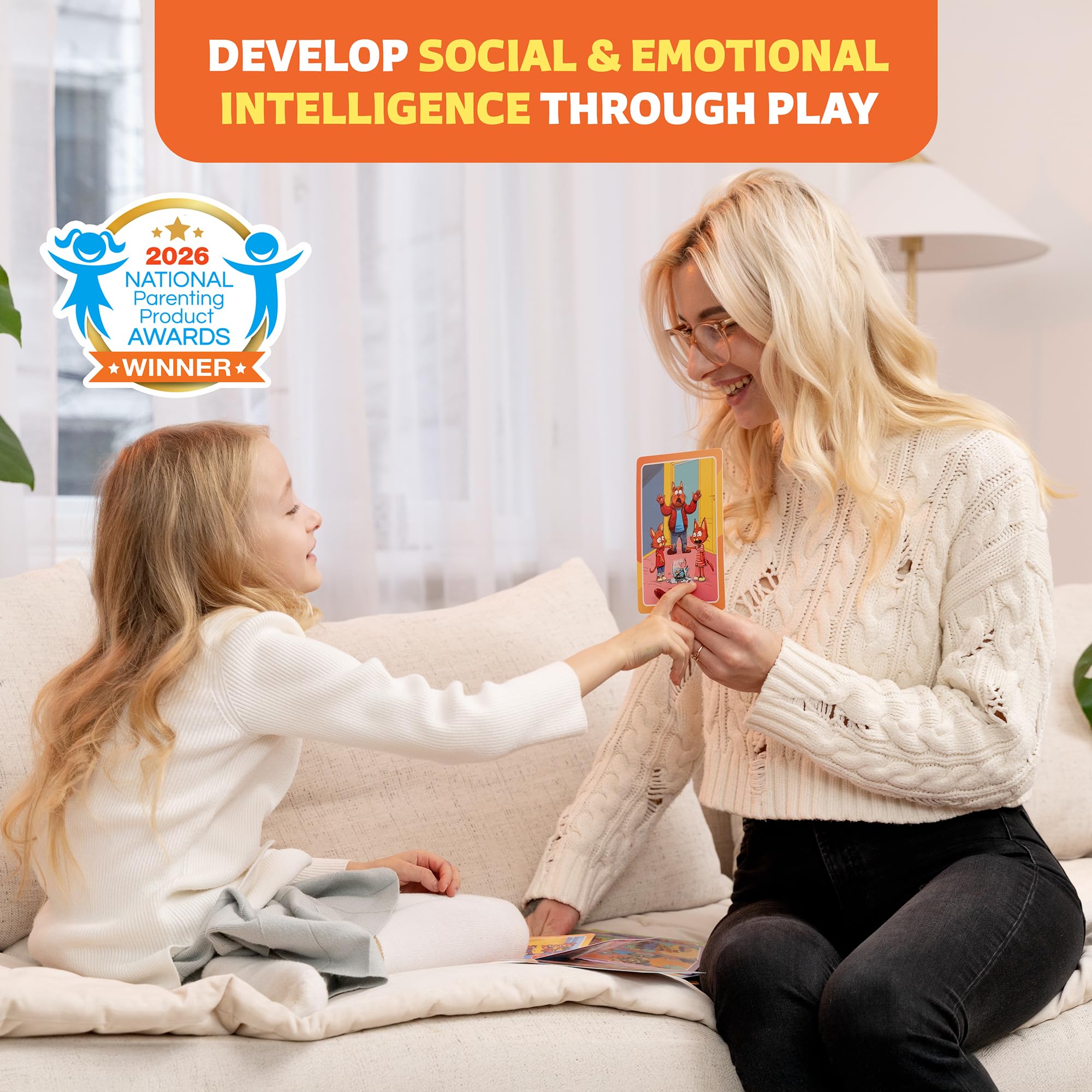
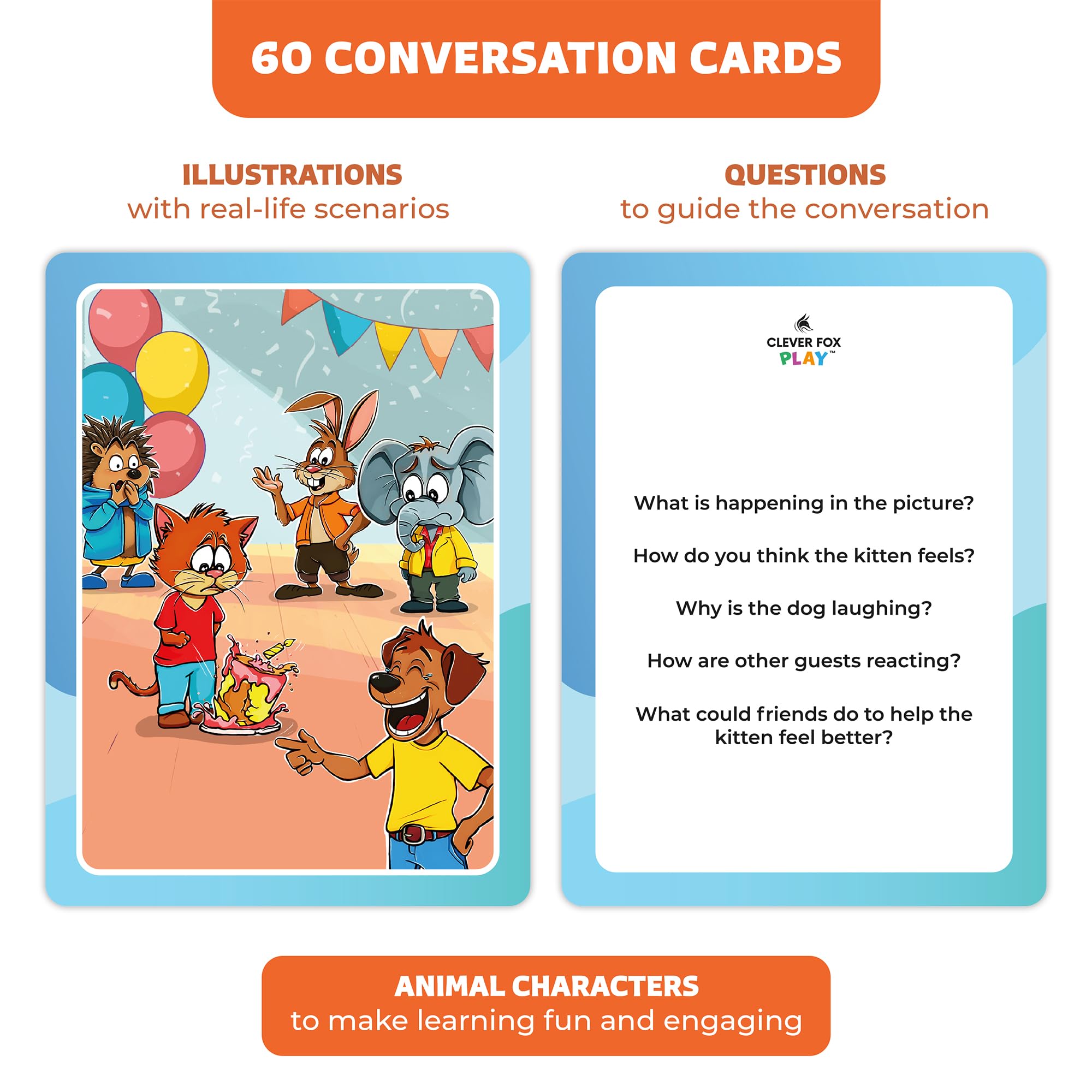
Who What Why Conversation Cards for Kids, Speech Therapy Materials, Ages 4+
- DEVELOP EMOTIONAL & SOCIAL INTELLIGENCE – Who What Why conversation cards for kids use friendly illustrations…
- FOSTER OBSERVATION & CRITICAL THINKING – Each speech therapy card includes visual clues, such as characters’…
- RELATABLE SCENARIOS WITH ANIMAL CHARACTERS – Featuring 60 relatable situations kids may encounter at home or…
Try questions like "What do you think happened?" and "What could they do next?" Then let your child finish before you add your own idea. Waiting is part of the lesson.
Games with rules need coaching
Four and five year olds may start games with rules, but the rules tend to change, often at the whim of the bossiest child. That is normal, not naughty.
Agree on the rules before the game begins, out loud: "Everyone gets one turn, then we pass the dice. Does everyone agree?" If a rule changes halfway, pause and say, "That doesn't sound fair to everyone. Let's decide together."
A simple script for squabbles
When two children clash, walk through these steps calmly:
- Stop the action and keep everyone safe. "I won't let you grab."
- Name the feelings. "You're cross because you wanted the red car."
- Ask each child what happened, one at a time.
- Ask for ideas. "What could we try so you both get a turn?"
- Pick one idea and try it, with a timer if needed.
Skills and limits go together
Preschoolers naturally test limits, and they need well defined ones. Teaching "ask for a turn" does not replace a firm "we don't hit." Say both: "You can be angry. You can't hit. Use your words or ask me for help." Our guide to gentle discipline shows how to hold limits kindly.
Common mistakes to avoid:
If your child often hurts other children and seems unable to stop, talk with your paediatrician.
What if my child is shy, bossy or needs more alone time?
Children are wired differently. Some dive into play, some watch first, and some need quiet time to recharge. That is temperament, not a flaw. Your job is to respect the child you have while teaching the skills they need, whether they hang back or take charge.
Shy or quiet children: aim for a few good friendships
A shy child does not need to become the star of the sandbox. What matters more is how well they get along with the peers they do play with, not how many friends they collect.
Picture a four year old who stands at the edge of the playground, watching. She wants to join in but does not know how to start. Give her a short script she can practise at home:
- Walk up and stand near the game.
- Say, "Can I play too?" or "I like your tower. Can I help?"
- If the answer is no, say, "Okay, maybe next time," and find another activity.
Practise it with a teddy or with you playing the "other child." Silly voices help.
Then build a gentle warm up plan:
- Arrive early at a playdate so the space is not yet crowded.
- Invite just one child, for a short visit, so it stays manageable.
- Stay close at first, then drift away once play starts.
- Talk about it afterwards: "What was the best part?"
Bossy children: teach asking, not telling
In a small group of preschoolers, a dominant child often emerges and bosses the others around, and the rules of a game may change at that child's whim. This is common, so try not to panic. Treat it as a skill gap.
Give your child three phrases to swap in:
When the bossing happens, stay calm and say, "I heard you tell her what to do. Try asking her instead." Then praise the first time they do it.
Build a calming corner (not a time out)
Preschoolers test their emotional limits, and they do best with a safe, structured space where limits are clear. A calming corner gives big feelings somewhere to go. It is a place to regulate, never a punishment.
Set it up in a quiet spot with a cushion, a soft toy and a few feelings tools, such as the Emotion and Feeling Busy Book with its emotion charts or a flipbook your child can point to.

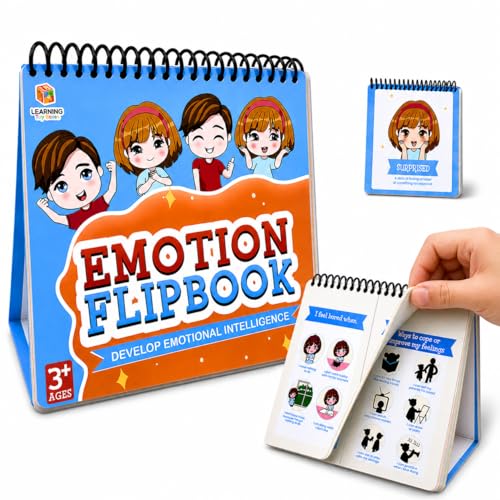
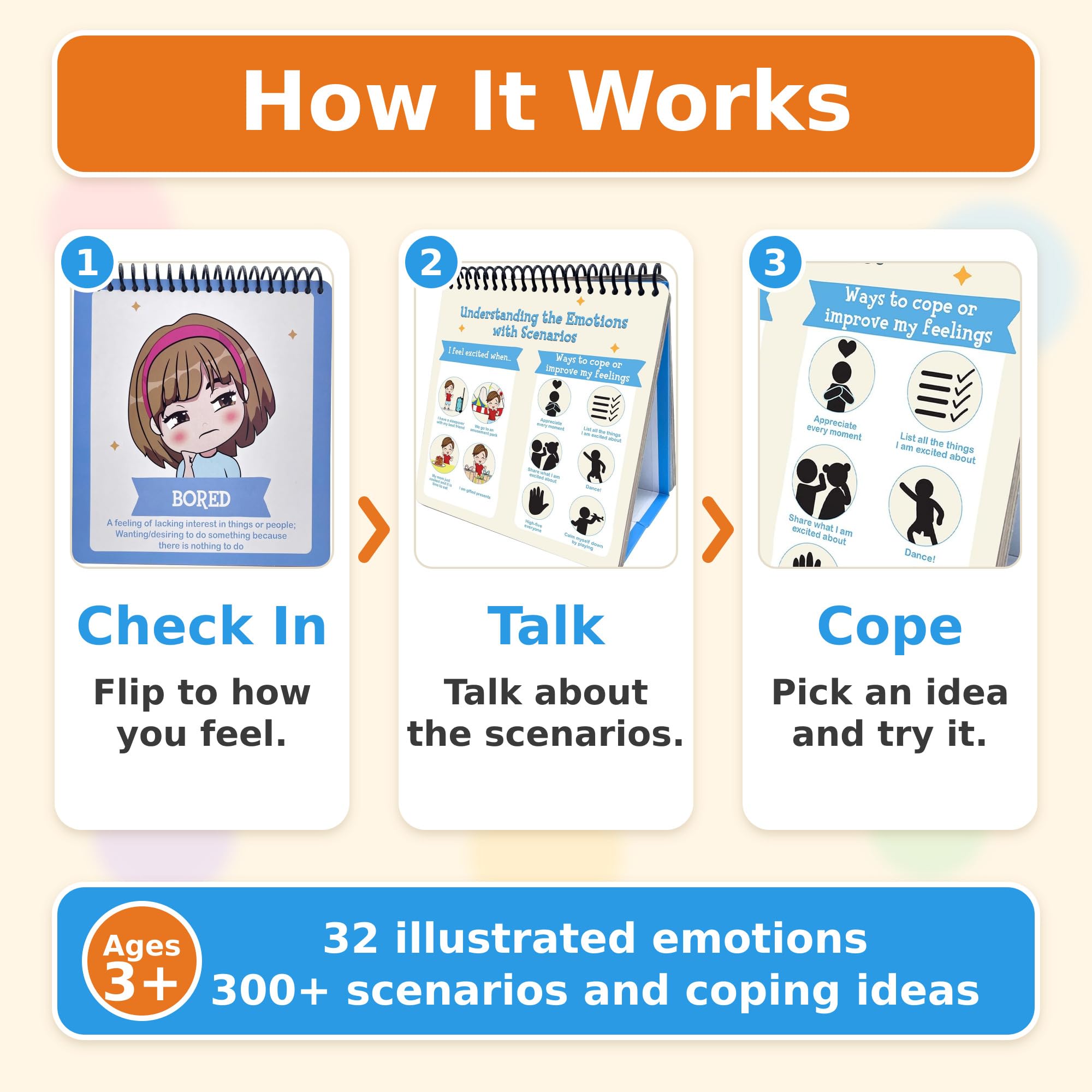
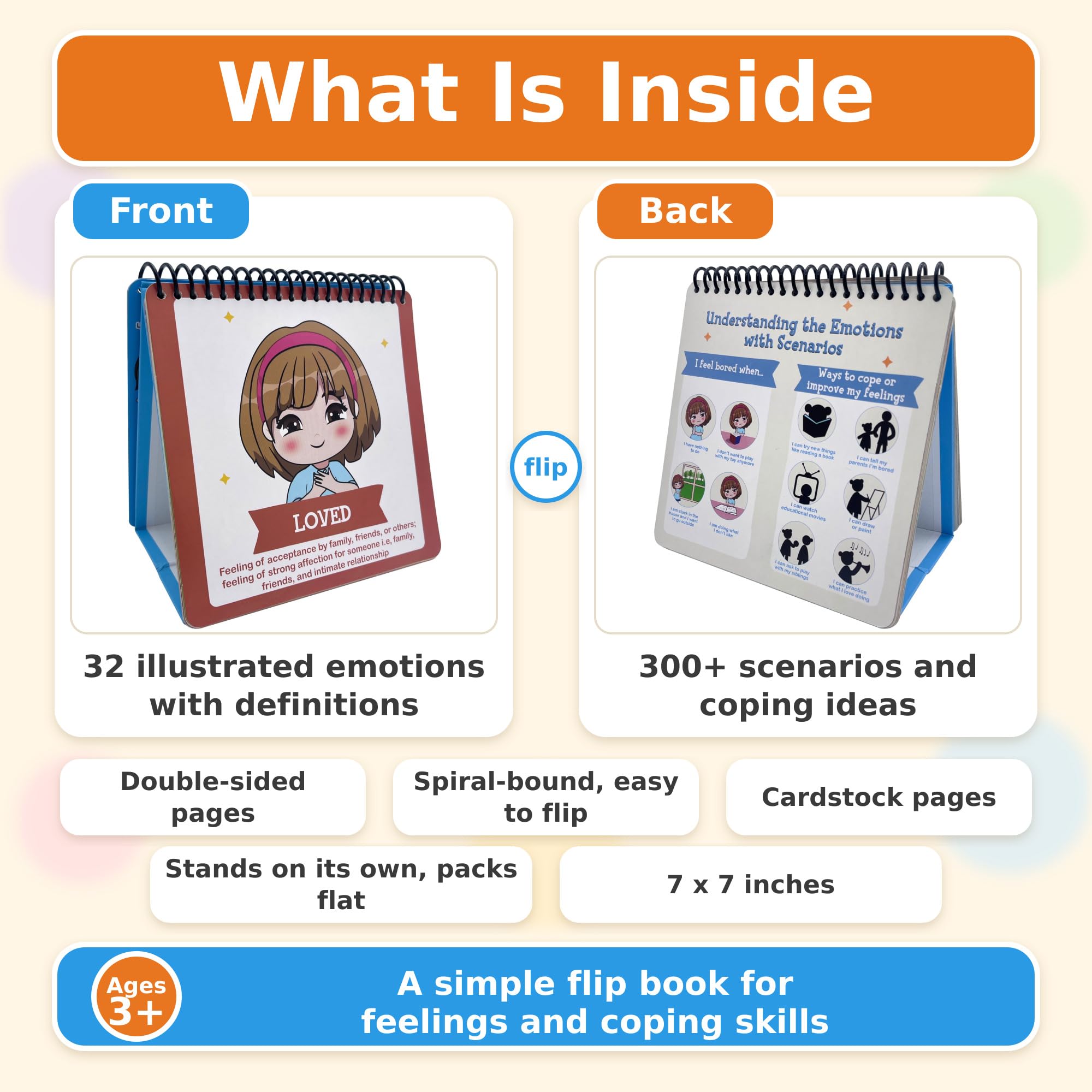
Emotion Flipbook for Kids - Feelings Flip Book, 32 Emotions, Coping Skills
- 32 EMOTIONS WITH COPING SKILLS: This emotion flip book pairs 32 illustrated faces and definitions with I feel…
- EMOTIONAL REGULATION MADE SIMPLE: Kids flip to the face that matches how they feel, then talk it through with…
- READY FOR THE CALM DOWN CORNER: Use this feelings flip book at home, in the classroom, in a counselor's…
To introduce it:
- Build it together on a calm day, and let your child choose the cushion.
- Explain its purpose: "This is where we go to feel calmer."
- Practise when everyone is calm, taking turns to "visit."
- Offer it kindly during upset: "Want to go to your calm spot? I'll sit with you."
Tired or hungry? Check the basics first
Social skills can often slip when a child is worn out or running on empty. Before you change your approach, look at how much sleep your preschooler needs and whether meals are steady. If food is a daily battle, what is normal with picky eating may help.
If your child seems extremely withdrawn or extremely aggressive, or if you simply have a nagging worry, talk with your paediatrician.
When should I worry about my preschooler's social skills?
Occasional limit testing is normal at this age, so one rough week does not mean something is wrong. What deserves a conversation with a professional is a pattern: little interest in playing with other children, extremely aggressive behaviour, or lashing out with no self control when angry or upset.
Wobble or pattern?
It is normal for preschoolers to test their physical, behavioral, and emotional limits.
MedlinePlus Medical Encyclopedia
That means pushing, grabbing and shouting "No!" are not red flags on their own. Look at how often it happens, how intense it is, and whether it follows your child from home to preschool to the park.
Picture a four year old who hits a classmate once during a tired, hungry afternoon, then says sorry when prompted. That is a wobble. Now picture a child who hits most days, in most settings, and cannot calm down even with your help. That is a pattern worth raising.
Use milestones as a loose guide
The AAP lists things many 3 to 4 year olds do: cooperate with other children and share, join in pretend play, and negotiate solutions to conflicts. Treat that list as a rough reference point, not a diagnostic checklist.
Children reach these skills at different speeds, and a missed item does not necessarily mean a problem, but if you are concerned, talk to your child's health care provider. The bigger signals are the two on the AAP's 4 to 5 year old list of concerns: showing little interest in playing with other children, and extremely aggressive behaviour.
What to do if the pattern is there
Keep it practical and calm.
- Over a few weeks, jot down when it happens (before lunch, at pickup), where (home, preschool, both) and how often.
- Note what happened just before and how long your child took to settle.
- Ask your child's teacher what they see during the day. Their view is valuable.
- Book a visit with your paediatrician and bring your notes. Ask whether an evaluation makes sense.
You are not there to get a label. You are there to get a clearer picture and, if needed, the right support. Nobody can honestly promise an outcome at this stage, so be wary of anyone who does.
Common mistakes
Tools can sit alongside professional guidance
Some families use structured supports, such as practice materials recommended by their clinician, once a professional is involved. A feelings workbook like the Emotion and Feeling Busy Book is one example of that kind of resource. These tools can make daily practice easier, but they do not replace an assessment. Ask your paediatrician or therapist which ones suit your child before you buy.
A simple four week plan
You do not need to overhaul your life. Add one small piece each week and keep the earlier ones going.
- Week one, feelings practice. Name one feeling a day ("You look frustrated"). Do a short check-in at breakfast or bedtime.
- Week two, add turn taking. Play one simple game daily, such as rolling a ball back and forth, and say "my turn, your turn" out loud.
- Week three, add a calm down routine. Pick one spot and one habit, like three slow breaths with a soft toy on the tummy. Practise when your child is calm, not mid meltdown.
- Week four, review. Look at your notes. What got easier? What did not? Take that to the teacher or paediatrician.
Small, steady practice builds skills, and asking for help early is a sign of good parenting, not failure. For the bigger picture on staying calm and consistent, see Positive Parenting and Gentle Discipline: What Works at Every Age.
Which feelings and social skills tool fits your child?
You do not need all of these. Pick the one that matches your child's age and the way they like to play, and use it a few minutes at a time.
| Option | Best Age Range | Primary Benefits | Main Drawbacks | Recommended Product | Price Range |
|---|---|---|---|---|---|
| Feelings busy book with mood pages | About 3 and up, with a grown up beside them | Names feelings, talks through social scenarios, lets your child draw their own emotions | Needs an adult to guide it; some pages suit older children | Emotion and Feeling Busy Book for Kids | $24.95 |
| Go Fish card game with faces | About 4 and up | Acting out feelings in a game, no reading needed, practises turn taking | Needs two or more players; younger children may lose patience | ThinkPsych Go Fish Faces and Feelings Card Game | $16.99 |
| Feelings flipbook with coping ideas | About 3 to early primary | Daily check in, pairs each feeling with a way to cope, handy for a calm down corner | Lots of content, so start with a few pages | Emotion Flipbook for Kids | $14.99 |
| Conversation cards about real situations | About 4 and up | Builds empathy and "what is going on here?" thinking through animal characters | Needs talking and some patience, so shy children may say little at first | Who What Why Conversation Cards for Kids | $16.99 |
| Feelings puzzle cards | About 3 and up | Matches feelings to real life images, a quiet and low pressure start | Teaches recognition more than behaviour; you still need to practise in real moments | Learning Resources Feelings and Emotions Puzzle Cards | $11.99 |
Key Takeaways
- Social skills are learned through practice, and most 3 and 4 year olds are still working on sharing and taking turns.
- Start with the basics: naming feelings, cooperating, and sharing space and toys.
- Practise when your child is calm, in short bursts, using the same simple words each time.
- Shy children are not broken. Respect their need for alone time, and focus on the skills they use when they do play.
- Tools like feelings cards, a flipbook or a game can make practice fun, but your calm presence matters more than any product.
- Keep notes on what you see, where and how often. They make a talk with your teacher or paediatrician much more useful.
- Ask for help early if your child shows little interest in other children, or lashes out often with no self control.
One last thought
Every parent has stood in a playground watching their child grab, hide, hover or hang back, and wondered if they are getting it wrong. You are not. Your child is learning one of the hardest things there is, how to be with other people, and they are learning it from you. Keep your words short, your voice calm and your practice small and regular.
Social skills grow in the gaps between ordinary moments, so every wait, every "my turn" and every kind word counts.
Tonight, pick one feeling to name together, and notice how it lands.
Sources & References
- US Department of Education. "Ed."
- US Department of Education. "Evidence-Based Social- Emotional Curricula and Intervention Packages."
- US Department of Education. "What Works Clearinghouse™ Preparing Young Children for School."
- American Psychological Association. "Cognitive and Social Skills to Expect From 3 to 5 Years."
- American Academy of Pediatrics. "Developmental Milestones: 3 to 4 Year Olds - HealthyChildren.org."
- ZERO TO THREE. "24-36 Months: Social-Emotional Development."
- naeyc.org. "104 Reprinted fromYoung Children • January 2010 ® 1, 2, 3."
- US Department of Education. "Evidence-Based Social-Emotional Learning Intervention ."
- ZERO TO THREE. "Baby Talks: Parent's COVID Questions Answered."
- medlineplus.gov. "Preschooler development: MedlinePlus Medical Encyclopedia."
- American Academy of Pediatrics. "Developmental Milestones: 4 to 5 Year Olds - HealthyChildren.org."
Frequently Asked Questions
What social skills should a 3 year old have?
Is it normal for my 4 year old to struggle with sharing?
How do I know if my preschooler's social skills are behind?
Does my shy child need a social skills curriculum?
How long do classroom social skills programs take?
Can I teach social skills at home without a program?
Was this helpful?
Thanks — your feedback helps us pick what to write next.